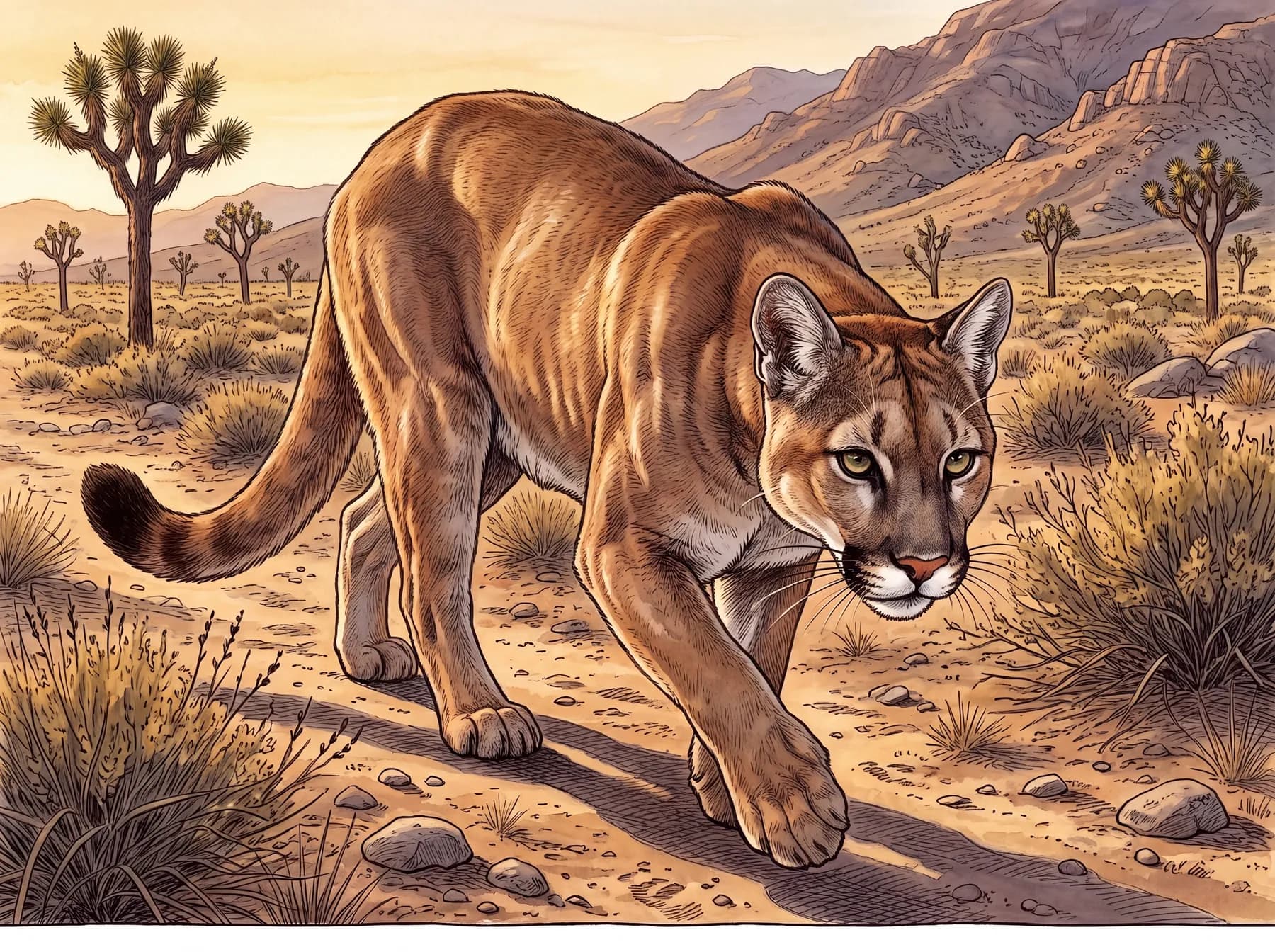
The arithmetic is what makes it a ghost. A single mountain lion holds ground measured not in acres but in scores to a couple hundred square miles, a female patrolling roughly 21 to 116, a big male 58 to 270, and it defends that country against others of its own kind. Spread the whole of Arizona's 2,500 to 3,500 cats across terrain like that and the density falls near the bottom of the published range for North America, somewhere around 0.3 to 7 animals per 100 square kilometers, with arid country at the low end. You can live inside lion range for years and never see one. The habitat here fits it well: Joshua-tree and blackbrush bajada below rocky ranges, mule deer feeding out on the flats, cover in the broken slopes above.
So the cat that crosses this bajada is not a resident you would ever expect to meet. It could be a disperser. Young males leave the country they were born in and travel far to find range no other lion holds, recorded natal movements of roughly 23 to 274 kilometers, a one-way search across unclaimed ground. Or it could be a resident male working the wide edge of an enormous territory. Either way it is following the deer, which are the anchor. Mountain lions eat mostly deer, and mule deer drawn down onto these flats are the reason a cat comes off the ranges at all. It belongs on this bajada's list, though none has been proven here yet.
When it hunts, it does not run its prey down. It is a stalk-and-ambush predator that closes the last distance from a ledge or a screen of brush and takes the animal by surprise — the physical envelope behind that is a leap of about 20 feet up or 40 feet out. A lion can eat an entire deer over two nights, caching the carcass under dirt and debris between visits. So the thing you are far likelier to read is not the cat but its work: a covered kill, or a track pressed into dust at the soft edges of the day, when lions mostly move. Learn the print. Four toes, three lobes across the base of the heel pad in a rough M, and no claw marks, because the claws retract. That last absence is what separates it from a dog or coyote track, which shows claw marks.
None of this makes it a danger to the household, and the honest register is respect rather than dread. A mountain lion can injure or kill a person, and the state wildlife agency says so plainly, which is why its guidance is specific. But fatal attacks are vanishingly rare — roughly 29 across all of North America since 1868, about 0.18 a year, against something like 28 people killed by lightning in the United States annually. If you do meet one, do not run, because running can trigger the chase. Stand and face it, make yourself look large, pick up small children and keep pets close, and back away slowly. If a lion does attack, fight back; people have driven them off with rocks, sticks, and bare hands.
Watch the dust after a cool night for a four-toed print with no claw marks.