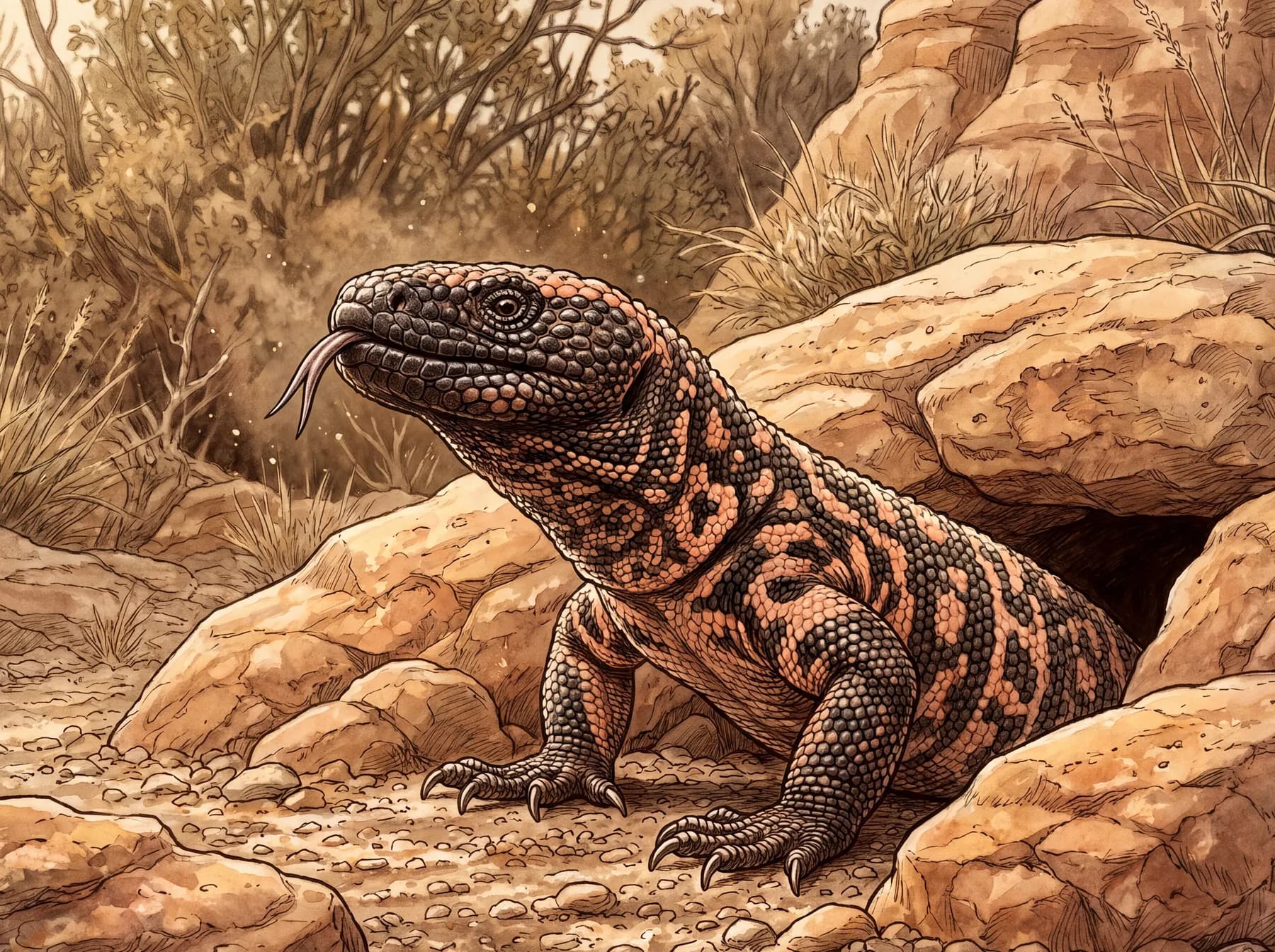
The reason people can live on this bajada for a decade and never meet a Gila monster is not that the animal is scarce. It is that it is almost never above ground. This is core range for the banded Gila monster, the pale-marked northern subspecies that keeps to this Joshua-tree and blackbrush high desert, and Mohave County sits well inside its documented country. What keeps it out of sight is arithmetic.
It spends more than ninety percent of its life below the surface, in burrows and rock shelters, living off fat banked in its thick tail. Radio-tracking through one documented active season found the lizard on the surface for only about ten days out of a roughly ninety-day stretch, most of them mild spring mornings. It comes up mainly from late April into mid-June to hunt; once the July monsoon arrives it shifts to dusk and dark. What few meals it takes are large. As a nest-raider it takes young rabbits, ground squirrels, and pack rats, along with the eggs and nestlings of birds, then banks the haul as tail fat against the long months underground.
It is the only venomous lizard native to the United States, not one of two as the old story goes; its single close relative lives in Mexico. The venom works nothing like a rattlesnake's. There are no hollow fangs and no strike. It is made in the lower jaw and travels along grooved teeth into the wound by capillary action while the lizard bites down and chews, so the dose depends on how long it holds on. That makes it a defensive, hang-on weapon, and using it usually means the animal is being handled. Left alone it is slow and uninterested, and bites are almost always the result of someone picking one up. The danger is real but overstated. The bite is severely painful and rarely worse than that, though rarely is not never: in 2024 a man died from the venom of a captive pet, the first such death in roughly ninety years. Arizona has protected the species since 1952, the first venomous animal in North America given legal protection. You do not touch it, move it, or harm it.
There is a stranger footnote to the venom. A peptide in it, exendin-4, became the basis of a class of diabetes and weight-loss drugs, the same biology behind the GLP-1 medicines. The animal almost nobody here has seen turned out to be carrying a medicine.
If you do meet one, there is no mistaking it: a heavy, blunt, black lizard beaded all over in bony scales, banded across the back in pink and orange as though the pattern were laid on by hand. Nothing else in this country looks remotely like it.
None we've found here. The likeliest proof is a slow beaded animal crossing open dirt on a spring morning, gone under by noon.