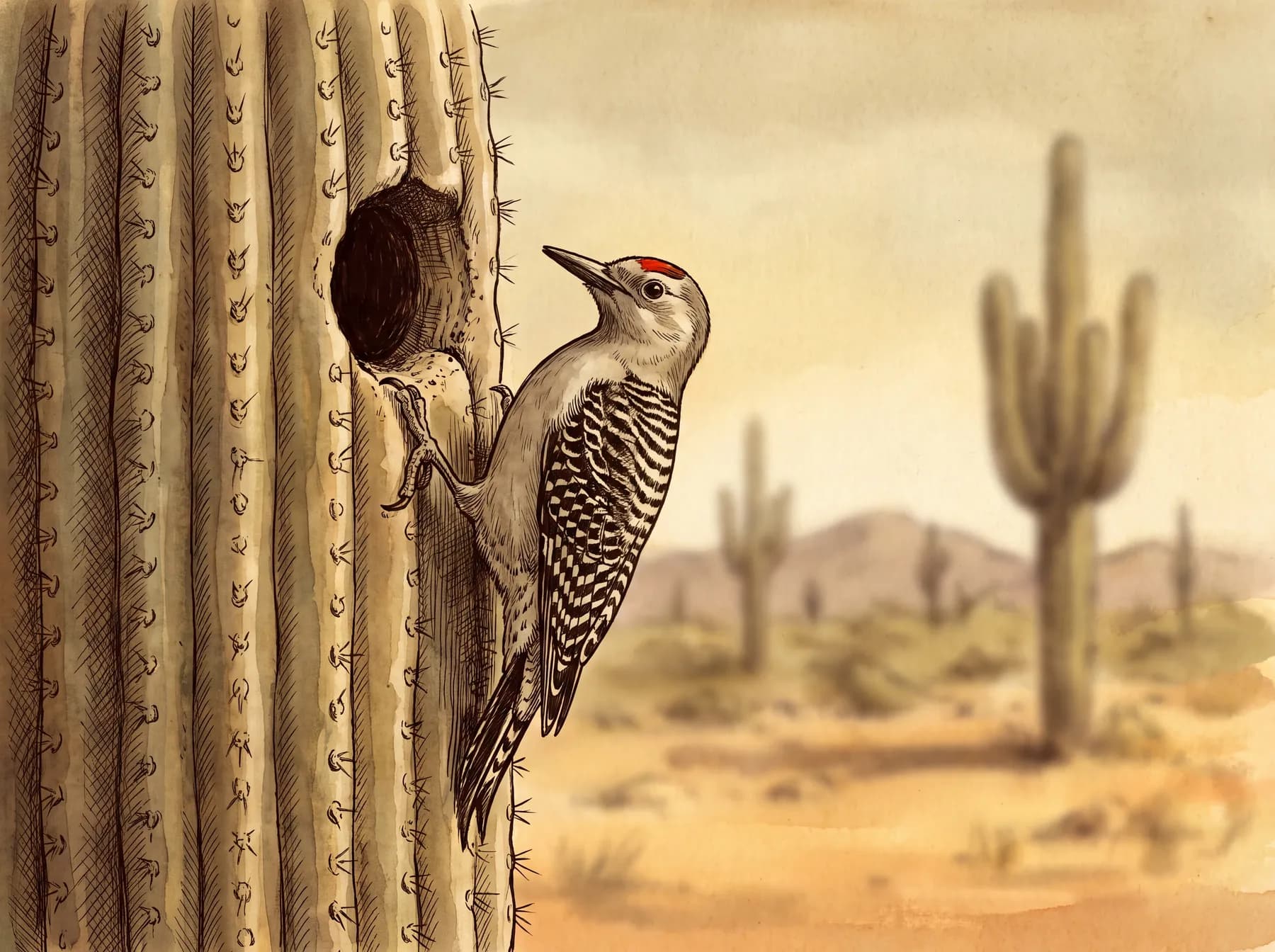
Only two birds on Earth cut a nest into a living saguaro, and the Gila woodpecker is one of them. It chisels a hole about 5 centimeters wide into the green flesh partway up the column, and the cactus does something a tree never would: it heals. The saguaro floods the wound with a resinous, lignin-rich sap that hardens into a bark-like scar, sealing the cavity watertight against rot and water loss. The bird cannot move in right away. It waits about a year for the sap to dry and the scar to harden, and only then does it nest.
That cured pocket is called a saguaro boot, and it outlasts the plant that made it. You can find boots on the ground years after the cactus has fallen and rotted, hard hollow shells shaped like a bird's front door. While a boot is in use, the woodpecker is running a housing supply the rest of the desert leans on. When it moves out, a queue of species that cannot dig their own holes moves in: elf owls, screech-owls, an American kestrel, flycatchers, none of them able to cut the cavity they need. The excavator leaves, and the neighborhood it built keeps working.
Here the famous story stops matching this ground. There is no saguaro anywhere near this parcel. Saguaro grows only in the Sonoran Desert; it does not occur in the Mojave at all, at any elevation, and this bajada is Joshua tree, blackbrush, and creosote: Mojave, not Sonoran. The keystone drama plays out somewhere else. The Gila woodpecker is a Sonoran bird, and in Mohave County its real ground is the low Colorado River corridor around 450 feet, the desert drainages well below and west of this high shelf.
It belongs on the county list by a number that does not quite mean what it seems to. Arizona gives the bird's elevation range as 150 to 4,800 feet, which puts 3,050 comfortably inside, while the continental rule of thumb, usually below 3,300 feet, puts it just outside. Neither settles the question, because elevation is not the gate. Substrate is. Without a saguaro, or a wash lined with cottonwood, willow, or mesquite grown big enough to hold a cavity, the bird has nowhere to nest, and elevation alone does not put it here.
So if a Gila woodpecker turns up on this ground at all, it will not be a settled resident of the Joshua-tree flats. It would be a wanderer following a wooded wash in fall or winter, working riparian trees and never a cactus. None verified here, and the honest expectation is that mostly you will not find one. The birds that do wander carry a small red cap on the male's crown alone; the female's head is plain gray, and the back of both is barred black and white like a zebra.
Listen along the wooded wash, not the open flats: a rolling churr, and a zebra-barred back climbing a tree that is not a cactus.