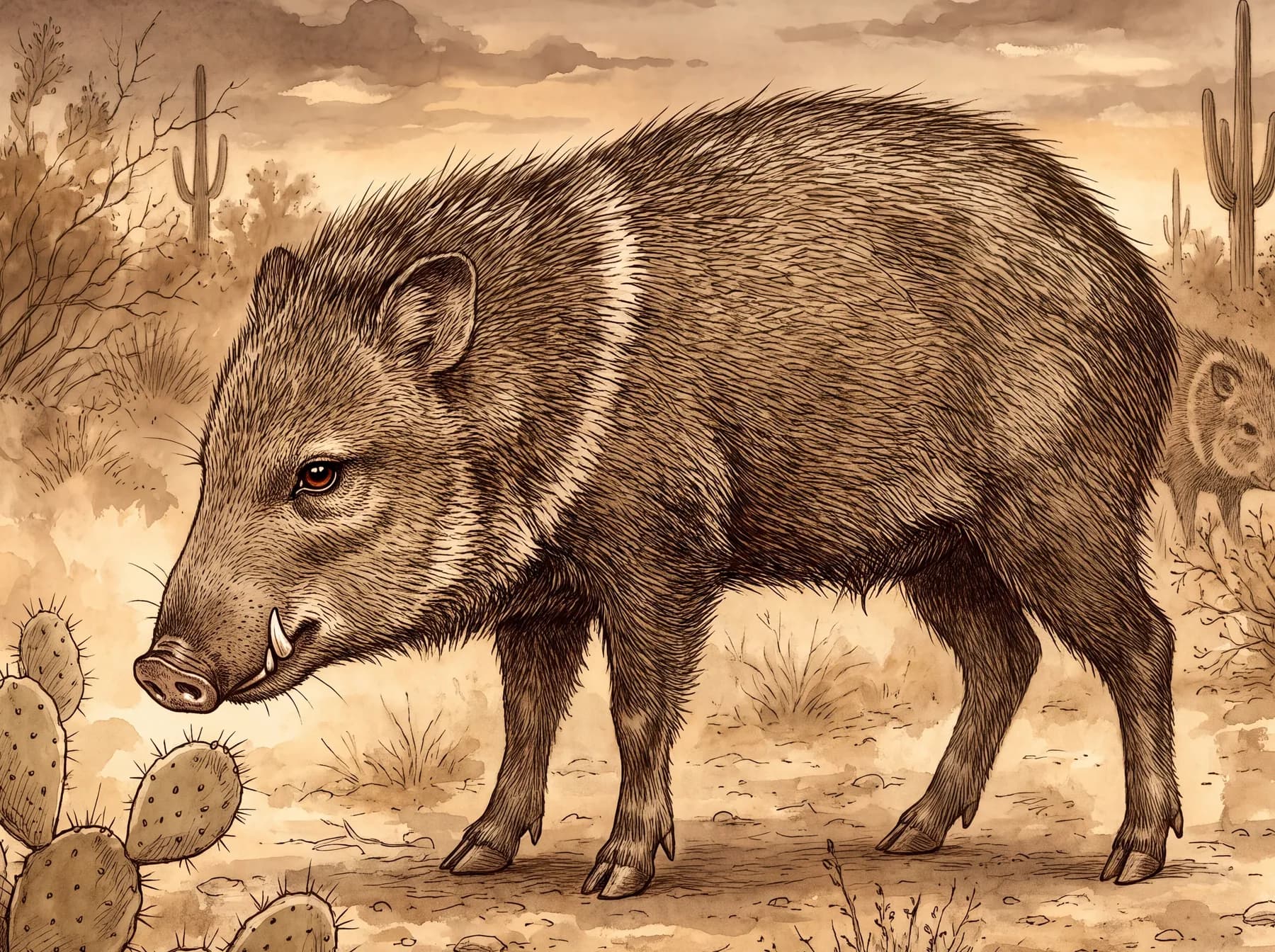
You may smell a javelina herd before you see anything of it. High on the rump each animal carries a scent gland that leaks a musky, oily fluid, and the herd rubs it onto rocks, stumps, and one another until the whole group smells of the same thing. Whether the smell reaches you first is field lore rather than a measured fact, but the gland is real and the musk is strong.
That scent does more than mark territory. The same oil works as boundary sign, herd glue, and alarm at once: animals greet by rubbing head to rump, passing the smell back and forth, and the gland fires a warning when something goes wrong.
The cohesion goes deeper than company. A javelina has a poorly insulating coat with no true undercoat, and it cannot cool itself by sweating, so it pants instead. To hold its core temperature in a tight band, roughly 37.9 to 38.5 degrees Celsius, it relies on behavior: huddling together for warmth through cold desert nights, crowding into thick brush for shade, and shifting between hot and cool ground as the day turns. A family group of 5 to 15 animals that eats, sleeps, and forages as one body is not merely sociable. The herd is a thermostat.
It helps to say what the animal is not. A javelina is a peccary, family Tayassuidae, and not a pig; the resemblance is convergent evolution, two separate lineages arriving at a similar build. Peccaries are a New World family, distinct from the true pigs of the Old World. Pig-like is fair. Pig, hog, or boar is wrong.
On this bajada the honest verdict is maybe. Javelina are listed as an influential species of Mohave Desertscrub, the habitat covering northwestern Arizona generally between 1,000 and 3,000 feet, and at about 3,050 feet this ground rides the very top edge of that band. Elevation is not the limiter here; javelina range from the desert floor to around 7,000 feet, and cover is what they actually need. They key on prickly pear and cholla, on dense thickets, and on the brushy washes that hold roots and water, with prickly pear running to more than half the diet on many ranges, pads and spines and all. The open creosote and Joshua-tree flats offer little of that, so a herd that works this parcel will keep to the washes and the thick brush, not the bare pan.
Where they do reach a homestead they are a determined nuisance more than a danger. Eyesight is poor and the herd instinct is strong, so a startled group squares off with ears laid back and claps its canines together in a dry popping that serves as warning, then may bluff-charge before moving off if given room. The real trigger is a dog, which javelina treat as a predator and will injure or kill. Don't feed them, keep birdseed and pet food up, and know that even a solid 4-foot fence or an electric wire 8 to 10 inches off the ground is most effective against them, not proof against their hide and strength.
Nobody's confirmed one on this ground. Listen low in the washes for that dry clatter of teeth, and trust your nose first.