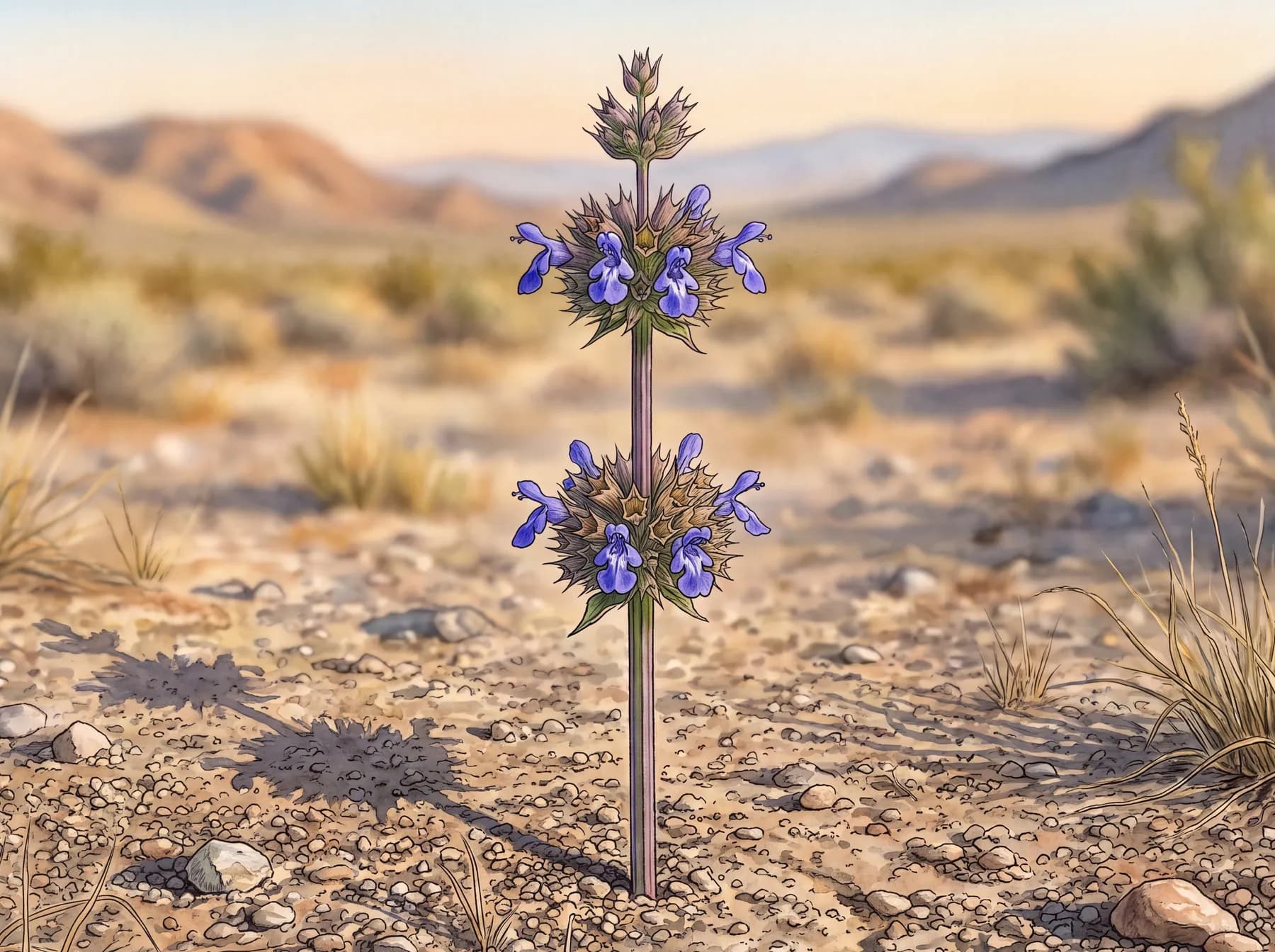
A dry winter, and there is nothing to find. No rosette, no blue flower, no stalk; the plant is not on this ground, and it has not died, because it was never up. Desert chia spends most of its life as seed, waiting in the dirt for a winter wet enough to be worth the risk. When the fall and winter rains come in quantity, the seed bank answers, and a bajada that looked bare throws up rosettes and, by spring, stands of blue-flowered stalks. In a poor year you can walk the same ground and find none.
The seeds are tiny nutlets, 1.5 to 2 mm, tan-to-gray and mottled with black. Drop one in water and it clouds over with gel in moments, the same trick as the chia in a health-food jar. But that gel is not built for us. The chia sold as a superfood is a Mexican cousin, Salvia hispanica; this is the native Salvia columbariae, same genus and the same gel, a different plant. Researchers found that a wetted seed sheds a mucilaginous coat that works like glue, binding to soil grains and holding even after it dries, fixing the seed in place and hiding it from the ants, birds and rodents that hunt seed. The famous gel is, first, a seed's armor.
That coat buys the seed time, and time is what a rain-gated annual lives on. A seed can sit through the dry years and still be alive when the rain arrives: stock held in storage for 17 years later germinated at 77 to 100 percent. Height tracks the water, the plant running anywhere from 3 to 70 cm depending on the winter it got, so a wet year raises tall stands and a lean one a few stunted inches. Everything the plant owns is loaded into that hard little package, and the standing stalk is disposable, a single season's errand to set seed before the heat comes.
The same energy that makes a good ration made this a real food here. The nutlets are dense with protein and oil, and desert chia was an important traditional food of many tribes across California, Arizona and northern Mexico. The Mohave, Chumash, Cahuilla, Kumeyaay, Yavapai and Apache, among others, ground and soaked it into pinole or a warm porridge; the Cahuilla stirred the meal into alkaline water to better its flavor and nutrition. Attempts to sell the wild desert chia as a crop in the last century mostly failed; it feeds people best where it grows, one wet winter at a time.
When it does come up among the creosote and blackbrush, the stalk gives it away. Roll the stem between finger and thumb and it has four flat faces, not a round one, the mint-family mark, and the crushed leaves smell minty to skunky. Up that square stalk sit one or a few spherical whorls of flower, spaced in tiers, each a small spiny ball of green-to-purplish awn-tipped calyces ringed with blue two-lipped blooms. Nothing else here stacks spiny flower-balls up a square stem.
Look low first, though. Before the stalk rises, chia is a flat rosette of deeply lobed leaves pressed to the dirt, waiting on rain.