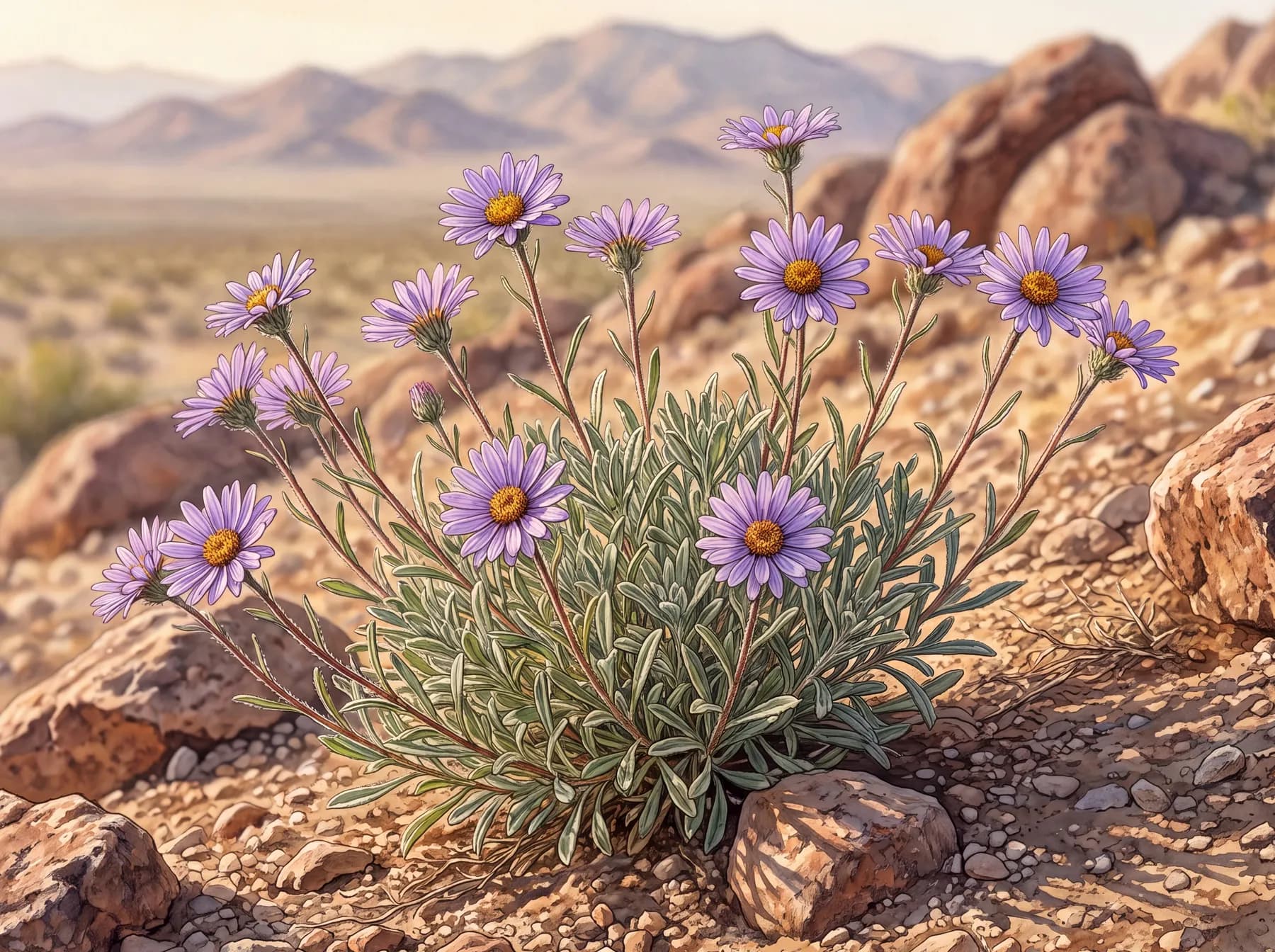
On the poorest ground here, the gravelly grades and rocky slopes where almost nothing else keeps a footing, you can find the largest flower in the neighborhood. It is a single lavender daisy about two inches across, up to sixty narrow rays around a yellow center, held out on a long bare stalk above a low mound of grey leaves. Nothing else on this rocky ground throws a pastel head that big on soil that poor. The question the plant sets you is how it pays for the show.
The name answers it, twice. Xylorhiza means woody root in Greek, and the common name, woodyaster, says the same thing plainer. This is not an annual that sprouts, flowers, and dies inside one wet spring. It is a perennial subshrub that persists year to year from a woody base, a low branching plant a foot to two and a half feet tall, and it keeps its investment underground where the drought cannot reach it. A plant starting from seed each spring bets the whole season on the rain arriving. The aster has already bought its ground; what it decides each year is only whether to spend on flowers.
It does not spend on a schedule. The main bloom runs March through June, but the plant can flower again in October when the summer monsoon has delivered enough rain to fund it. The calendar opens a window; the water decides whether anything comes through it. A lavender head in fall means the monsoon paid out, and a grey mound carrying nothing can mean the ground simply could not afford the flower that year.
The flower is doing its own accounting. A head that large and pale, lifted clear of the foliage on a leafless stalk, is easy to pick out on open rocky ground where visitors may be spread far apart, and the plant works a broad crowd rather than courting one partner: butterflies, moths, flies, honeybees, and native bees all visit the yellow disc. Later the seeds and the low cover feed others in turn, hummingbirds and small mammals and seed-eating birds.
Up close, read the leaves. They are lance-shaped and up to two and a half inches long, edged with spiny teeth and tipped with a spine, clothed in grey hairs and faintly sticky to the touch. The epithet tortifolia means twisted leaf, though the toothed grey margin is a surer mark than any twist. It belongs on the rocky grades and outcrops of this high desert rather than the flats, and it sits mid-band in its published range. We expect it here; for now the page is teaching us what to look for, not recording a find.
One solitary pastel daisy on a bare stalk over a grey mound of toothed leaves. On this rocky ground, nothing else makes it.