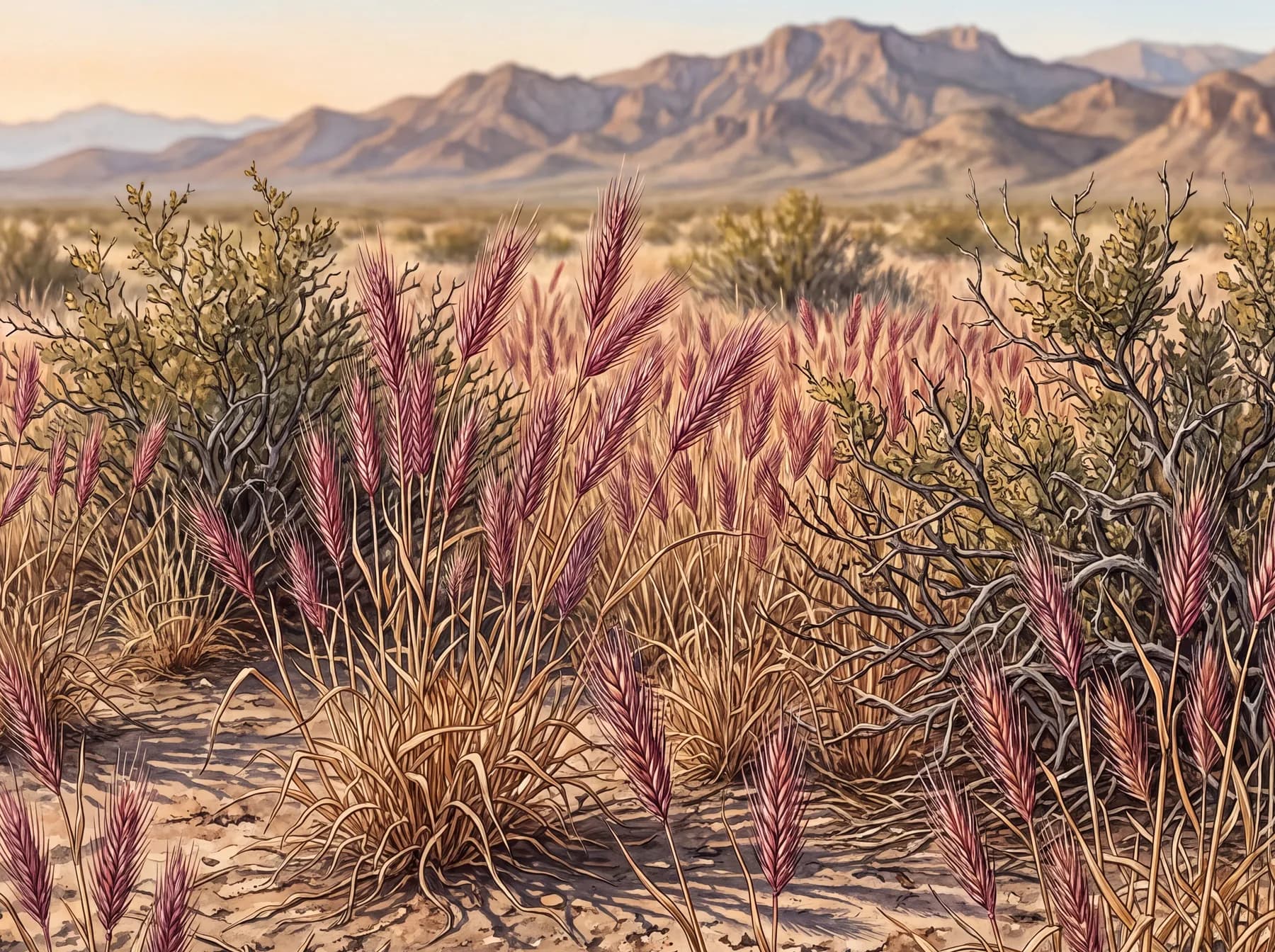
The most dangerous plant on this bajada is not the one with spines. It is a soft, ankle-high grass already cured to straw by early summer, dead while the natives around it are still green. Red brome is not from here. It is a winter annual out of the Mediterranean, southern and western Europe, that naturalized across the Southwest and is now one of the dominant invasive grasses of the Mojave. It did not evolve on this ground, and this ground did not evolve to carry what it brings.
The Mojave was, for a long time, hard to burn. The shrubs stand far apart. Creosote, blackbrush, and the yuccas hold their distance through competition for scarce water, with bare ground between them, and a fire that starts in one shrub finds nothing to cross on and dies in the gap. Red brome fills the gap. It grows in the interspaces, the formerly bare ground, as a fine continuous carpet rather than as scattered plants, and when it cures it becomes a mat of dry fuel connecting one shrub to the next. It builds a fuse across ground that used to stop flame.
Two things make that fuse worse than a single dry season. The dead grass lingers: red brome litter persists about two years, against roughly one year for native annual forbs, so the fuel bed accumulates instead of clearing. And the plants it carries fire into cannot come back. Creosote and blackbrush do not resprout after burning, and the yuccas, Joshua tree among them, are fire-sensitive as well. A brome fire on its own is often too light to ignite a large creosote; it takes a heavy grass year and wind to carry flame into mature shrubs. But where it does burn, little native shrub recovers and the grass returns fastest. That is the loop: burn, brome, burn again, until shrubland has been converted to annual grassland.
This is not a local oddity. Models put 76 percent of the Mojave ecoregion at high or very high suitability for red brome and its cousin cheatgrass together. The grass reaches past fire, too. When the seed heads ripen, the long stiff awns turn sharp and barbed, and they lodge in the mouths, eyes, ears, and fur of livestock, dogs, and wildlife. The same needle that catches on your sock catches in a coyote's gums.
To catch it early, learn the seed head. Through late winter and spring the plant is soft and hairy and green, then flushes red-purple as it ripens, throwing a dense, one-sided, foxtail-like panicle one to four inches long and bristling with straight awns. Up close, the reddish cast and the spiky brush on a thin stem are hard to mistake. At distance the tell changes: a straw-colored haze lying over the flats in early summer, continuous where the ground should be bare, while the shrubs still hold green.
Look at the interspaces, not the shrubs. Bare gravel means the fuse is not laid yet. A straw carpet means it is.