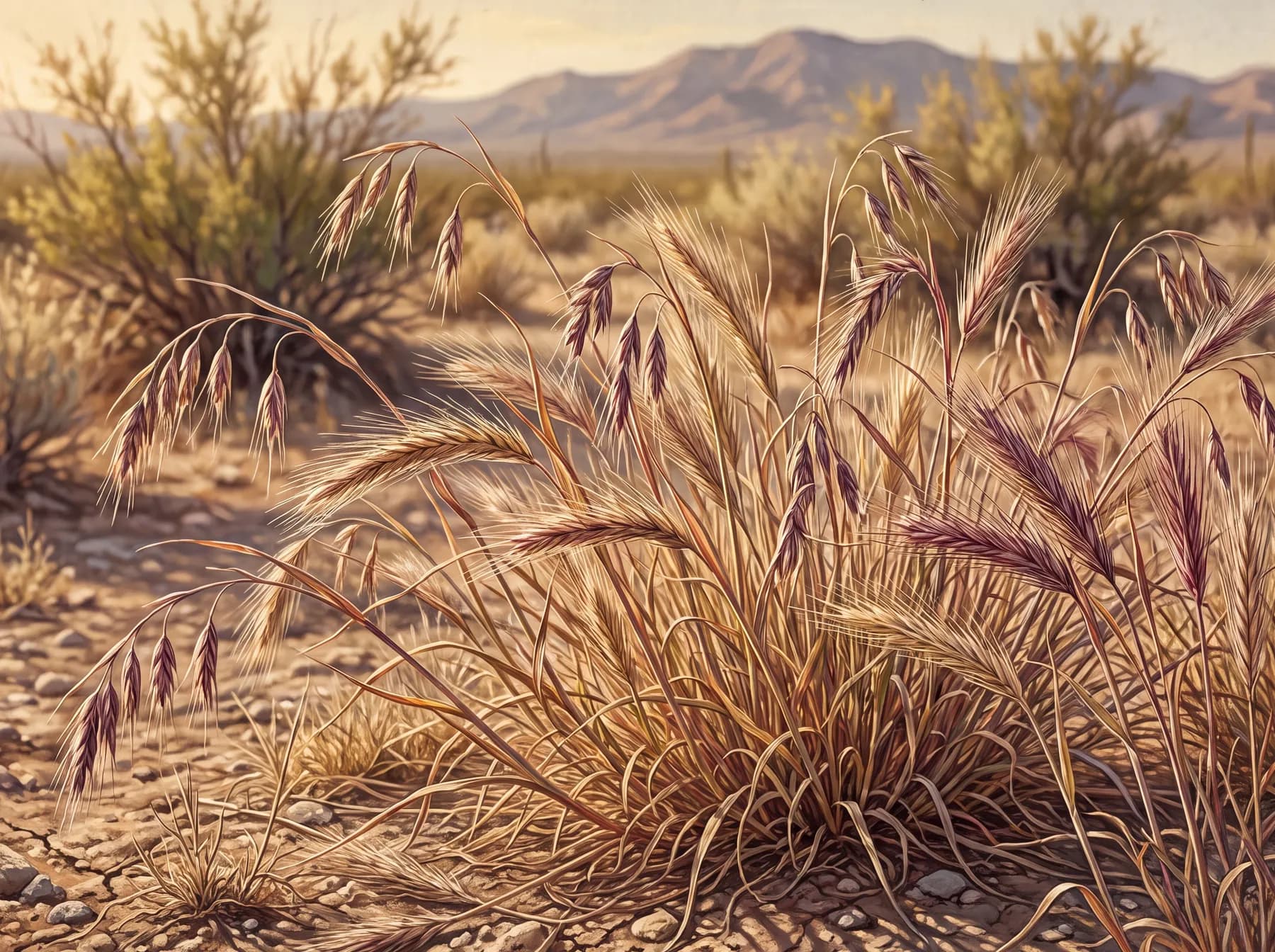
Softness is the give-away. Run a hand across the seed head and it bends and yields, a one-sided spray of slender spikelets all nodding to the same side, each tipped with a straight awn about a centimeter long. It can look almost pretty, which is part of the trouble. Cheatgrass is a winter annual from Eurasia, carried into North America in the 1800s as a contaminant in seed and grain, and it makes its living by keeping a different calendar than everything around it.
It germinates with the first cool-season moisture, in fall or early spring, then holds through winter as a small seedling while the native perennials stay dormant. By the time those natives wake, cheatgrass has already pushed roots down and pulled the water out of the upper soil, below the depth the natives will reach for it. It does not outmuscle them. It drinks the season before the one the natives are built for has properly begun. Then it flowers, cures to straw, and is dead by early summer.
That dead grass is the second half of the problem. Where this desert once kept bare ground between its shrubs, cheatgrass fills the gaps with a continuous fine fuel, and fine fuel carries fire sideways from shrub to shrub instead of letting it die in the open. This ground never evolved to burn often. Big sagebrush needs something like 20 to 50 years between fires to persist; cheatgrass shortens that interval to roughly 10 to 12 years or less. The shrubs burn and do not return, and the grass returns first, because a burn is the disturbance it favors. Across the Great Basin that loop has converted more than 100 million acres, the largest single vegetation change in the interior West.
This parcel sits inside the band where cheatgrass is most abundant, between 2,000 and 6,000 feet. It has a warmer, lower cousin, red brome, and the two divide largely by elevation. Cheatgrass is the cooler-country invader, the one that climbs above 5,000 feet into pinyon and juniper and creeps back downhill into ground like this. You can tell them apart by hand. Cheatgrass droops and gives; red brome stands stiff and bristly and pricks. Droop and down is cheat; stiff and up is red.
Watch its color, too. Cheatgrass runs green, then reddish-purple, then straw, and the purple stage is a warning in itself: it marks fire conditions coming within about two weeks. Look for it first on disturbed ground, the track, the pad, the broken edges where the natives have not closed back over.
Green in early spring, purple for a fortnight, straw by summer. Learn the soft nodding head before it seeds, not after.