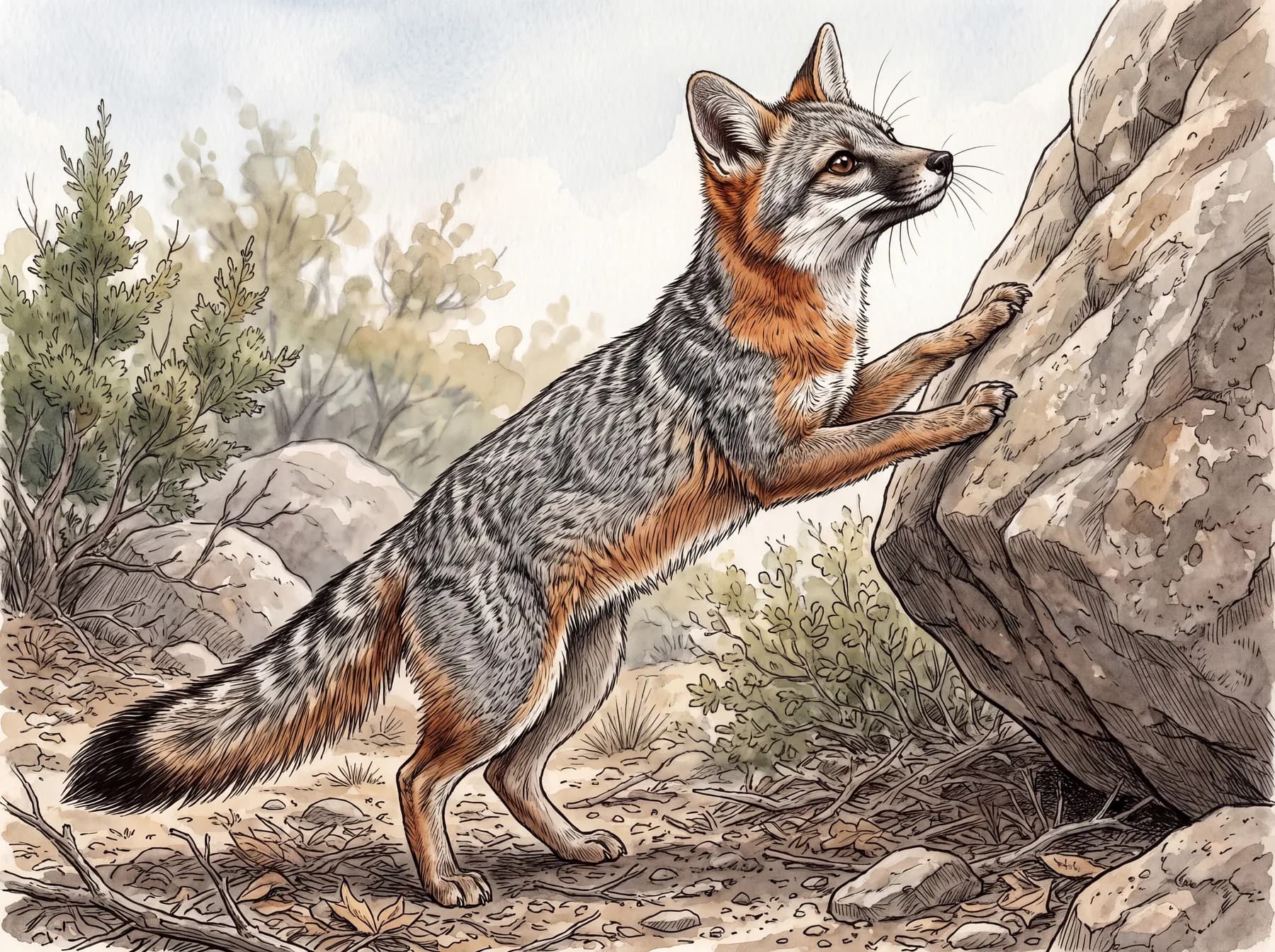
If you ever see a fox looking down at you from the branches of a juniper, it is a gray fox, because it is the only wild dog in North America that climbs trees. It goes up gripping the bark with hooked, only half-retractile claws and pushing with its hind feet, and it will rest or forage well off the ground. One was even recorded fifteen feet up the trunk of a saguaro, which is not a thing the rest of the dog family does.
It is worth knowing it is not a red fox gone gray. Its genus is the most ancient branch of the living dog family, and the animal wears the difference plainly: grizzled salt-and-pepper gray above, rich rufous on the neck and legs, and a black stripe running down the top of the tail to a black tip. The red fox's tail ends in white; the gray fox's ends in black. That one detail separates them at a glance.
It is the most omnivorous of our wild dogs. In the season when desert fruit is on, plant matter can climb to as much as seventy percent of what it eats by volume, then fall back to roughly two-thirds meat across the rest of the year. The climbing may buy it refuge from coyotes, which kill smaller foxes where they can. That is the leading explanation, though it has not actually been demonstrated.
Here is the honest part. At this elevation the gray fox is real but not the signature animal of the open flats. It leans on brushy washes, rock outcrops, and rimrock — cover, and something to climb — and it is more at home higher up, in the pinyon and oak. On the blackbrush plain it is the exception, and none has shown here for us.
The climbing is not its only oddity. As the oldest branch of the dog family it keeps to dog rules loosely, denning in hollow logs and rock piles, hunting rodents and birds one night and stripping fruit from a shrub the next, more improviser than specialist. It is the wild dog least committed to being a dog.
So look up, not only down. A dog in a tree is no trick of the light here. It is the one fox that climbs.