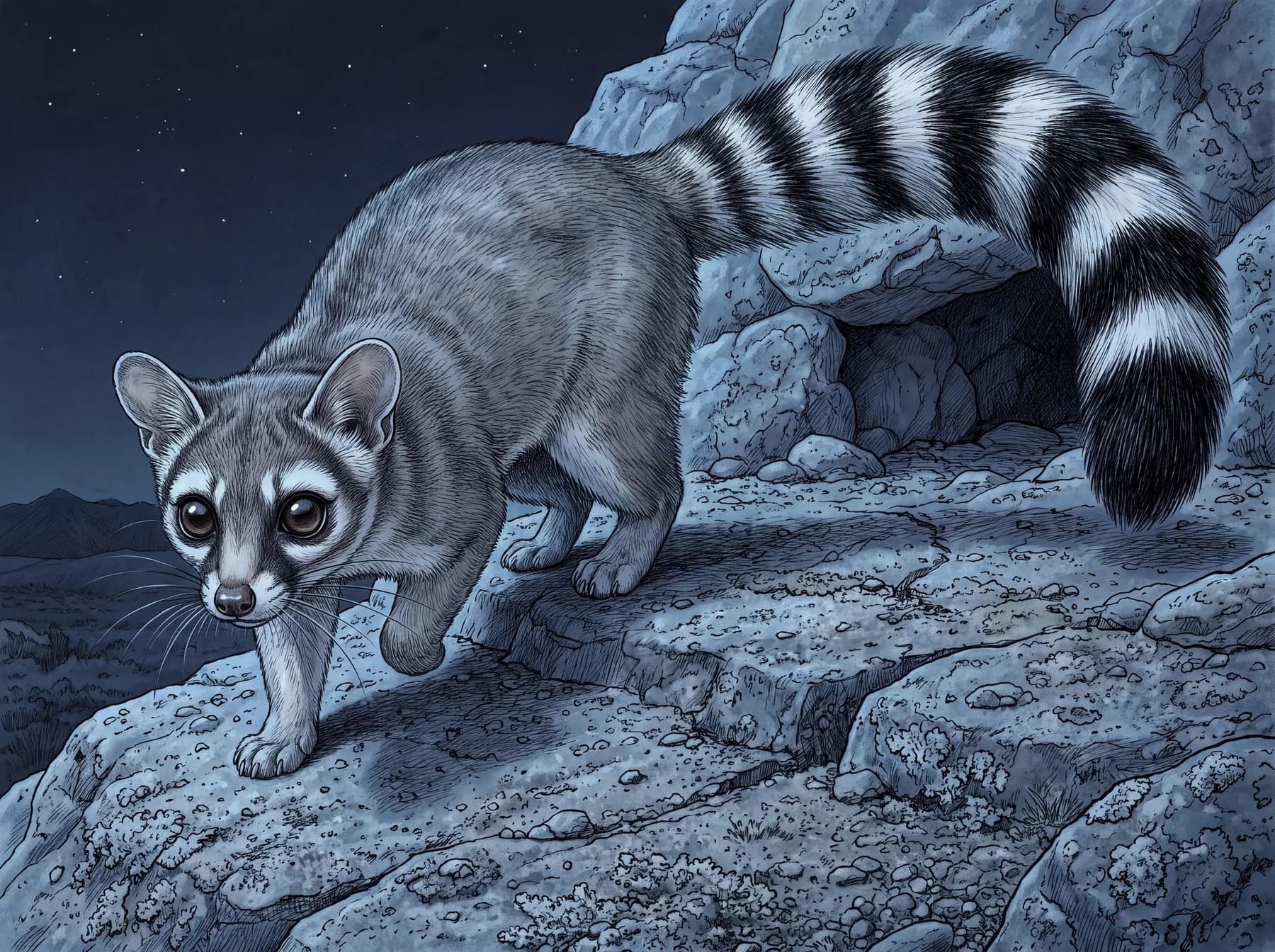
Arizona's state mammal is one that most residents will never see. Arizona schoolchildren helped vote the ringtail into that office in 1986, and it remains half a rumor. It is strictly nocturnal, cat-sized but built like the raccoon it is actually related to, with a tail as long as its body banded in black and white and huge dark-ringed eyes for gathering what little light the desert night offers. For a state animal, the county's public record holds only about five research-grade citizen-science photographs of one.
What it does with that body is climb like almost nothing else here. Its hind feet can rotate at least 180 degrees, which lets it come straight down a cliff face or a tree trunk headfirst and reverse out of a crevice it has backed into. It lives in the rock: outcrops, cliffs, canyon walls, and talus, the broken ground you would call impassable.
It is often miscalled a cat, and miscast as a fruit-eater. Across the year it is mostly a hunter of insects and small animals, with fruit coming and going by season, and no one has actually measured its diet in this desert. It is also among the most efficient water-savers of any carnivore, able to get by on the moisture in what it catches, which is part of how a rock-dwelling hunter makes a living where there is no standing water.
So it is almost certainly here, in the rocky draws, and almost certainly unseen. That is a detection problem more than a true rarity: a small, silent, night-moving animal you are far likelier to catch as a pair of shining eyes in your headlamp, or a banded tail crossing the beam, than to ever meet by day.
The old names give away how much it puzzled people: "miner's cat" and "ring-tailed cat," for an animal that is neither a cat nor, really, rare, just nocturnal and bound to the rock. Miners are said to have kept them around camps to work the mice, and the same reversing ankles that carry it down a cliff carried it down a mine timber.
Watch the rocks at night, not the flats. The tail gives it away first: as long as the animal, and ringed to the tip.