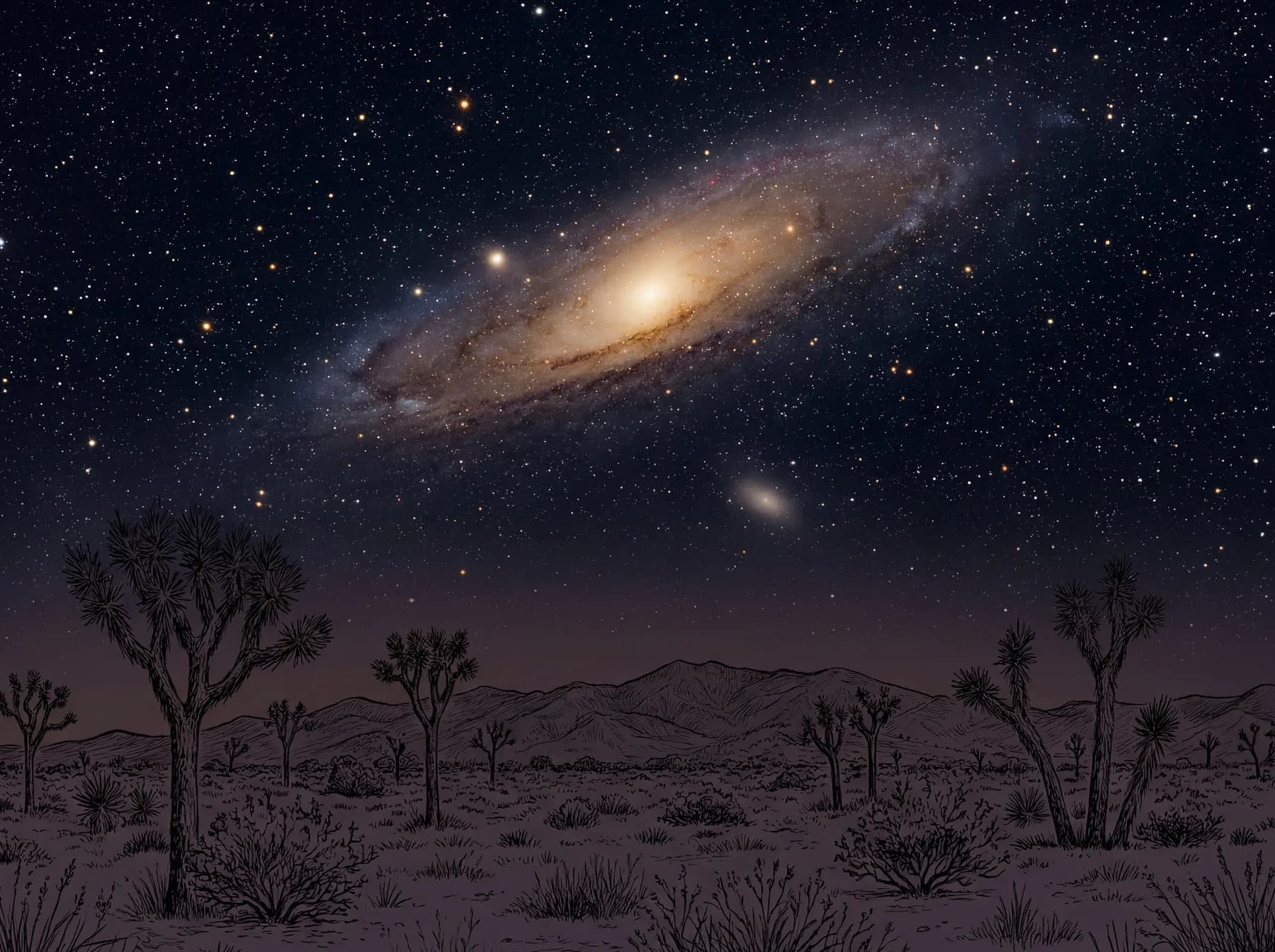
The trick to seeing it is to not look straight at it. On a moonless autumn night the Andromeda Galaxy sits nearly overhead from this desert as a small, soft smudge, dim enough that a direct stare loses it. Look a little to the side and it steadies into view; look back at it and it fades again. It is the faintest thing you will find up there that is also the largest, and both of those are true at once.
What your eye actually catches is only the bright core. The full disc spans about six full-moon widths of sky, but the outer arms are too faint to register without a long camera exposure, so the naked eye gets the center and nothing else. That center is a spiral galaxy, Messier 31, a little larger than our own Milky Way and holding something like a trillion suns. The smudge is what a trillion suns look like from two and a half million light-years away. The light landing in your eye tonight left before our species existed.
People like to call it the farthest thing the naked eye can reach. Under an ordinary town sky that is close enough to true. But this ground sells its darkness, and the darkness undoes the claim. The same clear, dry air that lets Andromeda show at all lets a fainter galaxy show too: the Triangulum Galaxy, Messier 33, farther still at about 2.88 million light-years, and just reachable by a dark-adapted eye from this latitude. So Andromeda is one of the farthest things a person can see unaided. It is not the record. Its own good conditions dethrone it.
The sideways-looking trick is not folklore; it is how the eye is built. The center of your retina is packed with cones, which read color and detail in daylight and go nearly useless in the dark. The rods that handle faint light sit off to the sides. Aim the smudge at that sensitive edge, by looking a little away from where you know it is, and it brightens. Stare straight at it and you drop its light onto the part of the eye that is blind to dim things.
Autumn is when it is easy. Andromeda rides high overhead on fall and early-winter evenings here, well up out of the thick, dimming air near the horizon. Binoculars turn the smudge into a clear oval with a bright heart, and that is worth doing at least once. But the point of the naked-eye view is not detail. It is distance: that you are looking at another galaxy, unaided, from your own two feet on dark ground.
Find the core first with your side vision, then let the dark do the rest. Do not stare, or you will lose it.