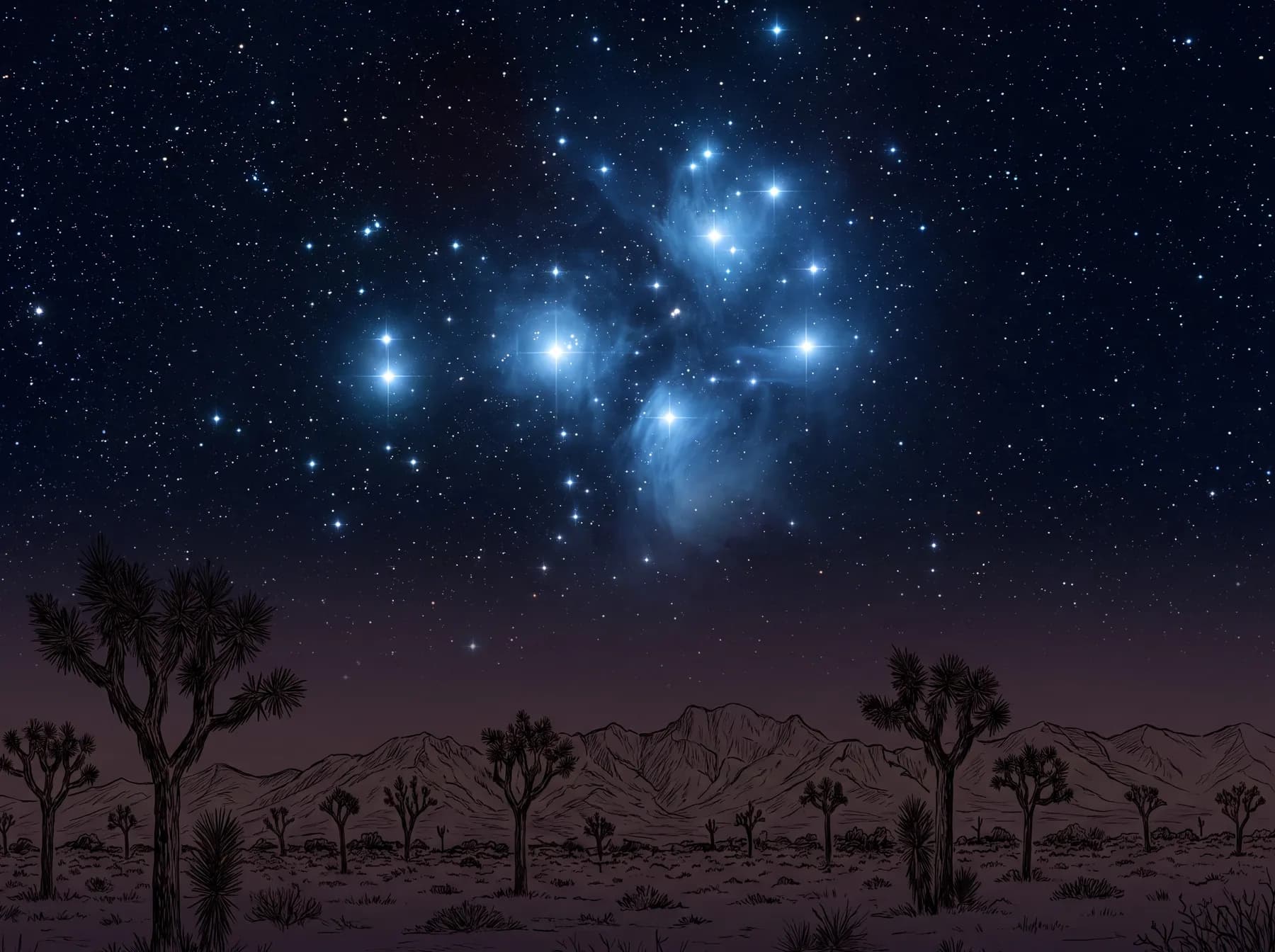
On a clear winter night, find the little knot of blue light high in Taurus and try to count the separate stars inside it. In most skies, and in most of a person's life, the answer comes back six. The cluster is small and tight, about two degrees across, roughly four full moons laid side by side, and six pale points is all it seems to give up. That number is worth doubting, because from dark, dry ground the sky hands you more.
Counting the Pleiades is one of the oldest naked-eye measures of how sharp your vision is and how dark your sky. Sharp eyes under a properly dark sky pull out seven, and a few observers have reported far more, up to fourteen in exceptional conditions. The high desert here, thin and cloudless where the rain shadow wrings the air dry, is the kind of sky that lets you get past six. Give your eyes a good while away from any light, then look a little to the side of the cluster rather than straight at it. The faint ones arrive.
The six you win that way are only the bright tip of the thing. Surveys have confirmed more than a thousand stars in the Pleiades, a true open cluster, hundreds of them born together from one cloud of gas and still drifting together through the galaxy. The bright members burn a hard blue-white because they are hot, B-type stars, and young: a small fraction of the sun's age. Most pairs that look close in the sky are a trick of line of sight, a near star in front of a distant one. These stars are neighbors, roughly four hundred light-years off, related to one another.
That makes the old name a small puzzle. The classical Greeks called them the Seven Sisters, and cultures across several continents independently settled on seven, though only six come easily to the eye. Whether a real star has faded since, or seven was always the count of a sharper-eyed night, no one can say. It is folklore rather than physics, but the pattern itself is real: a great many people looked up at the same handful of stars and told a story about seven.
None of it needs a telescope. Raise a pair of binoculars to the cluster and the field detonates, the six becoming dozens and then more than a hundred, the swarm behind the tip showing itself all at once. It is one of the few sights that rewards the smallest instrument you own.
Point binoculars at the fuzzy little dipper high in winter. It is not the Little Dipper, and there are far more stars than you think.