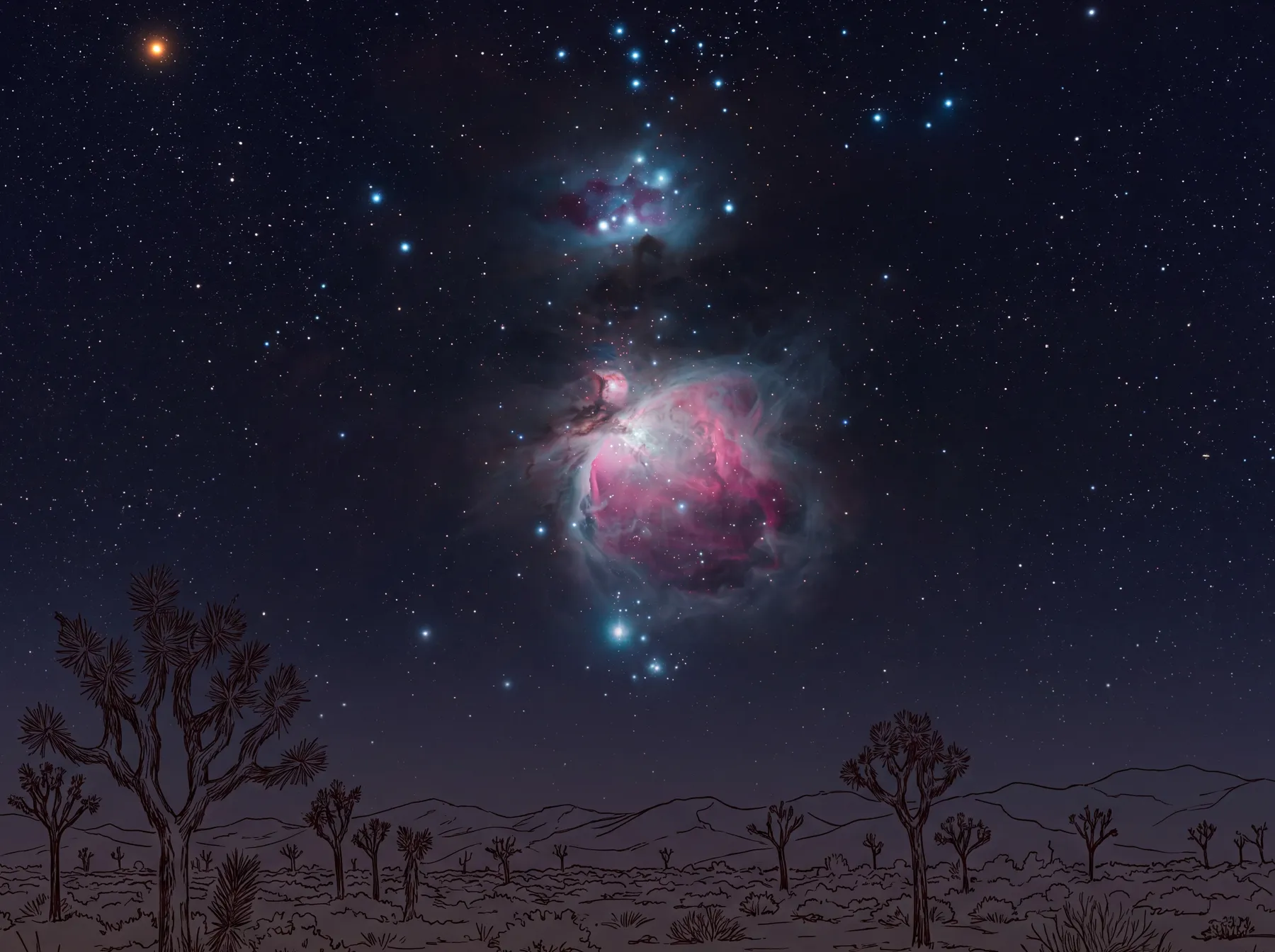
On a cold, clear night from December through March, one pattern settles the whole southern sky: three bright stars in a short, straight row, evenly spaced and tilted at an angle. Nothing else up there looks like it. The three do not actually hang in a line; the eye assembles them into one from this angle, and never lets it go. Those are the belt of Orion, and they sit almost on the celestial equator, which is a plain way of saying they rise due east, set due west, and can be seen from nearly everywhere people live. From this bajada they ride high into the south through the driest, steadiest air of the year.
The belt earns its keep as a pointer. Follow its line down and to the left about twenty degrees and you land on Sirius, the brightest star in the night sky. Follow it up and to the right and you reach Aldebaran, and past that the small huddle of the Pleiades. Learn the belt and you have not learned one constellation. You have learned how to find half the winter sky from a single anchor.
The interesting thing hangs below the belt, in the short line of the sword. Look at its middle star on a dark night and it refuses to snap to a point. It stays soft, fuzzy at the edges, faintly wrong. That is because it is not a star. It is the Orion Nebula, a cloud of gas and dust roughly thirteen hundred light-years off, and the nearest place to us where massive stars are actively being made — something like seven hundred of them catalogued inside, at every stage of switching on. Under a city's skyglow that smudge is lost. Here the naked eye still finds it, binoculars open it into a glowing fan, and a telescope resolves the knot of hot young stars lighting it from within.
At the upper-left shoulder burns a different kind of object, red-orange even to the bare eye. This is Betelgeuse, a red supergiant near the end of its life, and vast: by one measure some 764 times the width of our sun, wide enough that dropped where the sun sits, its surface would swallow the orbit of Mars. It will end as a supernova. Nobody can tell you when. The honest window runs from tonight to something like a hundred thousand years off. So the same figure carries a nursery in its sword and a dying giant at its shoulder, both in plain view.
Take binoculars to the middle star of the sword. If it holds its blur instead of sharpening to a point, that is the nursery.