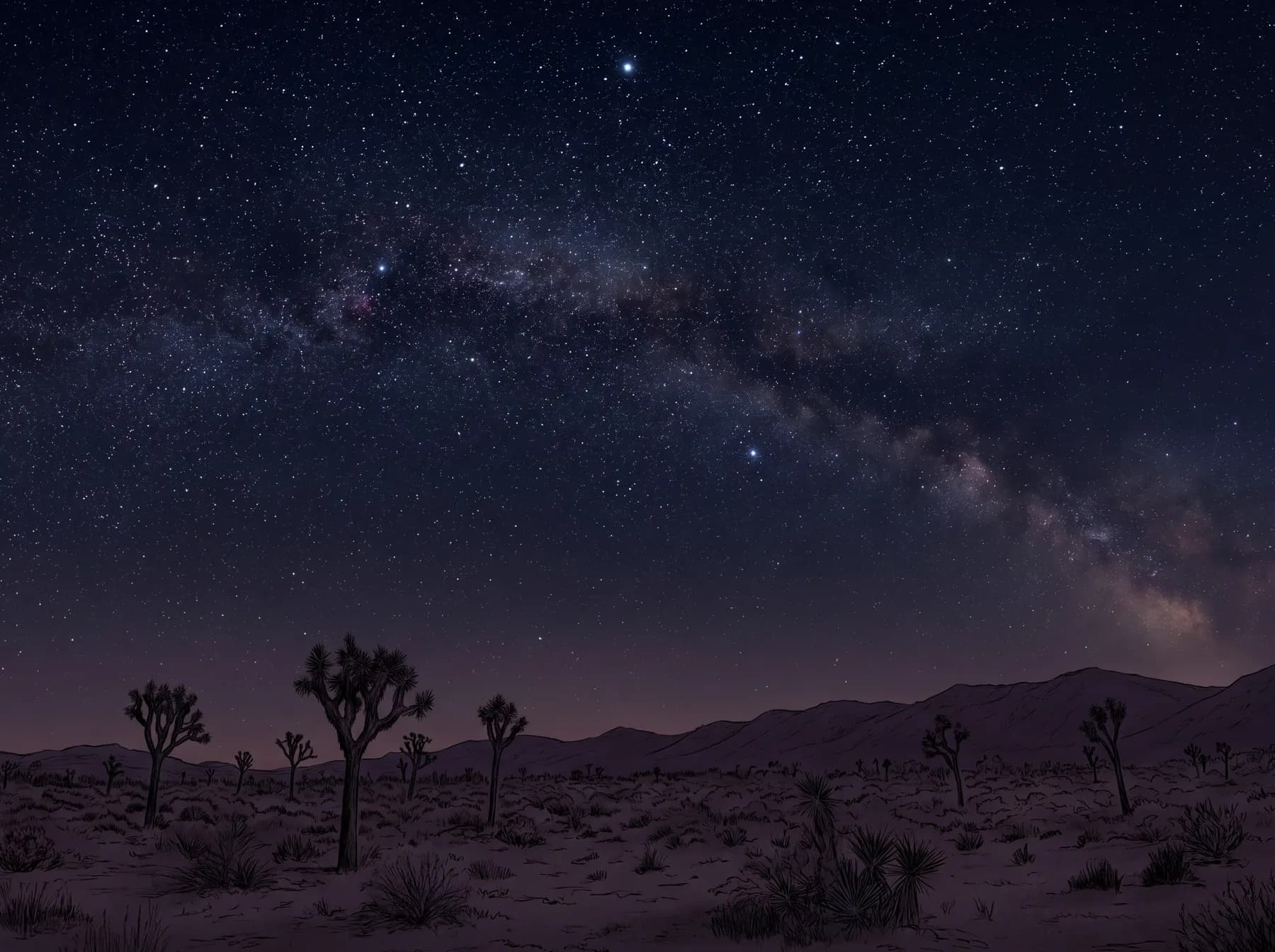
Watch the northern sky for an hour on a clear desert night and almost everything in it moves. The stars swing slowly counterclockwise, the way they have all your life without your noticing, because a city sky rarely holds still long enough, or dark enough, to catch them at it. One point does not move. Find that point and you have found true north, for free, with no battery and no correction to remember.
The Big Dipper does the pointing. It is not a constellation but an asterism, a shape the eye assembles from seven stars inside the larger figure of Ursa Major, and on spring and summer evenings it rides high in the north where you cannot miss it. Look at the two stars that form the outer edge of its bowl, the side away from the handle. They are the Pointers, Merak and Dubhe. Draw a line from Merak up through Dubhe and keep going, about five times the gap between them, and it lands on a lone star sitting off by itself. That is Polaris.
Here is the part that surprises people. Polaris is not bright. It sits at magnitude 1.98, a second-magnitude star somewhere near the 48th brightest in the sky, and anyone expecting the famous North Star to blaze overhead has been looking for the wrong thing. What matters is not how much light it throws but where it sits: less than a degree from the north celestial pole, the fixed hinge the whole sky turns around. So while the Dipper wheels and the Pointers swing through the hours, Polaris barely stirs. That stillness, not brightness, is the whole use of it.
It gives you two readings for nothing. A magnetic compass points at magnetic north, and you have to know your local declination and correct for it or live with the error. Polaris asks for no correction; it stands over true north directly. Its height above the horizon hands you your latitude — the angle from the flat northern horizon up to the star equals how far north you stand, which here lifts it about a third of the way from the horizon to straight overhead. Sailors read their position off that one star for centuries before anything better existed.
One limit is worth knowing before you lean on it. This far south the Big Dipper is not fully circumpolar; on autumn evenings it sinks low and grazes the northern horizon, and behind a ridge it can drop from sight entirely. When it does, Cassiopeia runs the same trick from the far side of the pole. The dry, dark air here is what lets any of it work at all — a bright sky washes the Pointers and a second-magnitude star out of the sky.
Find the two stars on the Dipper's bowl, extend their line five times over, and the point that will not move is north.