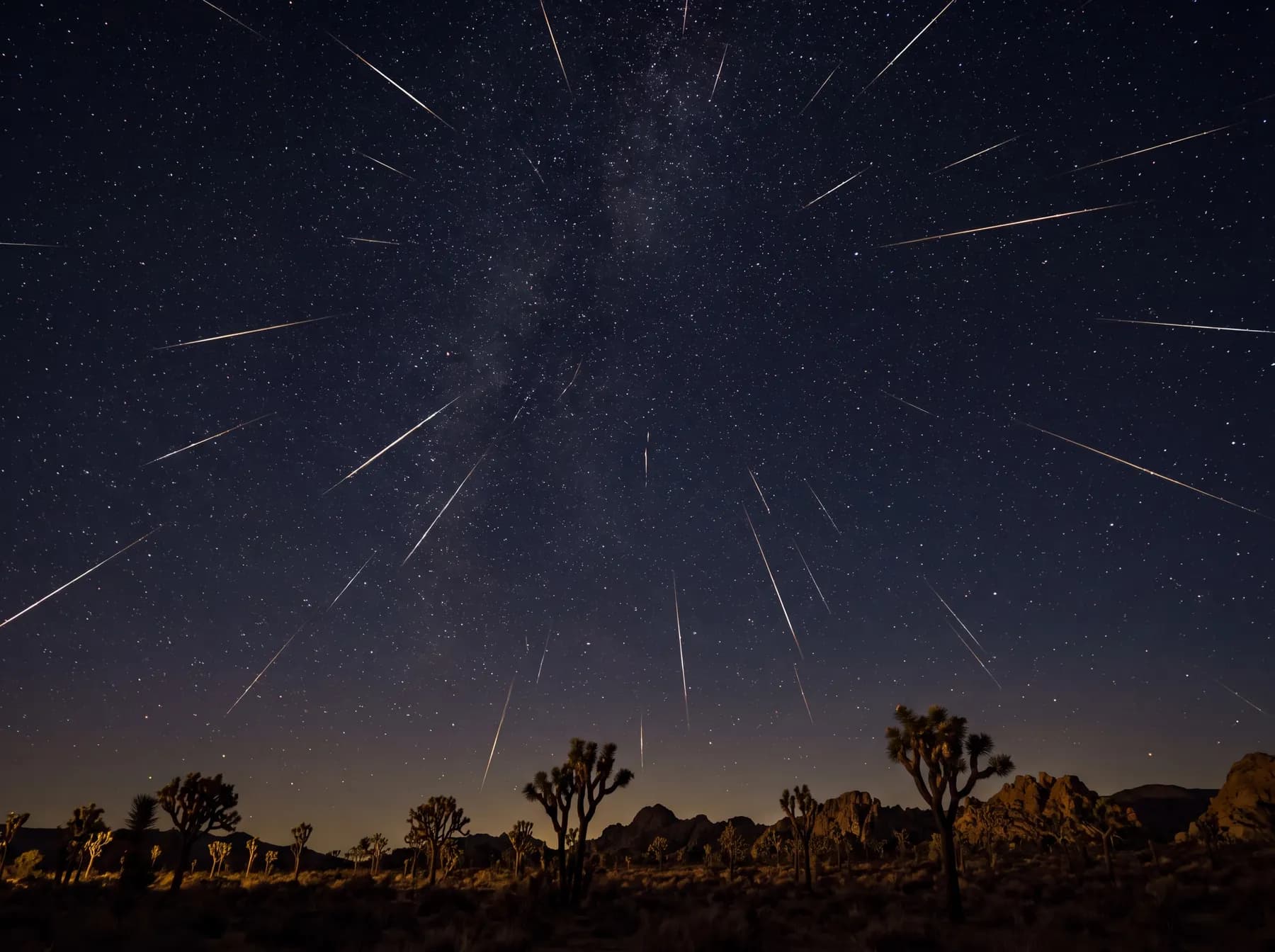
The best meteor shower of the year arrives in the coldest week of it, and that is most of the reason you have never watched it. The Geminids peak around the fourteenth of December, when the desert night is near its longest and its meanest, and almost everyone who would happily lie out on an August lawn for the Perseids is indoors by then. The show goes on above an empty yard.
Which is a shame, because the thing that drives people inside is the same thing that makes this the finest sky of the year. Cold air is dry air, and dry air is transparent. December nights on this bajada are the driest and steadiest the calendar offers, the moisture that softens a summer sky wrung down to a trace, so the dark overhead is deeper and cleaner than it will be again until next winter. The cold is not the price of the view. The cold is the view.
The meteors themselves are richer than the Perseids, more of them at the peak and brighter when they arrive. Part of that is speed. Geminids enter the atmosphere at around 35 kilometers a second, against the Perseids' 59, and the slower an object burns in, the more sedate and luminous the streak it leaves. They tend to run yellow and white, and now and then one carries a green cast. You need nothing to see this: no telescope, no binoculars, only dark ground and the patience to keep looking up while your feet go numb.
The strange part is where the debris comes from. Nearly every meteor shower is a comet's leavings, dust boiled off a ball of ice as it swings past the sun and strung along its orbit for the Earth to plow through. This one is not. The Geminids trace back to 3200 Phaethon, which is an asteroid — a rock, not an ice ball — and exactly how a rocky body laid down a stream this dense is still not settled. Phaethon does shed a little dust when it rounds the sun, enough to earn it the nickname rock comet, but nowhere near enough to account for the river of material the Earth meets every December. Something in its history is missing from the arithmetic.
So on the peak night you are lying in the cold watching pieces of an object that behaves like a comet and is not one. The radiant climbs high enough by mid-evening that you can begin earlier than with most showers, but the count builds as the night deepens and runs strong long after the summer crowds would have packed up and gone home.
Dress for real cold, lie back, and give it an hour past midnight; the slow bright ones come then, and some of them are green.