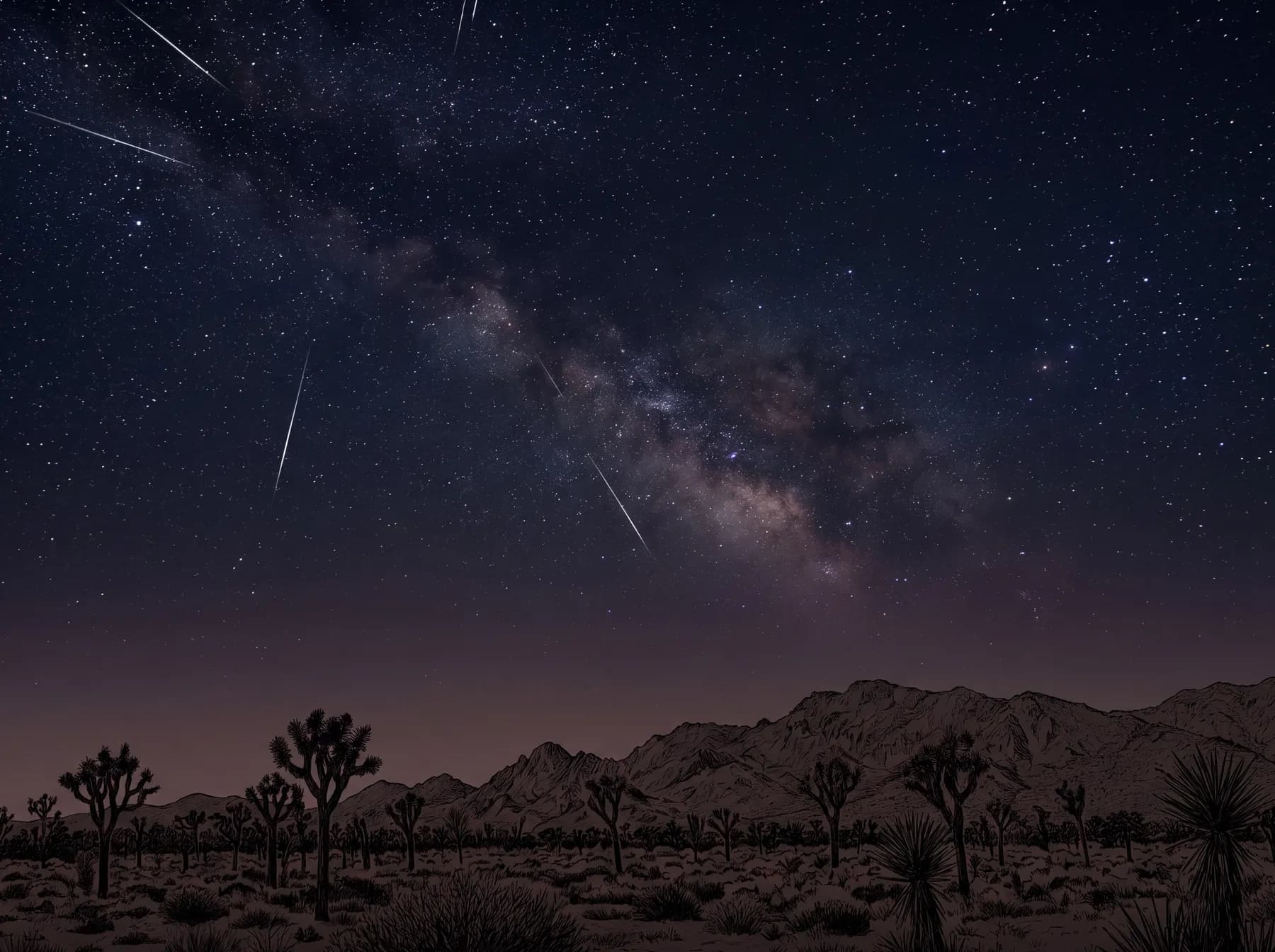
The desert hands you its best sky in January. The same dry, cloudless air leaves the winter nights here glass-clear, the stars steady instead of shimmering. That dark, dry sky is also what lets the fainter meteors register instead of washing out. The shower that fits it best, though, has a peak so short that most people sleep right through it.
Most showers are forgiving. They build over several nights and hold a broad peak, so if you miss the best hour you can go out the next night and still catch the tail. The Quadrantids do not work that way. Their maximum is famously narrow, a matter of hours, not days, and once it passes, the shower is effectively over. Whether you catch one of the year's strongest displays or almost nothing comes down to one question: did the peak fall while your patch of sky was dark?
That makes the date matter more than the shower does. It comes around the third of January, in the cold hours before dawn, when the radiant, the point the meteors seem to stream from, has climbed high in the north, off the handle of the Big Dipper. If the peak lands in your night, the rates build toward morning. If it lands over daylight on the far side of the world, you get the scraps.
The name is the first ghost. The Quadrantids are named for a constellation that no longer exists. Quadrans Muralis, the wall-mounted quadrant, was drawn onto the sky by the French astronomer Jérôme Lalande in 1795 and then dropped when astronomers settled the 88 modern constellations in the last century. Its stars were folded into Boötes, and the shower kept the name anyway.
The parent is the second ghost. Most showers trail a comet, the debris of dirty ice boiling off as it rounds the sun. This one traces back to 2003 EH1, which is not a comet but an asteroid — possibly a dead comet that has burned off everything volatile and gone dark, perhaps the remains of one that East Asian astronomers recorded roughly five hundred years ago. It is the same argument the Geminids started, and it has not been settled.
None of this needs a telescope, or binoculars, or any skill but patience. A meteor shower is the one part of the night sky that asks for nothing more than a dark place and the time to sit under it. The desert supplies the dark; you supply the alarm clock.
Check the date first. If the peak falls in your night, be outside before dawn, facing north, and give your eyes time to adjust.