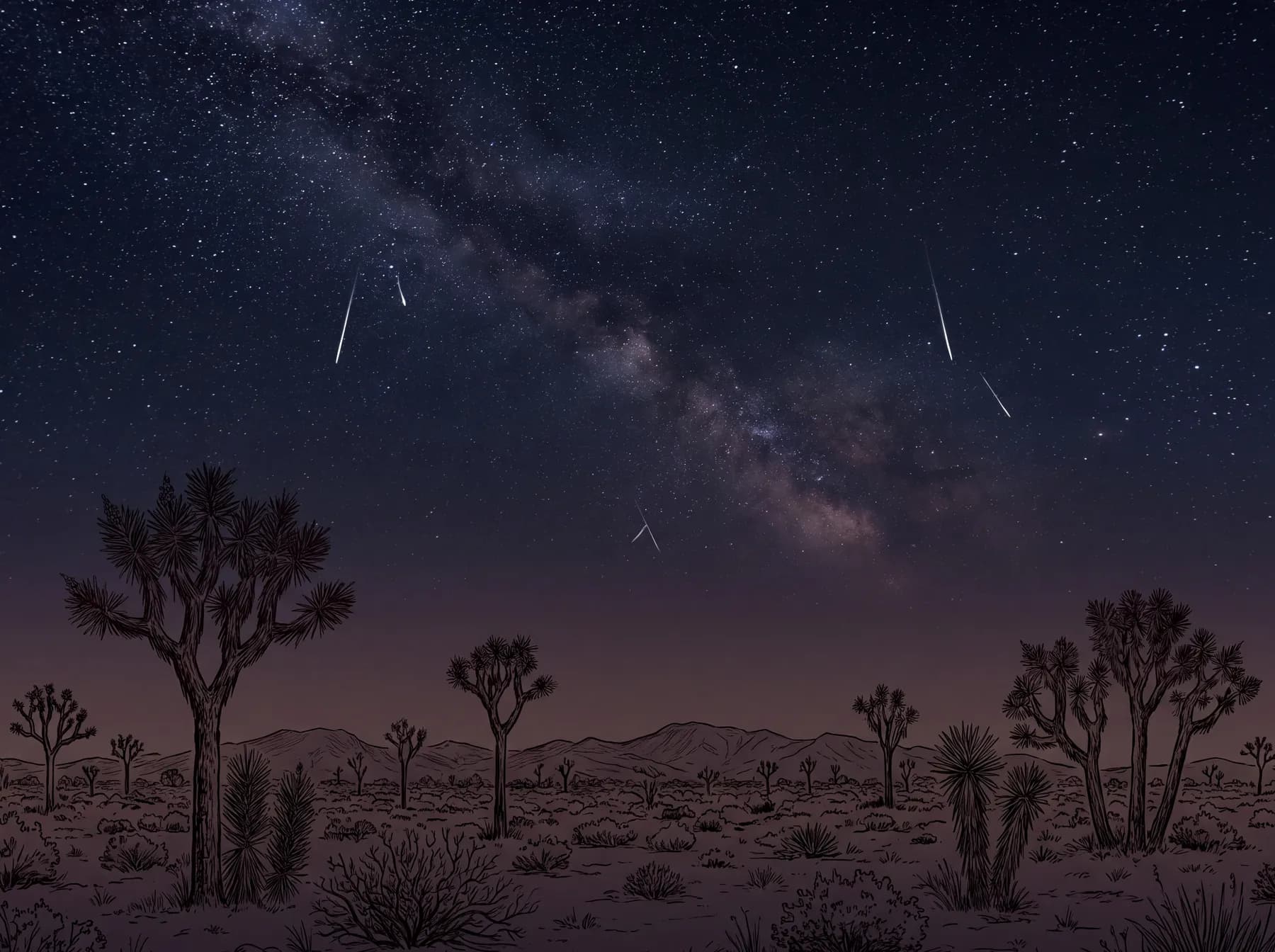
The streak of light across the sky is larger than the thing that makes it by a margin that is hard to hold in the head. Most Perseids are grains no bigger than sand. One touches the top of the air moving tens of thousands of miles an hour, and the line it draws can carry a long way across the dark. Nothing falls, and nothing burns up on impact. The grain never reaches the ground at all; it vaporises from friction high in the air, and what you see is not the grain but the glowing wake it tears open behind it.
The grains come from a comet. Comet Swift-Tuttle sheds a trail of dust along its orbit every time it swings past, and the Earth crosses that same trail, at the same point in its own orbit, in the second week of August. So the shower is an anniversary. We are not watching a comet go by. We are driving through the wreckage it left on laps it ran long before anyone stood here to look up, and will keep leaving on laps to come.
This is where the desert earns its place in a sky book. A meteor is a faint thing, and a city sky rubs out the faint ones before they finish their line. A sky as dry and dark as this one keeps them. Under it the Perseids will run around sixty an hour at the peak, roughly one a minute. That is the honest figure for a real pair of eyes, lower than the number usually quoted, which assumes a perfect sky and the radiant straight overhead. Sixty is more than you can hold without missing some.
The method is that there is no method, and no equipment. Do not reach for binoculars; they narrow the whole sky down to a keyhole, and you will catch fewer, not more. The naked eye, taking in everything at once, is the right tool for once. Lie back after midnight, when the corner of the sky the meteors seem to fly from has climbed higher and the rate is building toward dawn. Give your eyes twenty minutes in the dark to adjust, because the dim ones only show up once they have.
Part of why this is the shower most people have actually seen is the month. It peaks in August, when you can lie out on warm ground in a t-shirt and wait while the desert hands back the day's heat to a clear sky. The colder showers of December ask more of a body.
Face up, eyes loose on the whole dark. Don't chase one streak — the next arrives from a part of the sky you weren't watching.