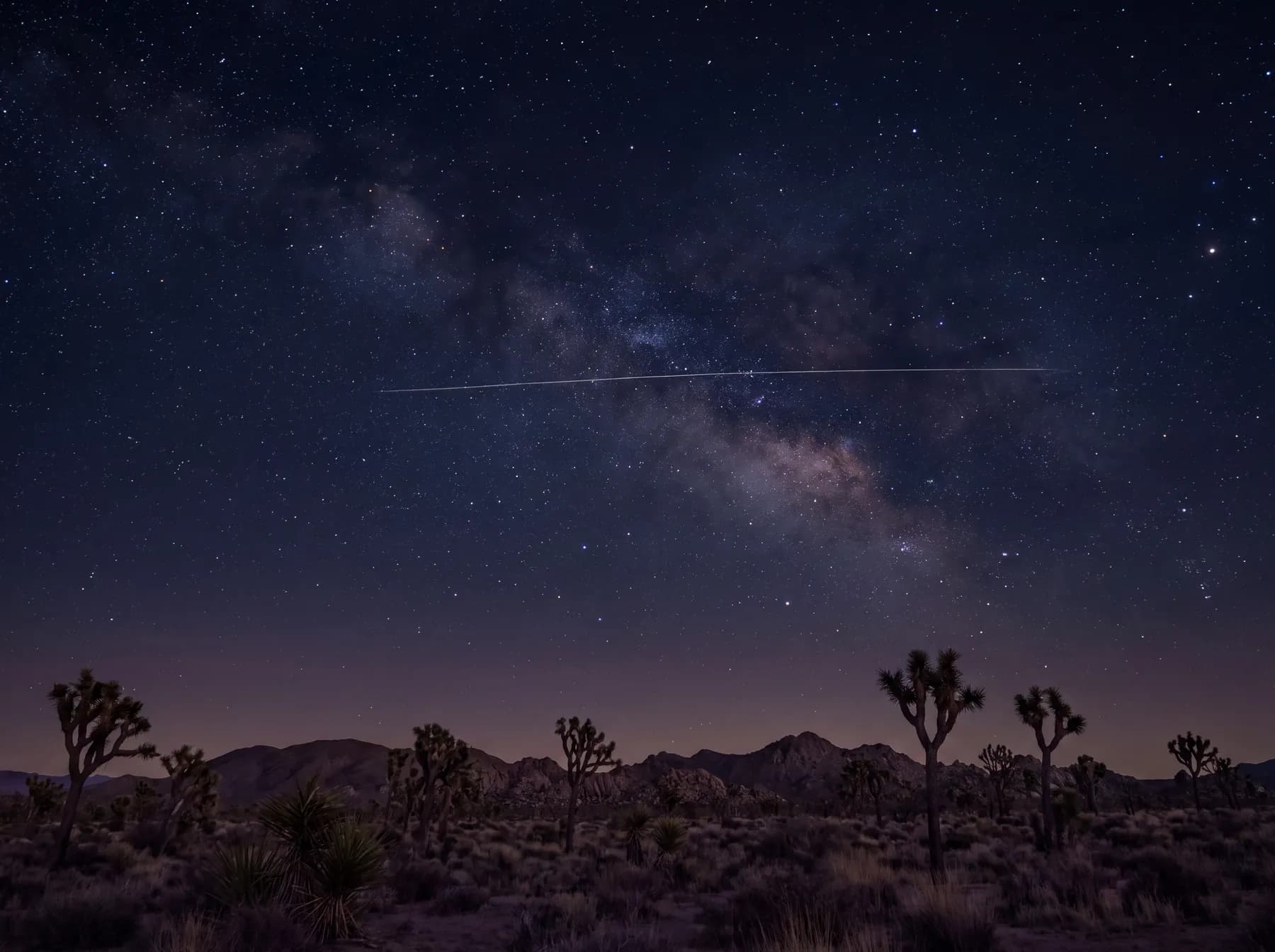
Almost everything else on this page makes you wait. The meteor may or may not come; the planets keep their own slow calendar; the Milky Way core rises when the season decides. One light up there keeps an appointment. A free app will hand you the exact minute it clears the horizon, the compass bearing to face, how high it will climb, and roughly where it will vanish, and then it arrives on time. Nothing else in the night sky lets you do that.
What you are looking at is a spacecraft about the size of a football field, counting its solar arrays, some two hundred and fifty miles up and moving near seventeen thousand five hundred miles an hour. NASA quotes those figures plainly. The part that is easy to forget while you watch a quiet dot slide across the dark: there are people inside it. The station has been continuously crewed since November 2000, which means for the whole of this century there has not been a night without someone living up there.
Telling it apart from a plane takes one look. It does not blink. Aircraft are required by law to carry flashing anti-collision lights, so a winking light is a plane every time; the station holds one steady, unwavering point, and that single test settles most of it. It is also brighter than any star up there, on a good pass about as bright as Venus, which NASA ranks the third-brightest thing in the sky after the Sun and Moon. A glint off the solar panels can flare it brighter still for a second or two.
Then there is the way it leaves. Often it does not set. It sails halfway up the sky and simply fades out, dimming to nothing in open air, because it has flown into the Earth's shadow and the sunlight that lit it has been cut off. That is the whole reason you only see it near dusk or dawn: the station is still up in sunlight while the ground below has already gone dark. It catches a sun that has already set for you, the same trick that lights the zodiacal cone before dawn. In the hours around midnight, the shadow reaches all the way up, and the station goes dark with everything else.
The clock it keeps is not ours. It laps the whole planet in about ninety minutes, sixteen times a day, so the crew rides through sixteen sunrises and sixteen sunsets in the time you get one. The bright point crossing this bajada in three to five minutes is most of a lap; by the time you have walked back inside, it is somewhere over an ocean.
This is the one light on the page a city could see too. The dark dry sky here only gives you the rest of it: the full arc, uninterrupted, horizon to horizon.
Check the app, then face the bearing it gave you. Thirty seconds later a steady point lifts from the dark and does not blink.