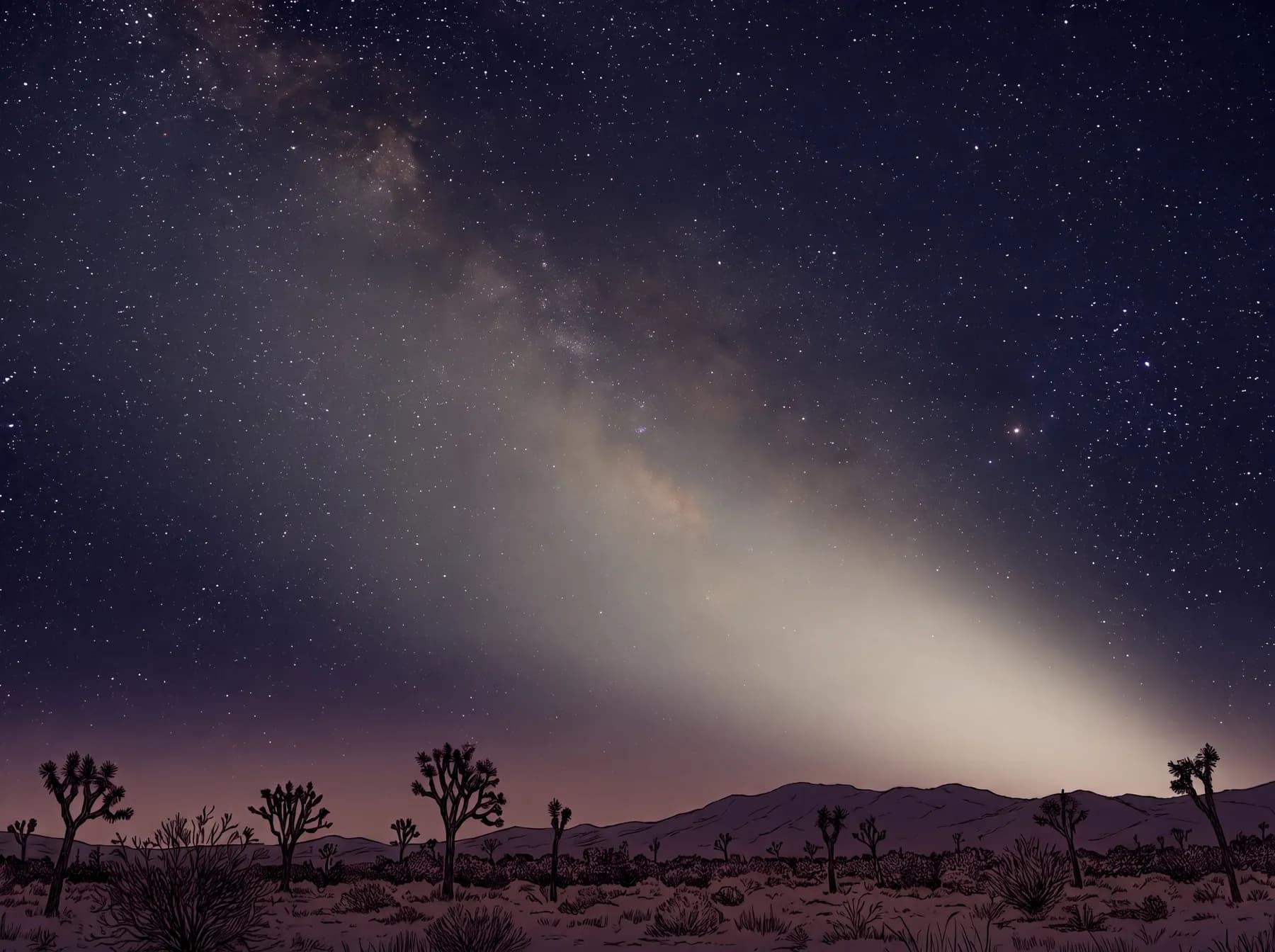
Before sunrise in autumn, on a morning with no moon, the eastern sky can begin to glow while it is still night. A soft tower of light leans up from the horizon where the sun will come up, broad at the base and tapering as it climbs. It is easy to read as the first of the morning — travelers and sailors did for centuries and called it the false dawn. It is not dawn. The sun is still well below the edge of the world, and the light left it a long time ago.
What lifts that cone is not the air above you. It is dust: a vast, flattened cloud of it, spread through the space between the planets and lying in the same plane the sun and planets ride. Sunlight scatters off the grains and returns to your eye as a faint smear tilted along the zodiac. Most of the dust is comet crumbs. Researchers attribute more than 85 percent of it to the slow fragmentation of Jupiter-family comets, and the rest to asteroids grinding against one another. The grains are tiny, about the size of cigarette smoke. You are looking at the ground-up leftovers of the solar system, lit from within.
The reason it belongs in a desert guide and not only an astronomy book is that almost nobody gets to see it. The zodiacal light is fainter than the Milky Way, and a modest amount of light will wash it out: a rising moon, a town's glow low on the horizon, the last stain of twilight. It takes a genuinely dark sky. A survey that mapped artificial light across the whole planet put this ground near 21.97 magnitudes per square arcsecond, close to as dark as the sky gets in this country, and the dry high-desert air holds it there, with little water vapor to catch and scatter stray light. Seeing the cone at all is a kind of certificate. Most people in lit country never have, and never will.
When to look is geometry. The cone stands upright only when the ecliptic meets the horizon at a steep angle, which at this latitude happens near the equinoxes: west after evening twilight fully drains in spring, or east before morning twilight in autumn. Give your eyes a solid twenty minutes of real dark first, no phone screen, so the rods can wake. Then look low, where the sky should be blackest, for a triangle that is a shade too pale to belong there.
If a pale tower leans out of the black an hour before any real dawn, you have found it: sunlight, off dust, arriving early.