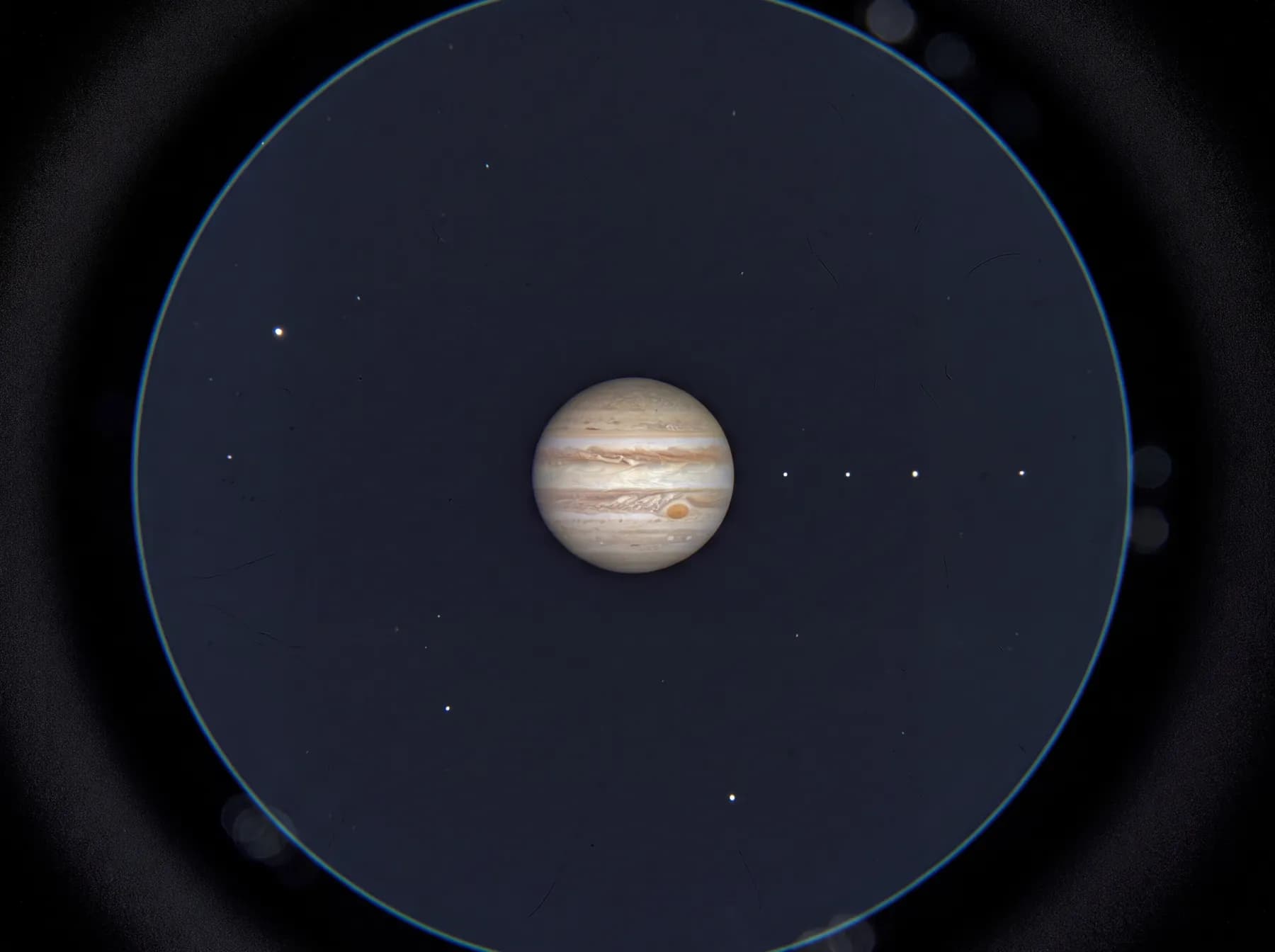
The quickest way to know you are looking at Jupiter and not a star is to watch whether it flinches. Stars twinkle; a planet is a wide enough source to average out the shivering air, so it holds a steady light. On a dry, dark night here that steadiness is easy to catch, because there is so little water vapor overhead to set the sky trembling. Find the brightest steady point that is not the hard white glare of Venus. Most years that is Jupiter, which peaks near magnitude −2.9 and rides second only to Venus, though at a great Mars opposition even that ranking briefly breaks.
Then raise a pair of binoculars, and if you can hold them still, the planet stops being alone. Braced against a fence post or a doorframe, ordinary binoculars will show three or four small points strung in a rough line to either side of it. Handheld, your pulse shakes them into a smear, so the steadiness is the whole trick. The points sit around magnitude five, well within reach of binoculars; the limit is never their faintness but your hands.
They are the four Galilean moons, Io, Europa, Ganymede, and Callisto, and they will not hold still. Io rounds the planet in under two days, so the line shifts hour to hour and certainly across a few nights. A moon that sat to the left reappears on the right, or slips behind the disc and comes back out the far side. One of them, Europa, is thought to hold a global ocean of salt water under its ice, water perhaps a hundred kilometers deep and kept liquid this far from the sun. None of that reaches your binoculars. What reaches them is a dot that was somewhere else last night.
That shifting line of dots is what Galileo turned his instrument toward in January 1610, and it is hard to overstate the damage it did to the old sky. Here were four bodies plainly circling something other than the Earth. A cosmos built with the Earth at its fixed center had to say why these four ignored it, and it had no answer. An argument two thousand years old did not end that winter, but it lost its floor.
There is a tidier story people like to hang on the planet, that its gravity has spent the age of the solar system, some four billion years, sweeping away the debris that would otherwise have battered the inner planets, so that a giant we did nothing to earn is the reason we are here to look up at all. It is a good story and still an open question. Newer simulations argue Jupiter flings about as much material inward as it clears away, protector and hazard in one body, and no one has settled which wins. Keep the moons, which you can check yourself, over the shield, which nobody yet can.
Brace the binoculars on a post, find the steady bright point, and count the dots beside it. Fewer than four means one is hiding.