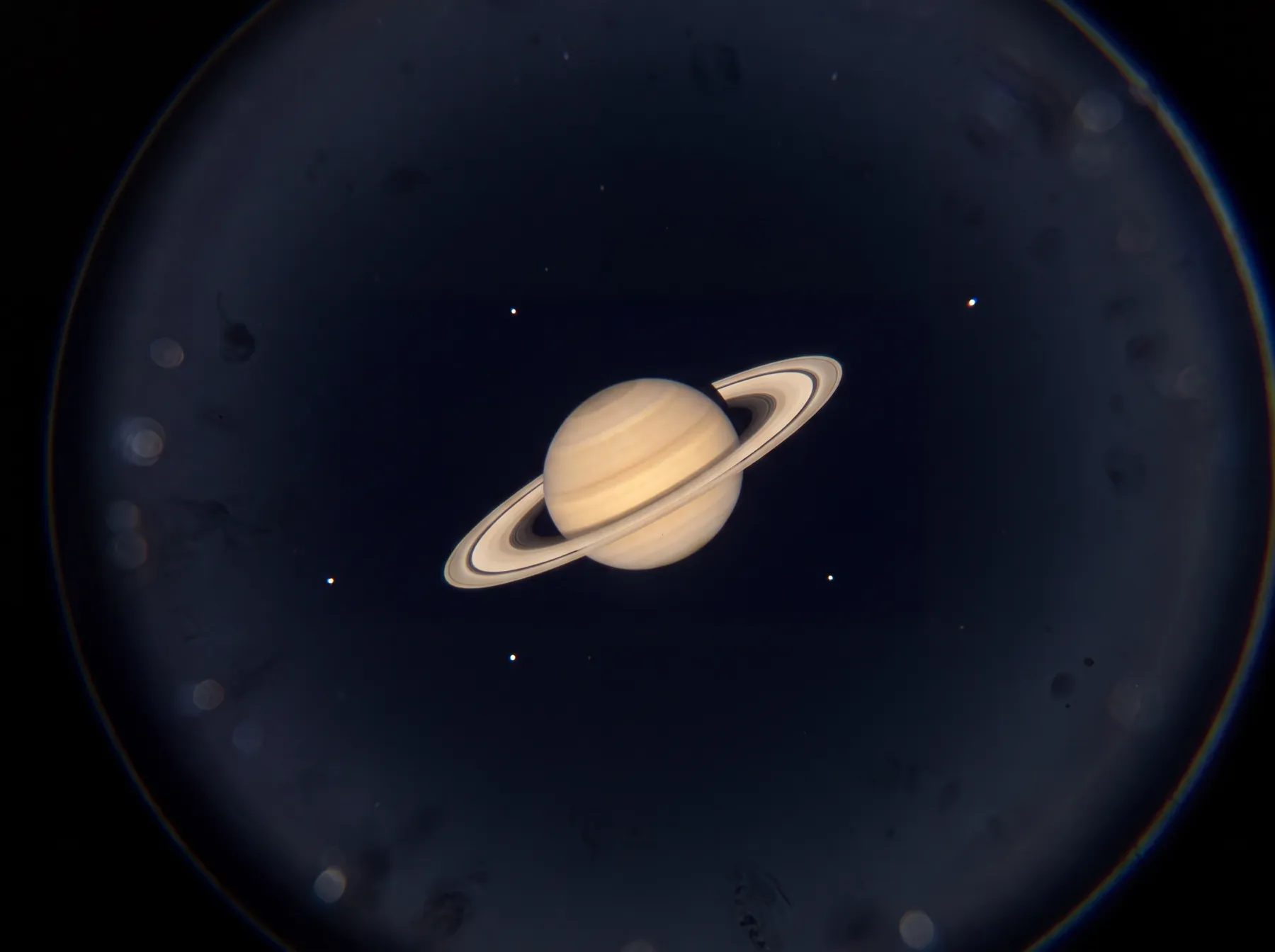
Find Saturn with nothing but your eyes and the honest first reaction is a small letdown. It sits among the stars as a pale, calm, faintly yellow point, and the dark sky here does nothing to fix that. At 21.97 magnitudes per square arcsecond this is about as black as ground-level sky gets, and the planet still looks like a slightly buttery star. The one tell is that it does not twinkle. Stars flare and shiver; Saturn holds steady, the way the other planets do, because it shows a tiny disc instead of a single hard point. That steadiness is how you pick it out. It is also the whole naked-eye event.
The change comes through glass, and it does not take much glass. A small telescope, even a cheap second-hand one, is enough. The rings begin to show at roughly 25 to 30 times magnification, and at about 50 times in a modest 3-inch scope they stand off the planet as a separate ring on every side. The first look is the same for everyone: it does not look real. It looks like a sticker someone pressed onto the end of the tube. Splitting the dark gap inside the rings asks a little more, steadier air and a bit more aperture, so treat that as a good night's bonus rather than a promise.
The rings themselves are not the solid hoop they imitate. They are billions of separate pieces of ice and rock, most of them small enough to hold in your hand, all orbiting in a sheet. And the sheet is astonishingly thin. Saturn's main A, B, and C rings are only about 10 meters top to bottom, roughly 30 feet, wrapped around a planet some 120,500 kilometers across. Scale that planet down to the size of a house and the rings come out thinner than a sheet of paper. The most famous structure in the solar system is, in proportion, barely there.
There is a second thing to find while you are pointed at it. Off to one side sits Titan, shining at around 8th magnitude, a point of light in the same small scope or even in binoculars. It reads as an ordinary faint star until you remember you are looking at the second-largest moon in the solar system, a world with a thick atmosphere, parked beside its planet.
This is the strange entry in a dark-sky guide, because the darkness is not what does the work. Most objects here need this black desert sky to appear at all. Saturn does not; it is bright enough to find from a lit city street. What the dry, still night adds is a steadier, blacker background for that little disc to snap against. The thing that turns the dull yellow point into rings is the aperture, not the sky.
Point a cheap tube at that calm yellow point some clear night, and the rings stand off it on every side.