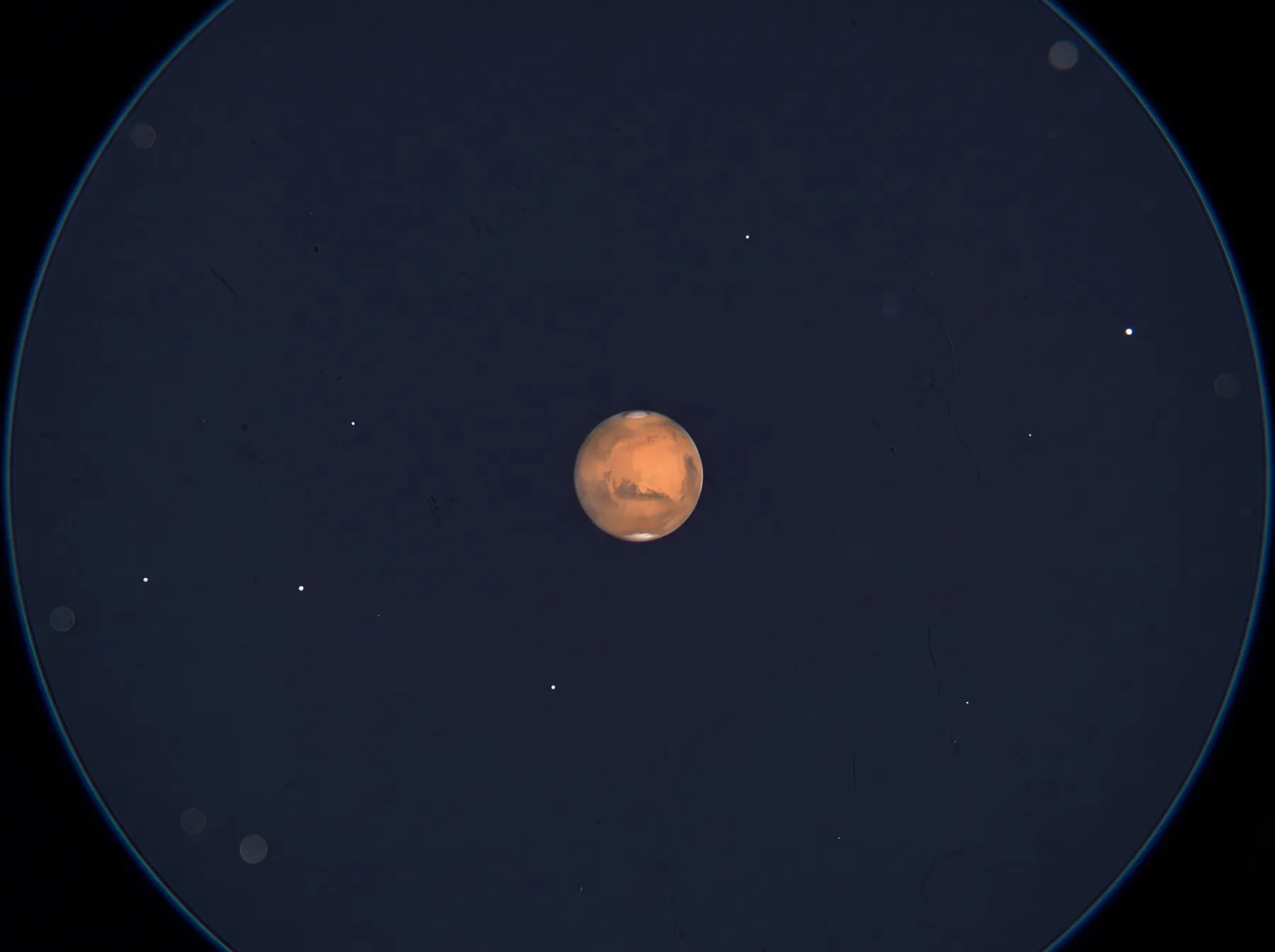
Of all the lights in the night sky, only one gives away what it is made of by its colour alone. Mars shows a dull orange to the naked eye, and that orange is not the air bending its light or your eye straining at something faint. It is real surface colour. The whole planet is coated in iron-oxide dust, which is to say rust, and from this dark ground you are reading that rust straight off the disc across all that distance. The other bright planets carry colours too, but theirs are the tint of high cloud tops and hard to catch; Mars alone shows you its actual ground.
Before the colour, though, settle that it is a planet and not a star. Stars twinkle because each one arrives as a single pinpoint that the atmosphere shivers on the way down. A planet shows a real disc, far too small to see as anything but a point, yet just wide enough that the shivering averages out, so it burns steady while the stars around it flicker. Mars holds that steady light the way all the planets do, and over weeks it also drifts against the fixed stars behind it.
Most of the time it is nothing to write home about, a rusty dot you would pass over. Then, roughly every twenty-six months, it becomes one of the brightest things in the sky. The cause is orbital. Earth runs a faster, tighter lap than Mars and about every twenty-six months catches up and passes it on the inside. That crossing is called opposition, when Mars stands closest, biggest, and brightest, and the swing between one opposition and the next is enormous for something you watch with the naked eye. At a strong one it climbs until it trails only Venus and rivals Jupiter; over the following months it sinks back to the dim orange speck it usually is.
Opposition is also the only time a telescope earns you much. Away from it, Mars is a featureless speck even under magnification. Near it, in the right air, the little disc resolves into something: a pale polar cap, smudged dark markings on an orange ground. The right air is the whole catch. That detail is faint and low in contrast, so any haze, any moisture, any glow along the horizon smears it into nothing. Dry, still, dark air at three thousand feet is the difference between a disc and a planet. The same wrung-out desert sky that makes the days so clear is what buys you the steadiness to make out another world's ground.
So the naked eye gives you two honest things and no more: the colour, which is genuine, and the slow tide of brightness that swells and fades over the years. The polar cap and the dark markings stay a telescope prize, and only on a still, dry, dark night.
Find the orange point that refuses to twinkle. Most years it is a quiet dot; roughly every twenty-six months, the reddest thing in the dark.