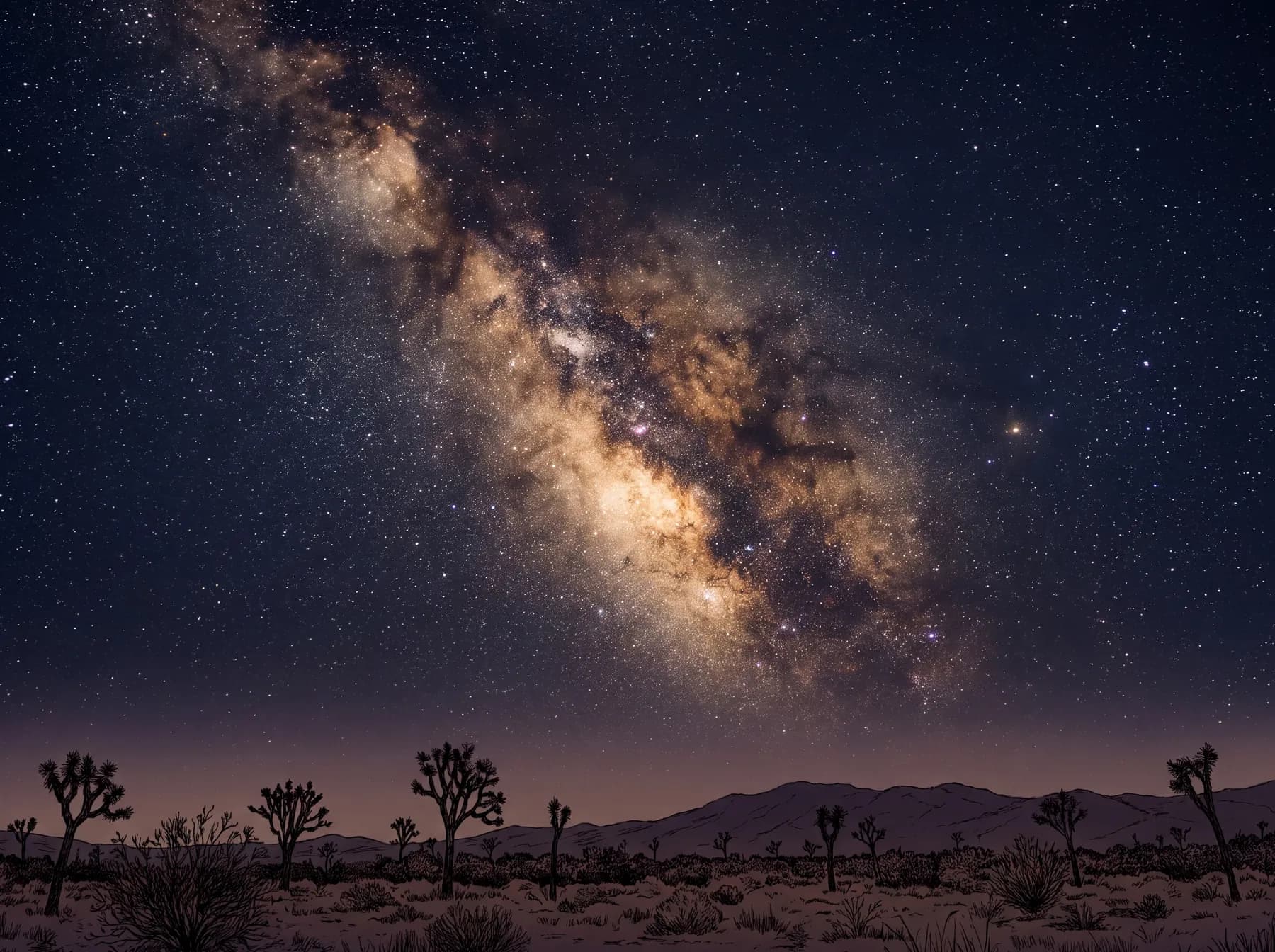
Wait until well after midnight in July, let the desert finish going dark, and a pale band climbs over the southeast horizon. One stretch of it, low in the south, looks brighter and more clotted than the rest, as though the light there had pooled. That thick, knotted patch is the direction of your own galaxy's center, and from this dry high ground you can find it with nothing but your eyes.
The band itself is the flat disc of the Milky Way seen edge-on, from a seat well out toward the galactic suburbs rather than above it. Look toward the brightest knot, in Sagittarius, and you are looking straight into the crowded central bulge, tens of thousands of light-years off. A supermassive black hole millions of times the sun's mass, Sagittarius A*, sits at the middle of it, and the Event Horizon Telescope managed to image it in 2022. None of that shows to the naked eye. What shows is the massed light of all the stars in between.
Run your eye down the band and you will notice dark lanes splitting it lengthwise. They read like gaps, places where the galaxy simply ran out of stars. They are the opposite. Those rifts are clouds of cold interstellar dust, near enough to stand between us and the glow, silhouetted against a hundred billion stars burning behind them. The same dust that blacks out the view is the material the galaxy builds its next stars from.
Most people alive have never seen any of this. Light pollution has erased the Milky Way for the majority of people in the developed world, so the band is a rumor to them rather than a sight. This desert reads differently. The night-sky atlases put this ground at 21.97 magnitudes per square arcsecond, with the artificial glow running about three percent above the natural background — dark and dry enough that the core arrives as a structured, shadow-casting object instead of a faint smudge. People travel a long way and book dark-sky sites a year ahead for what rises over this bajada on an ordinary clear night. It never climbs high here; at this latitude the center stays low across the southern sky, never overhead.
None of it comes quickly. Give your eyes twenty minutes with no phone and no torch, and let them settle into the dark on their own; the band that was invisible when you walked outside will slowly separate into bright cloud and dark rift while you stand there. Binoculars turn the brightest knot into a grainy field of single stars, though the unaided eye is enough for the shape and the lanes.
Look southeast after midnight between May and September, low over the desert, for the one stretch of the band that glows knotted and bright.