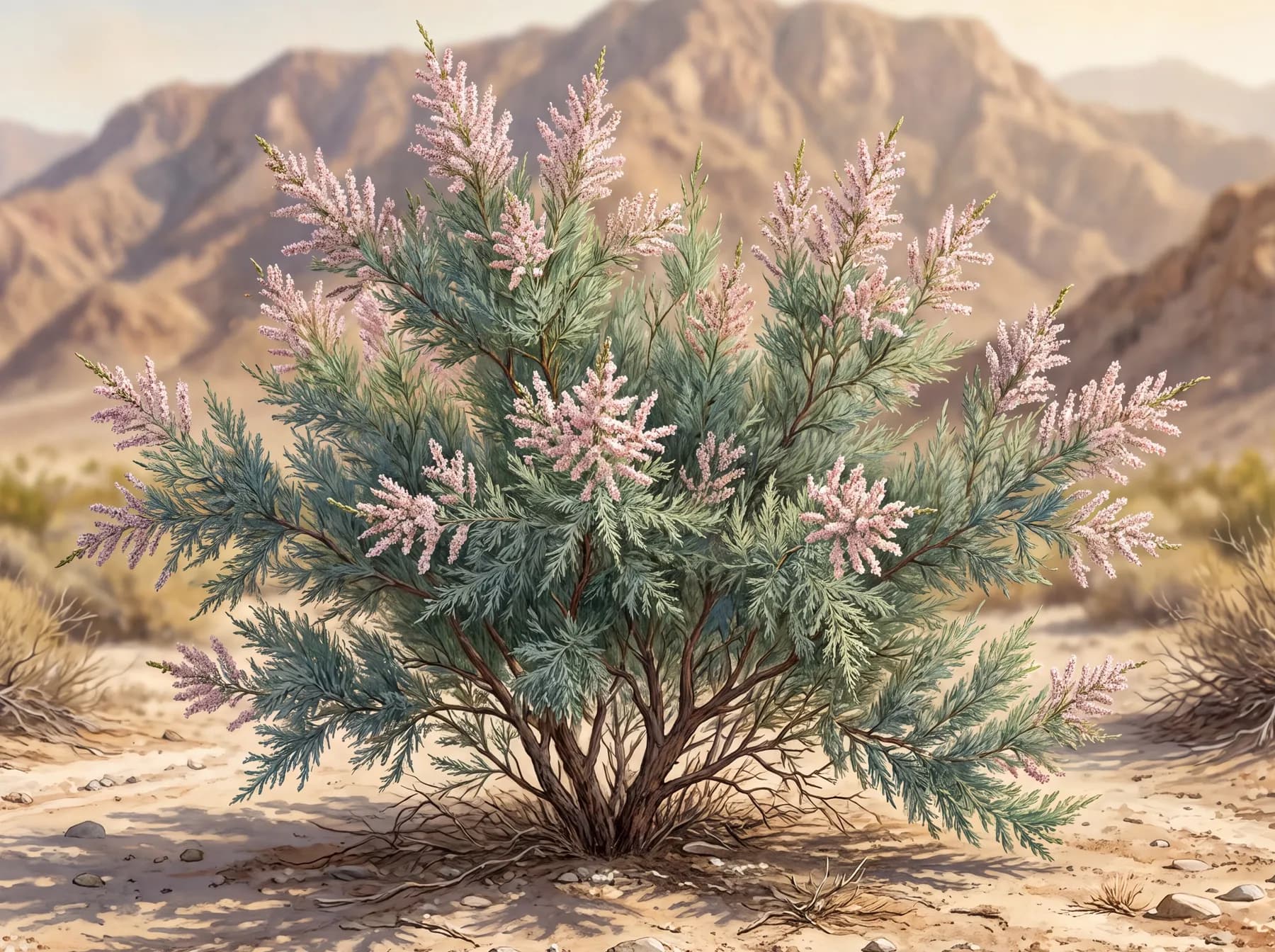
Nothing on the dry bajada is tamarisk, and that is the first thing to know about it. This is an introduced shrub from Eurasia, a plant of wet ground, and it does not read elevation the way the plants around it do. Up on this bench it will never take the open, thirsty slope, and it does not have to. Where water sits, a seep or a spring, a leaking trough, a weeping leach field, it establishes on ground the surrounding desert keeps too dry for anything else to hold. It tracks water, not the map.
You can recognize it before it becomes a thicket. The foliage is feathery and cedar-like, tiny scale leaves pressed flat to slender branchlets, so from a distance the plant reads as a soft juniper. In bloom it carries dense plumes of small flowers, pink fading toward white, and no native shrub here pairs juniper foliage with pink plumes. Then look at the soil beneath it. You will often find a pale salt crust, on the leaves and on the dirt both.
The salt is not incidental. Glands in the leaves excrete it onto the foliage, and as the leaves drop it builds up in the surface soil, raising the salinity until salt-intolerant native seedlings can no longer germinate. The plant is not just crowding its neighbors; it is salting the earth against them. Across the West this has run to a scale that is hard to picture: over one million hectares of riparian habitat, from northern Mexico to southern Canada, now dominated by tamarisk, the old cottonwood and willow galleries gone. Fire compounds it. Stands roughly 10 to 20 years old build dead litter and burn readily, and tamarisk resprouts from its root crown afterward while the natives often do not. The fire clears its competition and leaves the invader standing.
Somewhere you will read that a single tamarisk drinks two hundred gallons of water a day. That number is worth retiring. Its original source never described how the figure was measured, and when researchers went back and measured transpiration by sap flow, a realistic maximum came in under thirty-three gallons, off by roughly six times. Leaf for leaf, it uses about what a native willow uses; plant for plant, it is not a water hog. The honest complication runs the other way. A dense stand, packed with leaf area, can still pull a lot of water, because of how much canopy sits over the wet ground, not because any one plant is greedy. And where crews have cleared it hoping to recover flow, the water has not come back; transpiration was only a small part of the budget.
So there are real reasons to fight it here, and they are not the famous one. It displaces the trees that shade a desert stream, it salts the soil beneath it, and it changes how the land burns. Pulling it out will not hand back a spring. The case against it is what it does to the ground, not a number nobody could measure.
Look for the tell at any wet spot: feathery cedar foliage standing over pale, salt-crusted soil where the native seedlings have quietly stopped coming up.