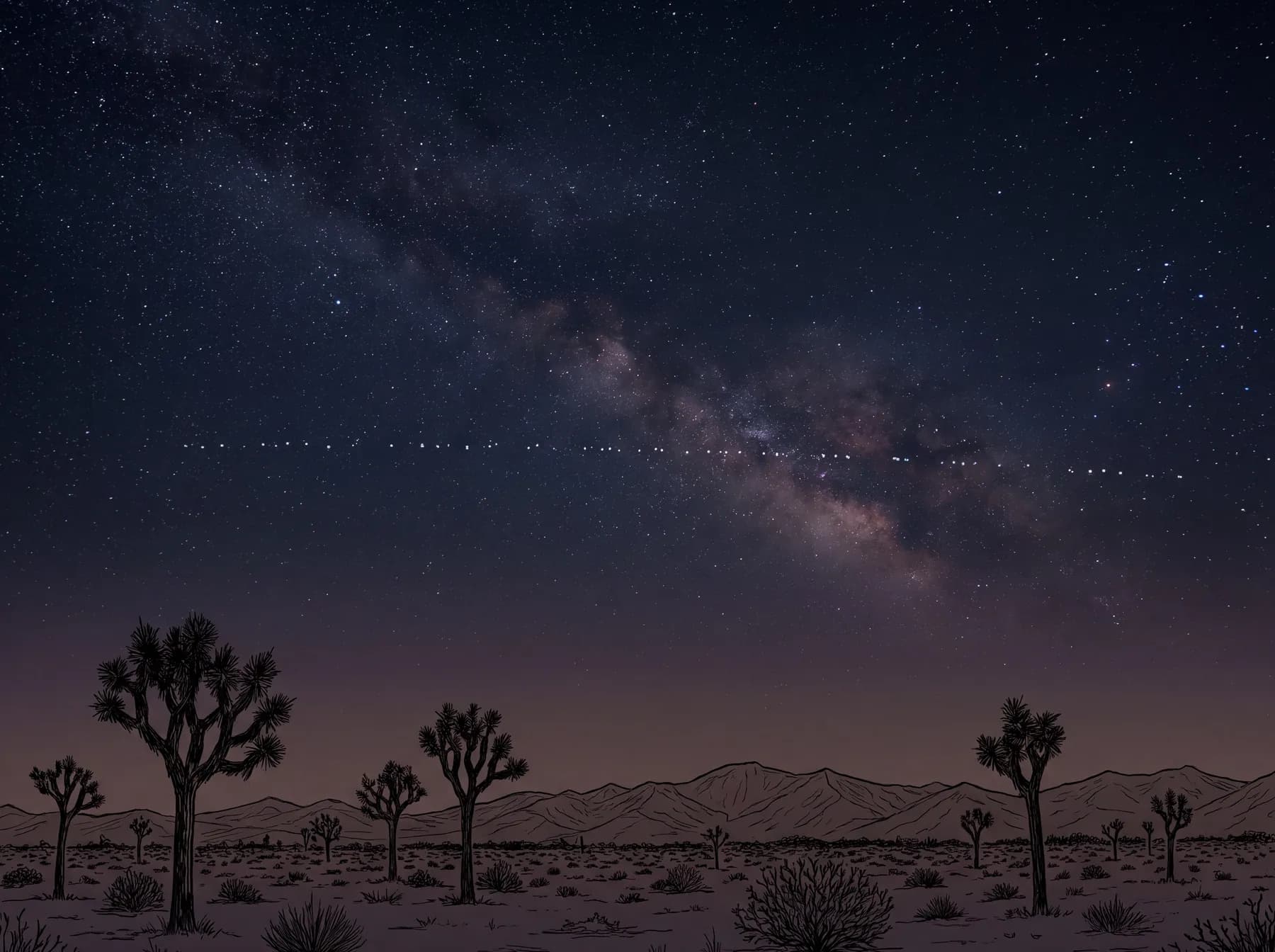
A light that slides across the stars without blinking is the one to watch. A plane announces itself, red and white, on and off; a satellite never does. It holds steady and crosses the dark at an even pace, a single point moving from one horizon toward the other, until it fades partway across as though switched off. That fade is the tell.
The point is catching sunlight. It rides high enough that the sun, already set for you on the ground, still reaches it, so it burns while the desert underneath has gone dark. When it crosses into Earth's shadow it has nothing left to reflect, and it simply goes out mid-sky. This is why satellites crowd the hours around dusk and dawn and thin toward local midnight, when the shadow has climbed all the way up. The same low sun lights the space station, and it raises the faint dust cone of the zodiacal light before dawn.
There are thousands of them up there now, enough that on a clear night here you can stand and watch and catch several in about 20 minutes without trying. None of it needs equipment. A dry, dark sky does the work a city sky cannot: no ground glow to drown a modest point of light, only steady dots ferrying between the stars. Individual Starlink satellites run around magnitude 3 to 6, naked-eye but never dazzling.
Now and then the dots arrive in a line. A few nights after a Starlink launch the fresh batch flies as a train — evenly spaced points in single file, beads strung along an invisible wire, sometimes dozens in procession. Nothing natural travels in a straight, evenly spaced string, so the first sight of one is genuinely strange. The batch is released together into a low orbit and flies that way only briefly. Over the next 2 to 4 weeks each satellite raises itself on an ion thruster toward its operating height near 550 kilometers, and the line spreads, thins, and blends into the scatter. That particular string, once dispersed, is never a line again.
There is one uncomfortable line in all this. The count is climbing steeply, and it is the single part of this dark sky getting worse rather than better. Professional astronomers have raised documented concerns about satellite streaks cutting across their exposures and about a slow brightening of the night itself. From the ground it stays a curiosity. Through a research telescope it is a growing problem, and the two views do not cancel.
Watch for the fade. A steady dot that dims and vanishes partway across the sky, never blinking, is a satellite crossing into Earth's shadow.