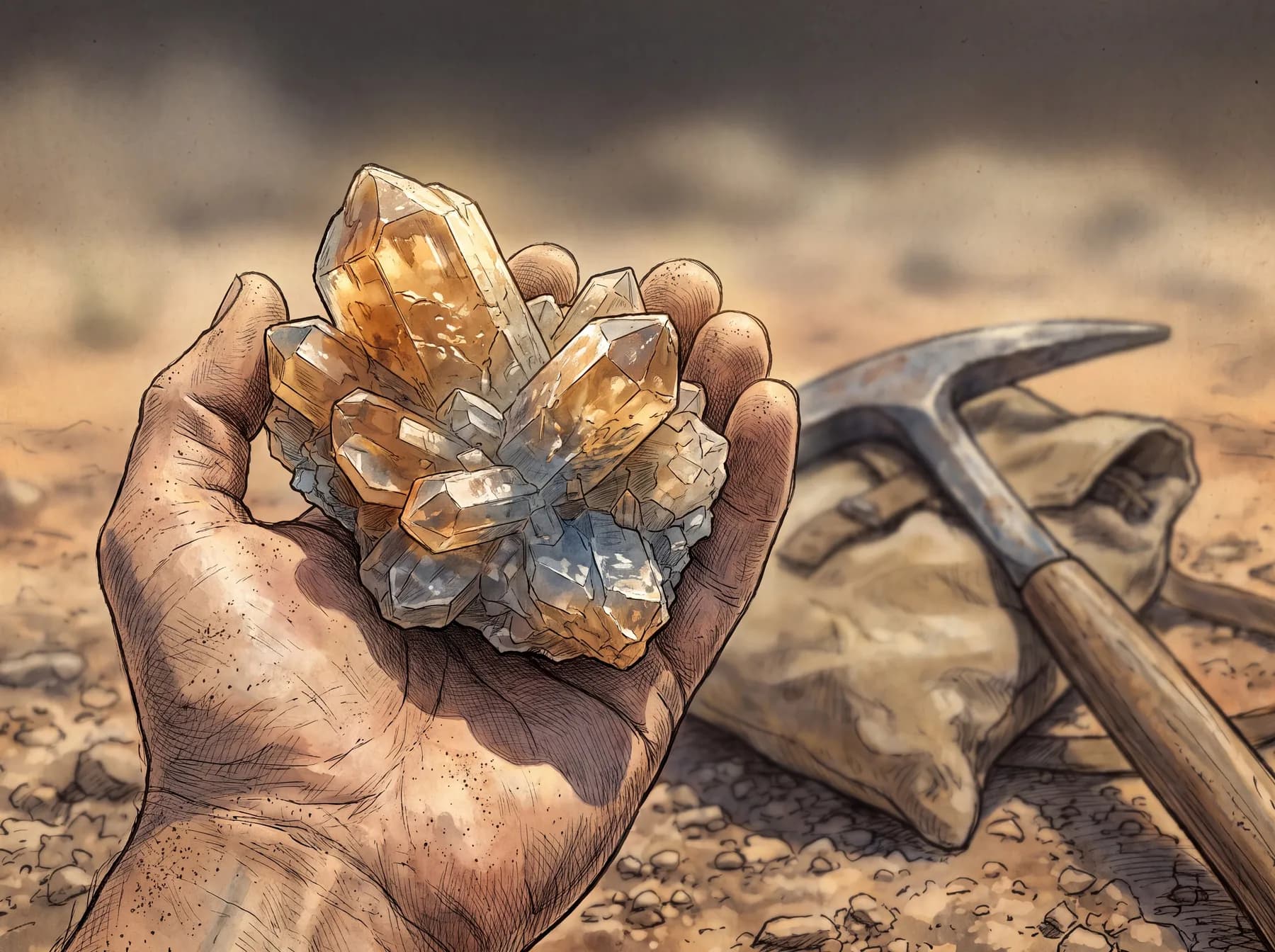
Pick up a piece of barite and your arm works it out before your eyes do. It is far heavier than a pale, dull, ordinary-looking rock has any business being, and that wrongness in the hand is the whole mineral. There is no glitter, no crystal drama, nothing much to photograph. Just weight where you did not expect any.
The number behind the feeling is its specific gravity, about 4.5, meaning a lump of barite weighs about 4.5 times what the same lump of water would, against roughly 2.65 for the quartz sand lying around it. Geologists call that heaviness exceptional for a nonmetallic mineral, and the name says the same thing: barite is from the Greek barys, heavy. The old miners just called it heavy spar. It is soft enough to scratch with a knife and plain enough to walk straight past, and it still weighs almost double what your hand predicts.
That one dull property runs a global industry. About 99 percent of the barite used in the United States is ground into drilling mud, the heavy fluid pumped down an oil or gas well to hold the pressure down and keep the well from coming back up the pipe. The mineral's single talent, being heavy, is the entire reason anyone digs it: a rock with no charisma and one very good idea.
It has a stranger job as well. Barium sulfate is the chalky drink a patient swallows before a stomach X-ray, and it works for the same reason it is safe. Barium's heavy atom blocks X-rays, so the gut lights up bright, while the compound refuses to dissolve, so it passes straight through a person unabsorbed and unchanged. Soluble barium is a poison; this one is not, purely because it will not break down. Heavy, inert, and good at doing nothing, in a body instead of a well.
It belongs in this guide because it belongs to this county. In Arizona barite runs in veins along faults and fractures, and Mohave County holds a scatter of old barite workings; where prospectors turned it up they often found metal near it, because it rides along with lead and silver ores. In sandy ground it can even grow into a "desert rose," a rosette of bladed crystals with grains of sand caught inside them.
And it is the stone this place is named for, the Barito in Barito Bajada. The name came up out of the ground and the slope it rides on, which is close to the most honest way for a place to get one.
Hand a chunk to somebody without a word of warning. They look at their hand, then at the rock, then at you. Every time.