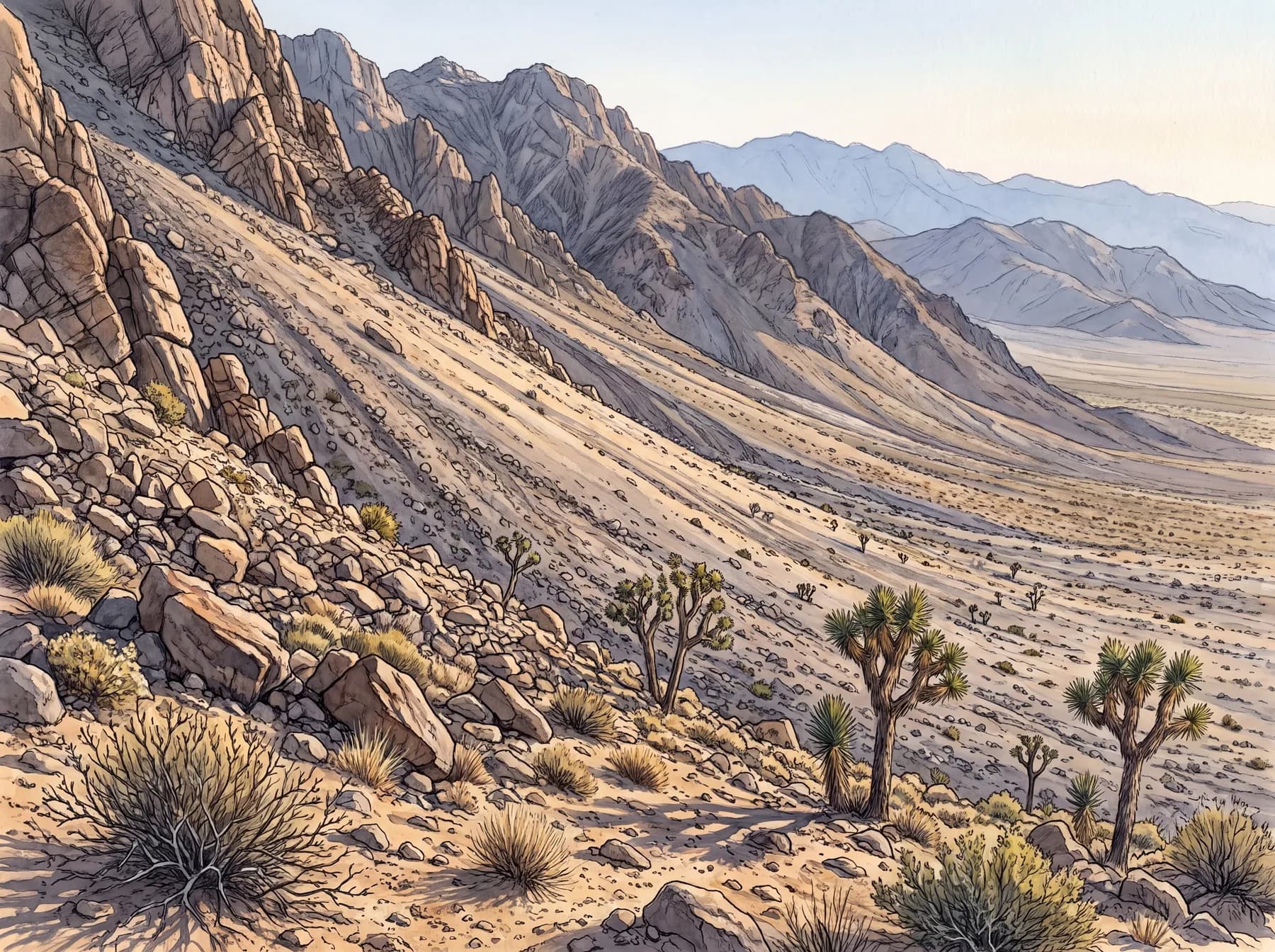
Stand out on this ground and your eye files it as flat. It is not. Leave a ball at your feet and it would roll, slowly, always the same direction, down toward the distant valley floor. A bajada is a gentle slope pretending to be a floor, and once you can feel the tilt the whole desert around it starts to line up.
Here is what you are standing on. A bajada is a broad apron of loose rock and sediment banked along the foot of a mountain range. Every canyon in that range flushes its gravel out of its mouth into a cone, an alluvial fan, and where a long line of those fans grows sideways until they overlap, they merge into one continuous ramp. The Spanish is plain about it: bajada, a descent, a slope. One fan is one canyon's work; the bajada is all of them added together along the range front, which is why it is easy and wrong to call a single fan by the whole apron's name.
The slope is sorted, and a storm does the sorting. When water comes roaring out of a canyon it is carrying everything, and as it spreads and slows it sets that load down in order: the heaviest boulders first, up at the canyon mouth where the push is strongest, then cobbles, then gravel, then sand, then the fine stuff last, far out where the flood has almost died. So a bajada is coarse and steep near the mountains and fine and nearly level toward the valley. The grade you can barely feel is a record of how much water it took to move each grain.
Because the ground changes down the slope, everything living on it changes too. The coarse upper fan drains fast and dries quickly; the fine toe holds moisture longer, and how deep you have to dig to hit hardpan shifts as you go. Plants read all of this and sort themselves into loose bands across the slope without a fence or a line to tell them where. Water, sediment, and even the cold night air drain the same way for the same reason. It is all downhill, and downhill is one direction here.
That gives you a way to read the ground before you dig it. Higher on the bajada means coarser, drier, faster to shed a rain. Lower means finer, wetter, the place runoff gathers. Where the washes split and braid across the apron is where a flood, when one comes, will fan out and spread. None of it announces itself; up on this bench the tilt is too soft to see, and you learn it by grain size and by where the water went last time.
Pour a cup of water on bare ground and watch which way it leaves. That way is downhill, and everything else follows it.