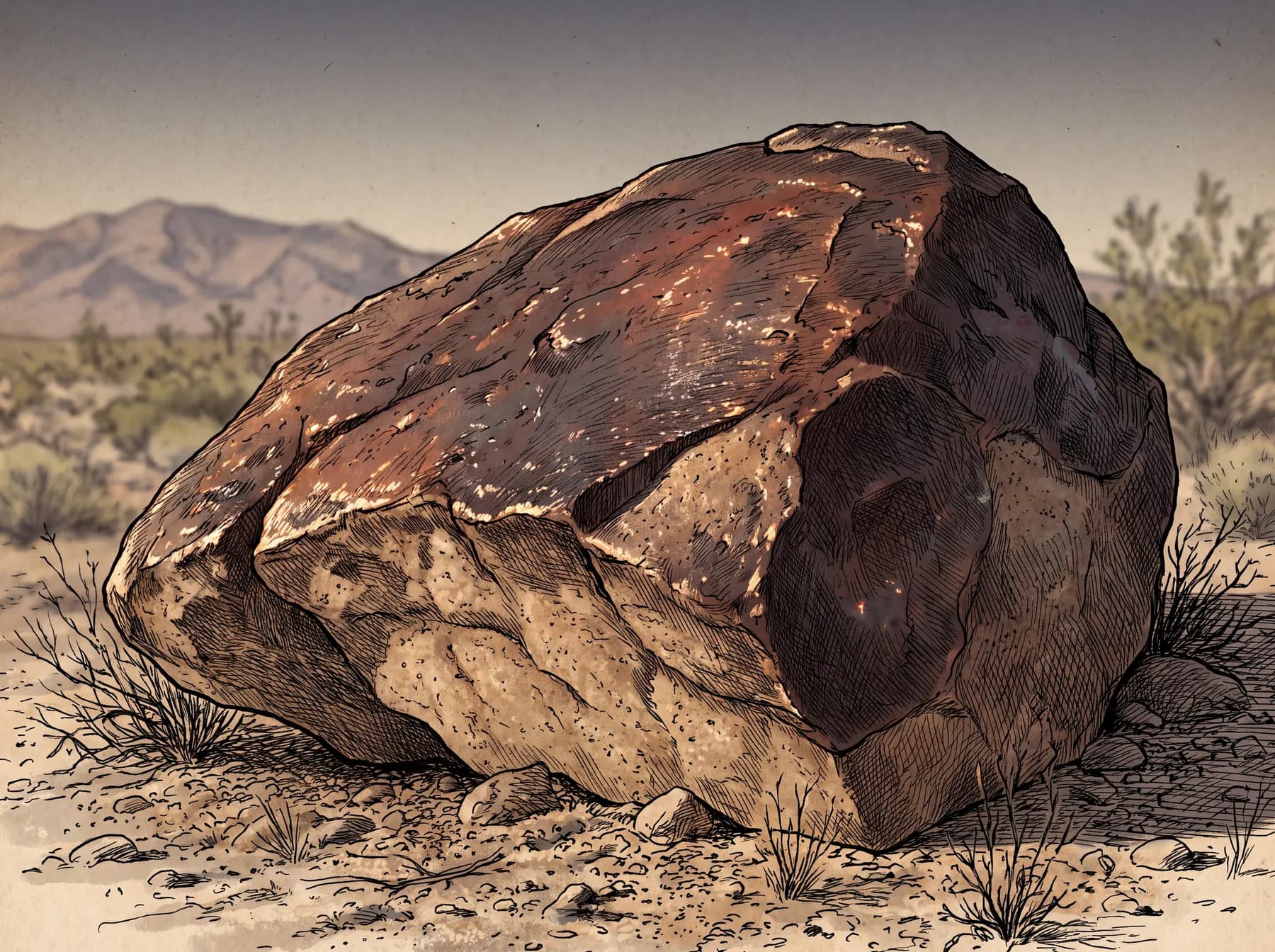
Snap a varnished cobble in two and the surprise is the inside. The outside carries the brown-to-black sheen you see on every long-sitting boulder and on the stones of a desert pavement, dark and faintly glossy. The fresh face is pale, plain, unstained rock. The color was never in the stone. It was painted on from the outside, and it stops at a skin only microns thick.
The easy story is rust, iron weeping up out of the rock and staining it dark. That is not what this is. The metals and the clay that make the coating did not come from the rock at all; they arrived on the wind, as dust, and were fixed onto the surface where they landed. The varnish is mostly clay minerals, up to about 70 percent, with the rest, roughly 30 percent, manganese and iron oxides and a scatter of trace elements. Its color comes from the sky, not the stone under it.
The manganese is the strange part. Measure the coating against both the rock beneath it and the ordinary dust blowing across this ground, and the varnish holds more manganese than either, concentrated well above any background it could have drawn from. Something is gathering it and pinning it in place. How is genuinely unsettled. One camp credits bacteria living on the rock, oxidizing manganese and fixing it there; another argues for plainer chemistry, the clay itself templating the metal out of the dust. No one has fully settled how the manganese concentrates. Both sides can point to evidence, and neither has closed the case.
Whatever does it works slowly. The coating accretes over thousands to tens of thousands of years, which is why it forms only where the ground has held still that long; a surface that washes or tumbles never keeps its skin. So the varnish reads as a clock, a rough gauge of how old a piece of ground is. Darker and glossier means longer exposed, a more stable patch of ground; a paler stone has either turned recently or sits where the surface still moves. Read across a pavement, the sheen tells you where water has let the stones lie.
The same slowness made it a canvas. People pecked through the dark skin to the pale rock beneath, and those lighter marks are the reason so much old rock art is legible at all. It cuts the other way too. Scratch a varnished stone now and the scar shows bright, and it will stay bright for a long time, since the skin that would cover it again takes millennia to grow back.
Break one open. The dark stops at the surface; the inside is pale. Whatever colored it came from the air, not the rock.