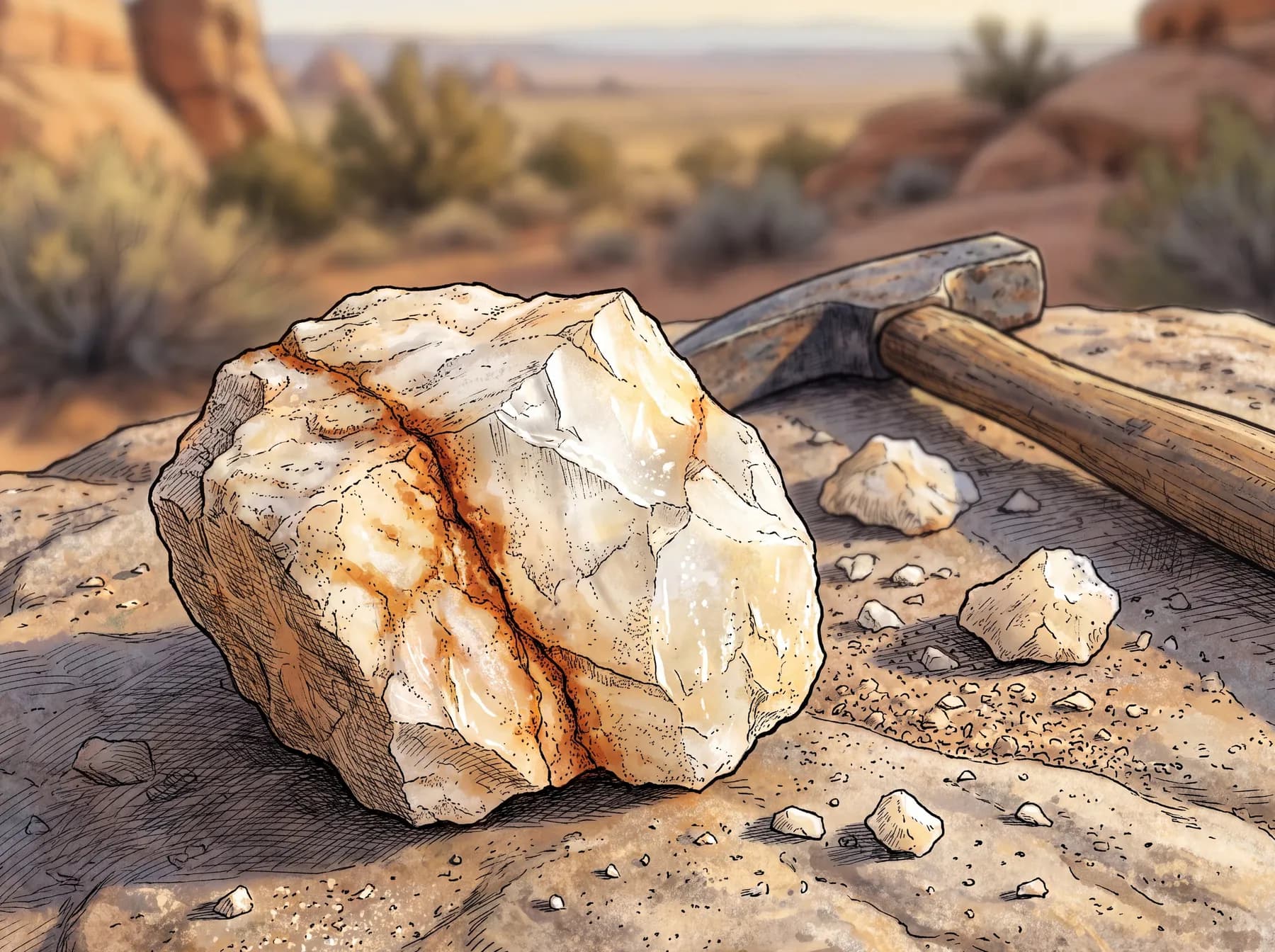
Pick a pale pebble off this bajada and drag it hard across an old truck's window glass. If it leaves a scratch and comes away unmarked itself, you are holding quartz. Almost nothing you turn up on this ground will do that. Quartz sits at 7 on the Mohs scale of hardness, the anchor point of the whole scale, and 7 is high enough that it scores glass and steel while a knife blade slides off it.
The scratch is the test because quartz gives you little else to go on. It is a plain mineral: milky white to clear to smoky, a greasy-to-glassy shine, and no crystal drama unless it grew into an open pocket, where it takes a six-sided form. It has no cleavage; strike it and it breaks in curved, shell-like faces, a conchoidal fracture, the way thick glass chips rather than splitting flat. That last detail separates it from feldspar, which is only a little softer at 6 but breaks along flat cleavage faces that catch the light. Calcite and gypsum you rule out faster still: a nail scratches them, and nothing common scratches quartz.
That durability is the real reason quartz matters here, and it has little to do with any single stone. Quartz is not only hard, it is chemically stubborn, so it barely weathers while the minerals around it rot in the dry heat and the rare rain. When a granite breaks down, the feldspar and mica turn to clay and wash away, and the quartz does not. It stays behind as grit. Most of the pale sand and gravel spread across this bajada is quartz grains, and most beach and dune sand in the world is the same: the durable survivor outlasting everything softer that once stood beside it.
Step back far enough and that one habit explains much of the planet's surface. Silicon dioxide is the most abundant single mineral in the continental crust to begin with, so a great deal of it enters the grinding mill of weathering; and because it comes out the far end nearly unchanged while its neighbors dissolve, it accumulates. The world's sand is not a record of what the rock was made of. It is a record of what would not break. Its hardness and chemical indifference are also why quartz becomes window glass and the small timekeeping crystal in a cheap watch, but that is a footnote to what it does here: it stays.
You can watch the sorting in a single handful of decomposed granite, the crumbling pinkish-grey rock that fills the washes here. Rub it apart and the soft grains give first; what is left rasping in your palm is the quartz, the glassy framework of the granite reduced to loose sand. The mountain does not fall apart evenly. It falls apart at the speed of its weakest mineral, and quartz sets the pace by refusing to keep it.
Next time, wet a handful of that pale wash sand and look close: the clear glassy grains that will not dull are quartz, still winning.