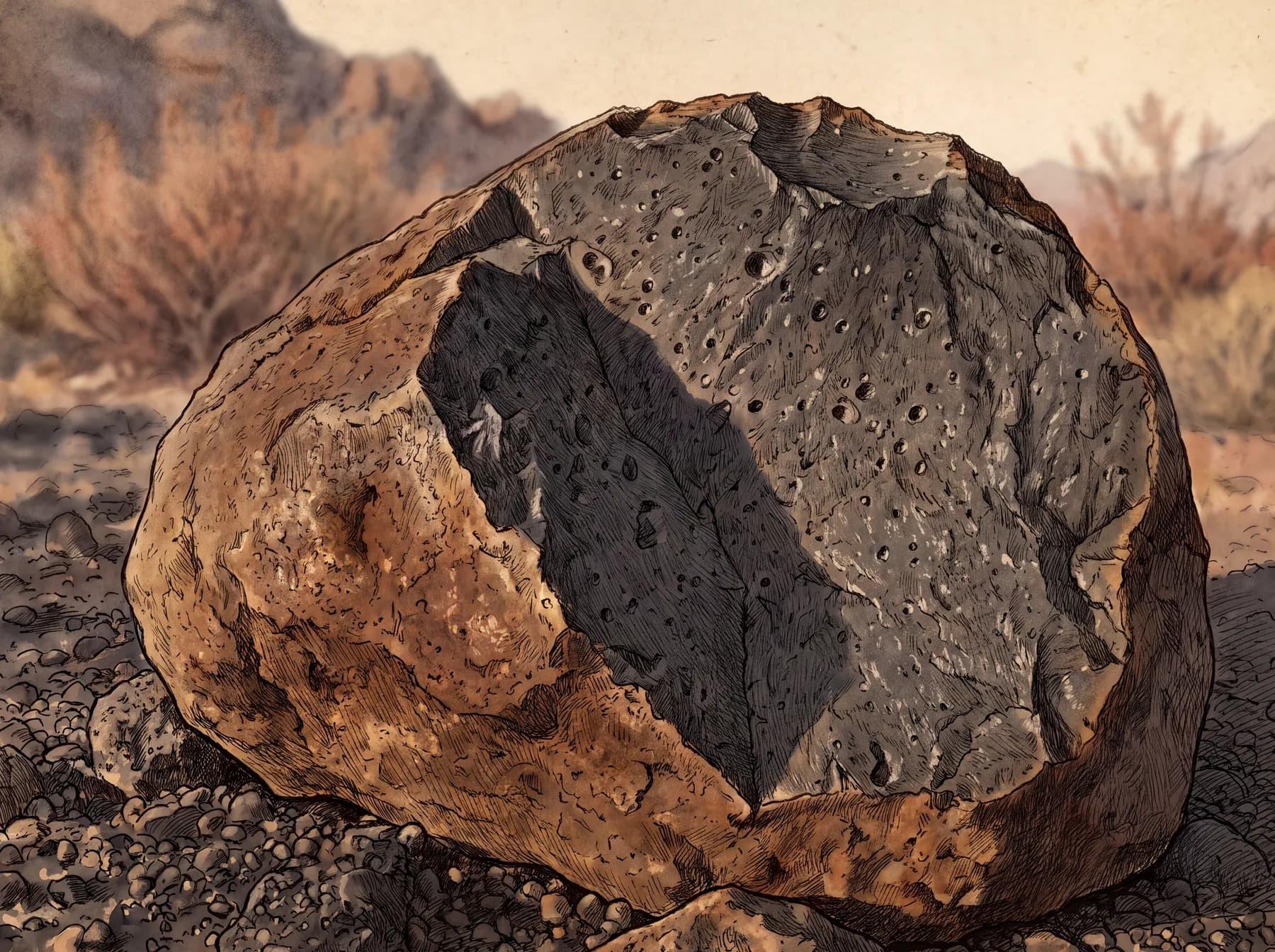
Pick up one of the dark rocks scattered across this bajada and the first thing to notice is what you cannot see. It is heavy, smooth, close to black, and where it has broken fresh the surface is dull and even, with no crystals to catch the light. That blankness is not the rock keeping a secret. It is the rock telling you how it was made.
Basalt is lava that cooled in a hurry. When it erupts at the surface and freezes there, the melt has no time to organize itself into crystals large enough to see, so it locks up fine-grained and dense, its structure too small for the naked eye to resolve. Geologists call rock that forms this way extrusive, meaning it set at the surface rather than far below it. It is the commonest volcanic rock on the planet, the stuff that floors the ocean basins, and here it built the flows, mesas, and cinder fields of a volcanic country.
The clean way to understand it is to hold it against its opposite. Granite carries the same broad ingredients but wears them differently: speckled, coarse, its crystals visible to the eye, because it cooled slowly, deep underground, with all the time it needed to grow them. Same recipe, a different history, and the difference is written in one thing you can read without a lens. Grain size is the fingerprint. A dark, heavy, smooth rock with no visible crystals cooled fast at the surface; a speckled, coarse one cooled slow and deep. You can read a rock's whole life off how big its crystals grew.
There is a cousin worth not confusing it with. Where the lava froze while it was still gassing off, it can set full of bubble-holes, light and pocked, grading into scoria. That one is airy where basalt is solid, and it will not fool your hand the way a piece of dense basalt does. Weight and a tight, even break keep the two apart.
Basalt also weathers dark and slow, and it takes a coat. Its boulders are the classic canvas for desert varnish, the thin manganese-and-iron skin that darkens exposed desert stone, so an old flow reads blacker the longer it has sat under the sun. And dark ground does what dark ground does. A basalt surface heats hard in the sun and holds that heat, a real piece of the small climate a seedling or a lizard meets at the ground.
Break one open. If the fresh face is dull and even, with nothing glinting back, the rock cooled fast at the surface.