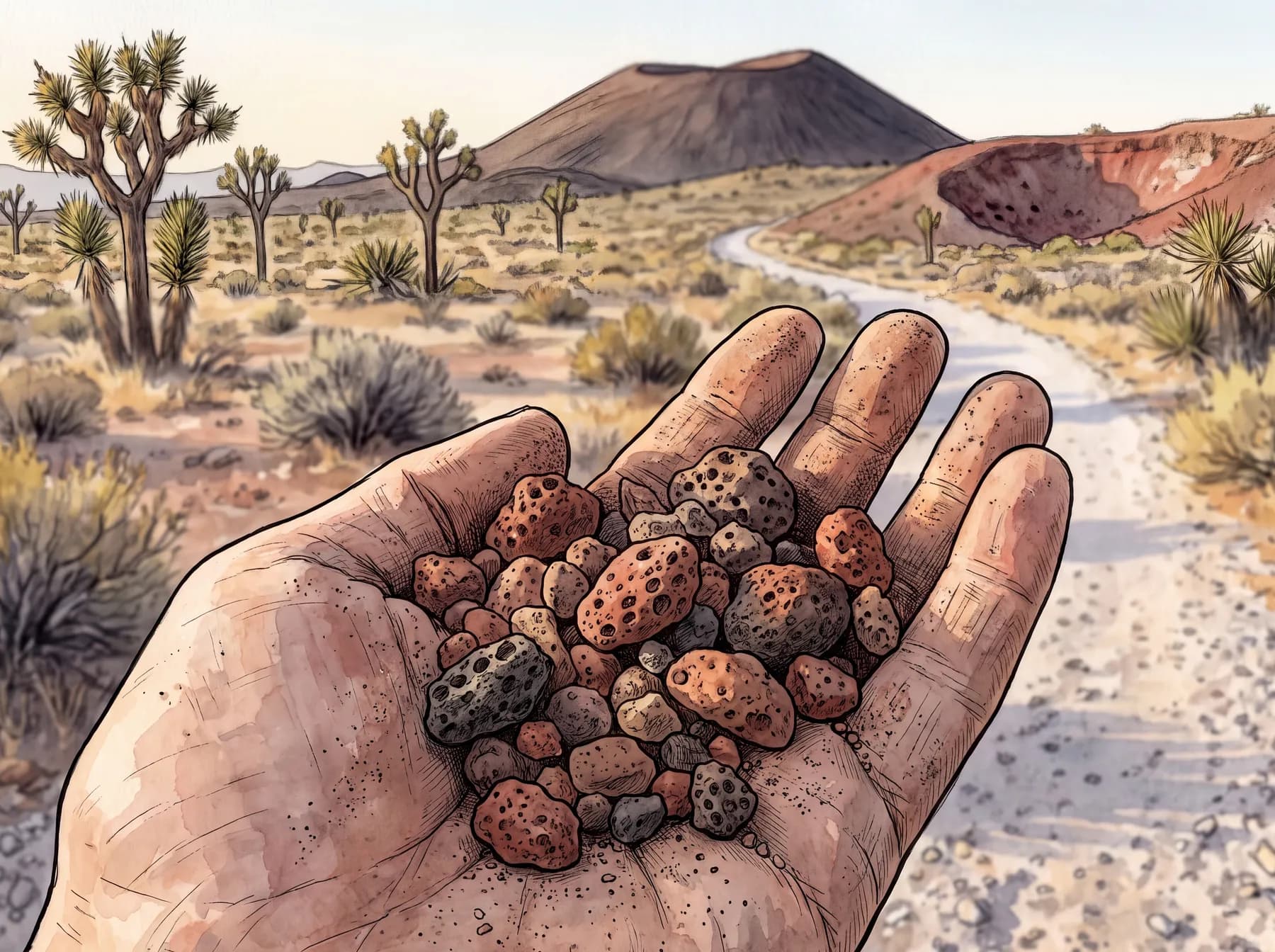
Grab a chunk of cinder and the surprise is in your hand before your eyes catch up. It is dark, rough enough to scrape skin, sometimes rusty red, and far too light for a rock that size. Scoria, which is the same thing geologists call volcanic cinder, is riddled with holes, and the holes are the whole story.
They are frozen bubbles. As magma rises toward an eruption, the gases dissolved in it come out of solution and form bubbles in the molten rock, the way a shaken bottle fizzes when it is opened. When a thrown blob of that frothing lava cools fast in the air, the bubbles freeze in place as cavities, called vesicles, and the rock sets full of them. That is why scoria is so light for its size and so sponge-rough to the touch.
So it is really basalt that foamed. It has the same dark, basaltic composition as a solid basalt flow, but where basalt froze dense and smooth, this erupted gassy and set full of air. Often its surface is oxidized to a rusty red. And instead of pouring out as a solid flow, it is flung out as loose clasts that pile up around the vent into a cinder cone, which is how a whole cinder field gets built.
Telling it from its solid cousin is a matter of weight and break. A dense, heavy, smooth-breaking dark rock is basalt; a dark rock so full of holes it feels half empty is scoria. Hold one of each and your hand makes the call before your eyes do; the holes never lie.
It has an honest practical use, too. Cinder is naturally light and free-draining, which is why it gets quarried for road base, traction grit, and desert landscaping. On the dry ground it is also a clue to the country's fire: a scatter of light, holey, rust-and-black rock means a volcanic source is somewhere near.
Heft the next dark rock you find. If it weighs almost nothing and looks chewed full of holes, it is cinder, and it froze mid-fizz.