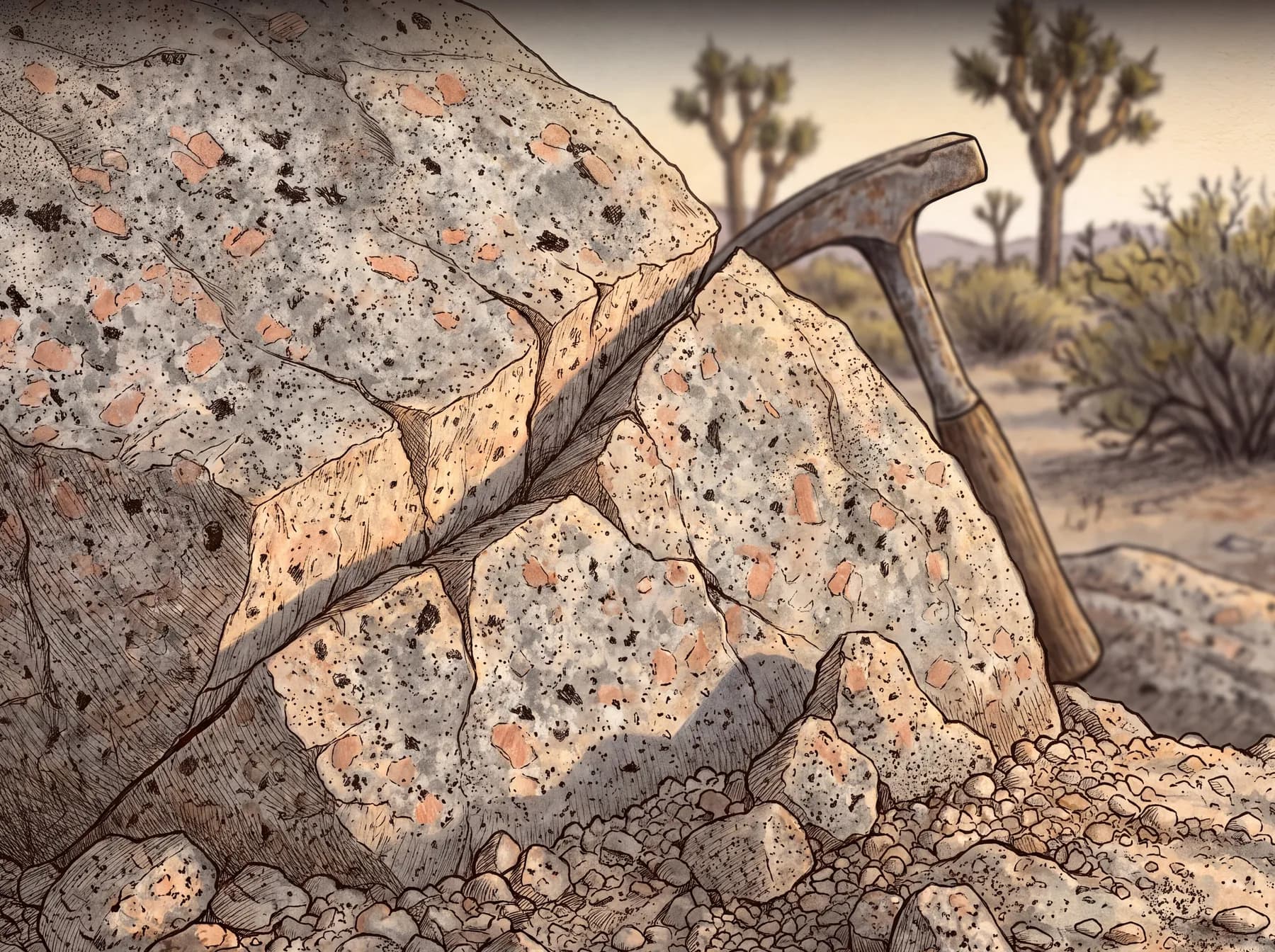
Lift a piece of the pale, speckled rock that builds the desert's boulder stacks and you are holding several minerals at once. Granite is a coarse mix of glassy grey quartz, blocky pink or white feldspar, and glittering flakes of mica, and the striking thing is that you can see every one of them with the naked eye. That visibility is not a small detail. It is the rock telling you where it was made.
Big crystals mean slow cooling. Granite is what geologists call intrusive: it forms when a body of molten rock cools slowly, deep underground, over a very long time, which gives each mineral the time it needs to grow into a crystal large enough to see. That is the exact opposite of basalt, which is the same broad family of material erupted and frozen fast at the surface, its crystals too small to make out. Same ingredients, wholly different histories, and the size of the grain is the fingerprint that tells them apart.
Then the desert takes it apart again, grain by grain. Out here the hard temperature swings and the different minerals expanding at different rates loosen the crystals along their boundaries, and the feldspar and mica weather faster than the stubborn quartz. So a granite outcrop granulates in place into a coarse, gritty sand of its own loosened crystals. That crumbled material has a name of its own, decomposed granite, or grus, and it is the pale grit you find aproned around the base of every granite hill.
The two together explain the classic desert boulder pile. As the outer rock rots to grus, the rounded, sounder cores are left behind, stacked and balanced, sitting in beds of their own crumbled grit. What survives longest in that grit is the quartz, because it is both hard and chemically stubborn, which is why so much of the pale sand and gravel washing down the bajada is quartz outlasting everything softer that grew beside it.
It is a practical rock, too. Decomposed granite is the desert's own free gravel, the natural surface for a path or a pad, quarried by the hills themselves as they come apart. Where it collects is where the mica flashes in the sun and the quartz grit gathers underfoot.
Read the grain to read the history. Big visible crystals mean a desert rock that hardened slowly, miles underground.