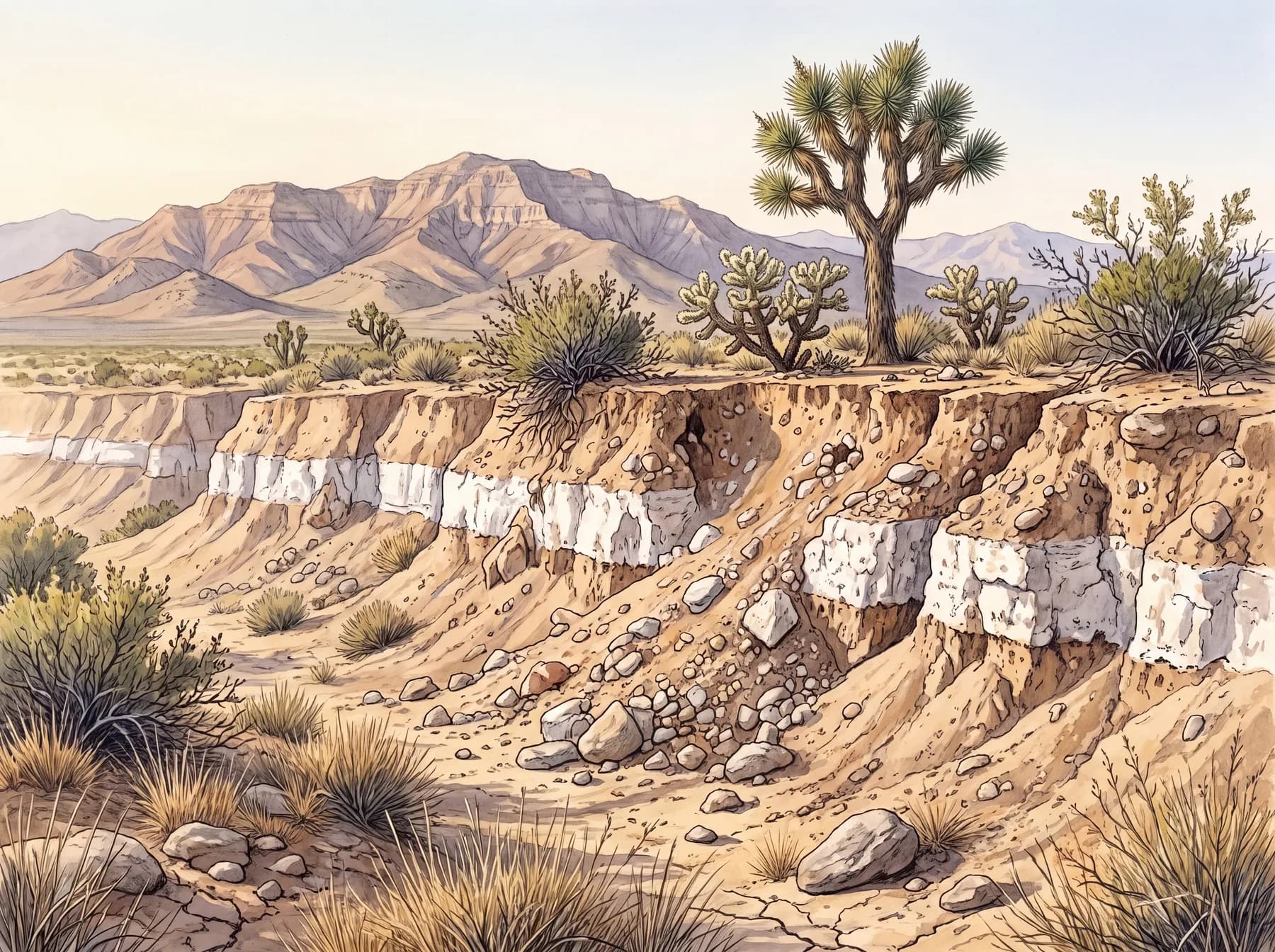
Dig a planting hole here and somewhere down in the loose soil the shovel stops as though it hit rock. It has not hit rock. It has hit a pale, cemented layer that a fence-post auger fights the same way, and the honest thing to say about it is that it is not a stone at all. It is soil that has been glued together by rain.
Caliche is a subsurface crust of calcium carbonate — the same chalky compound as limestone — that binds sand, gravel, and soil into a concrete-like hardpan. Soil scientists call it a petrocalcic horizon, or calcrete, or duricrust; the shovel just calls it the layer you cannot get through. What matters is where it comes from, because it is not a formation laid down from below. It grew in place, from the top down, over a long time.
The mechanism is a plumbing problem. With only a few inches of rain a year, water sinks into the ground carrying dissolved calcium, but it never soaks deep enough to flush that calcium out of the soil entirely. It gets partway down and stops. Then the desert heat pulls the moisture back upward to evaporate, and the calcium it was carrying has nowhere to go, so the carbonate precipitates and collects at one specific depth: as far as the water reliably reaches, and no farther. Do that for thousands to tens of thousands of years and the carbonate cements everything at that depth into hardpan.
Which is the part worth carrying home. The depth of the caliche is a rain gauge frozen in the ground. The layer sits at the average depth this desert's rain penetrates, so its position is a physical record of how little water ever gets into the soil here. Researchers working in Mojave soils put the major carbonate deposition around 20,000 years ago, in the late Pleistocene, accumulating at something like 1.0 to 3.5 grams per square metre per year. That is the pace of the glue: a rock you could not chip, assembled a fraction of a gram at a time.
It changes what the ground can do. Roots reach the hardpan and stop, the way the shovel did. Water reaches it and stops too, pooling above the layer instead of draining, so a hole dug into caliche can hold rainwater like a bucket and drown whatever is planted in it. This is why a planting hole here is real work, and why the depth of the layer, not the look of the topsoil, decides what a slope can grow. It ties to the bajada above it, where the caliche runs in depth bands down the slope.
Do not mistake it for bedrock underfoot, and do not confuse the pale crust with the dark stain of desert varnish on exposed rock. Caliche is soil that ran out of rain to move it.
Dig until the shovel stops on something pale and unbroken; that is the layer, and the depth is the reach of the rain.