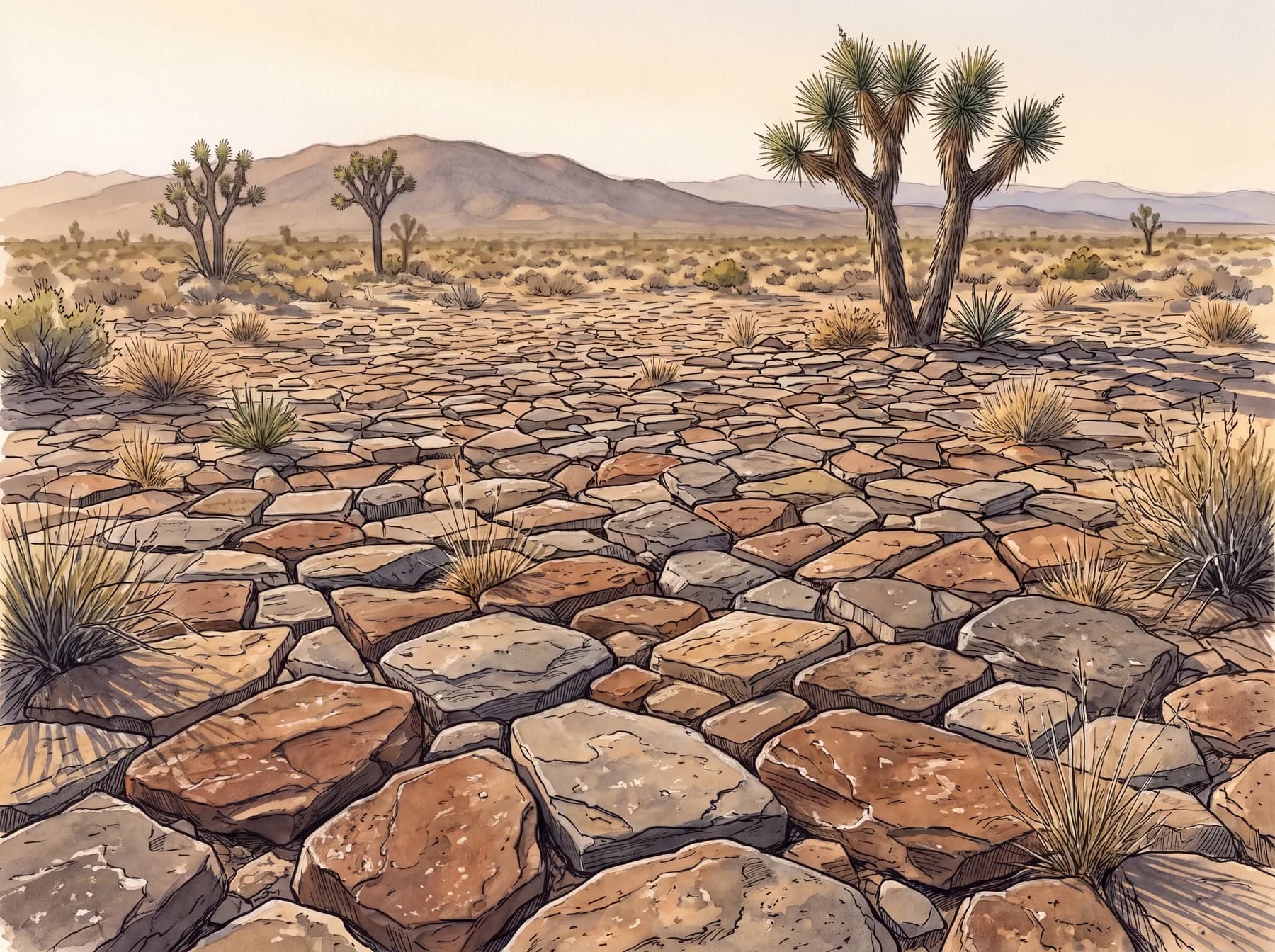
The ground here can go oddly tidy. Across the older flats it sets into a close mosaic of pebbles, packed edge to edge and usually just one stone thick, so tight that little grows through it. Walk from loose gravel onto one of these desert pavements and you can feel the change through your boots: the surface stops shifting and starts holding, an armored skin laid over the fan. The obvious story is that the wind did it, scouring away the fine dirt and leaving the heavy stones behind as a lag. That story is old, and it runs backward.
The better-supported model turns it upside down. The pebbles were at the surface first, and they mostly stayed there. What moved was the dust. Wind carries fine silt across this desert without pause, and where a stone lies the silt sifts down into the cracks and settles beneath it, grain by grain, until a layer of fine, often salty soil builds up under the pavement and lifts it. The stones did not climb, and the wind did not blow the dirt out from under them. The dust came down; the ground rose under the stones.
That is a slow way to build anything. Pavements, and the dark varnish that forms on their stones, develop over roughly 10,000 to 100,000 years. So a well-set pavement is not just a surface — it is a record of tens of millennia in which nothing tore this ground open. The stones have had that long to settle flush, to darken, to lock into each other like a floor no one grouted. Read that way, the tidiness is age.
Which is also why a pavement is easy to wreck and all but impossible to replace. Drive a tire across one, or scuff it with a boot heel, and you break the interlock and expose the pale soil underneath. On any timescale that matters to a person, it will not re-armor; the scar can sit there for decades, a bright line across the dark mosaic. A pavement is a clock and a seal at once, and the seal only works unbroken.
So learn to read it before you cross it. Darker, glossier stones set flush like tile mean an old, stable surface that has earned its varnish. Loose, pale, jumbled gravel means young or disturbed ground, the kind something recently crossed.
Kneel where the stones lie flush and dark and locked. That mosaic took longer to make than anything you could put back.