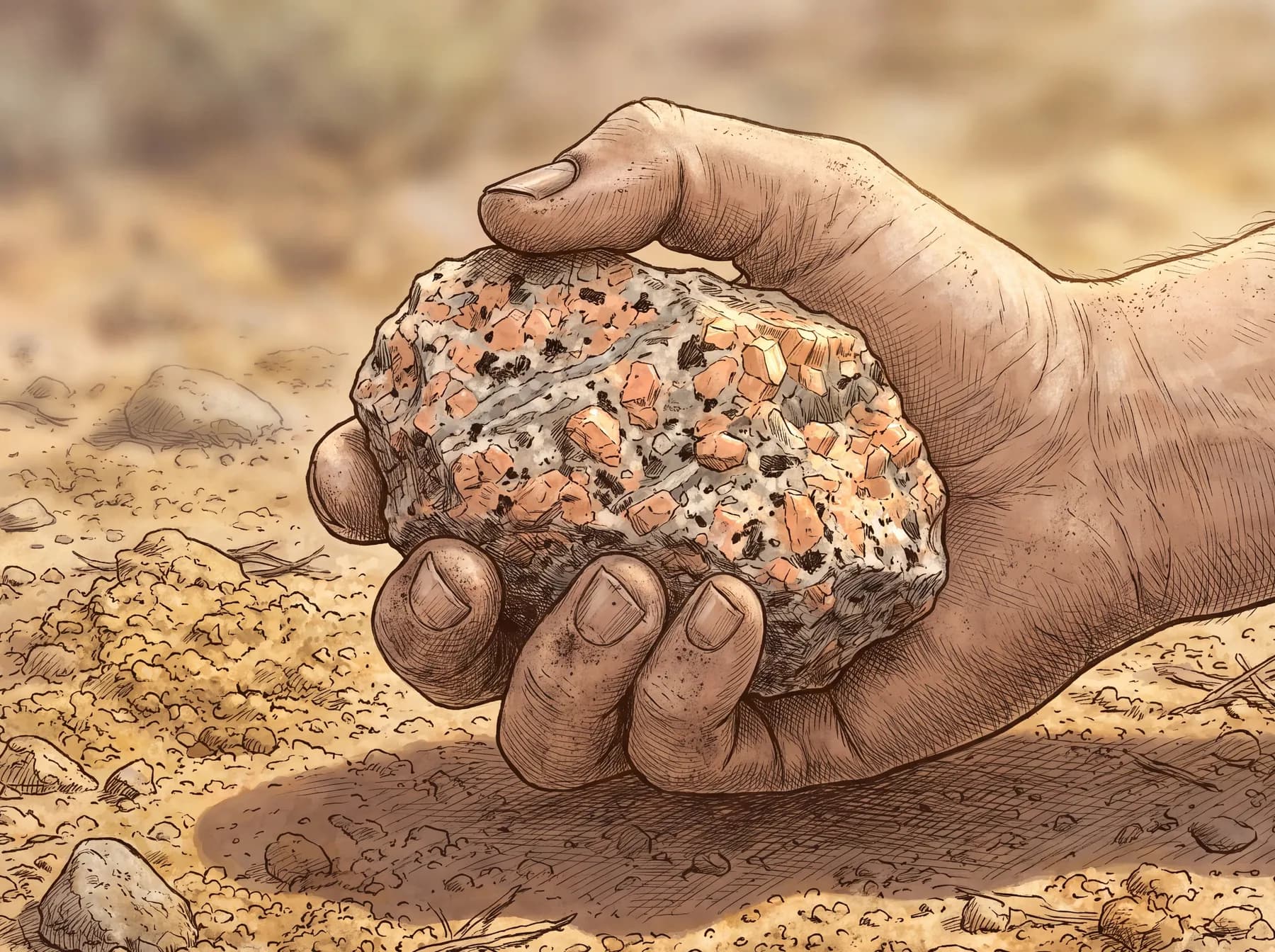
The pink in a granite boulder is not a stain, not sun-baking, not lichen. It is a mineral, and it is the most common one in Earth's crust. Feldspar sets the color of the rock: the blocky pink or grey grains are feldspar, the glassy grey specks are quartz, the shiny flakes are mica. Most of what looks like plain granite out on this bajada is mostly feldspar wearing quartz and mica as trim.
Calling it one mineral is the first mistake. Feldspar is a group, a family of aluminum-silicate minerals carrying potassium, sodium, or calcium in place of one another. The potassium kind tends to run pink; the sodium-to-calcium kind, called plagioclase, runs white to grey, and sometimes shows a face ruled with fine parallel lines, like the ghost of a comb dragged across it. You do not need to sort the chemistry to read the rock. You need to tell feldspar from quartz, and that is a thing your eye can do.
Here is the test. Pick up a chunk of granite and turn it in the sun. Feldspar breaks along two flat directions set at right angles, so it splits into little blocky pieces with flat, shiny faces, and as you turn the rock those faces catch the light and flash, then go dark, then flash again. Quartz does none of that. It breaks in curved, glassy scoops with no flat faces to throw the light. Feldspar has a hardness of about 6, enough to scratch glass; quartz, at 7, will scratch the feldspar right back. Flat faces that flash, and a mineral that yields to quartz, those two things name it.
The interesting part is what happens next, which is that feldspar does not last. It is the most abundant mineral here and also the least stubborn. Quartz is nearly inert; it shrugs off water and time and ends up as sand. Feldspar is chemically less stubborn. Given water and enough years it rots; the aluminum-silicate breaks down into clay minerals. So when a granite boulder finally comes apart, it comes apart into two fates: the quartz survives as pale sand, and the feldspar becomes clay. Sand and clay, born in the same rock, walking away from each other.
That split is the desert's soil being made. The ground underfoot is sand and clay in some ratio, and much of that ratio was decided grain by grain when the feldspar in a rock became clay while the quartz beside it refused. The rock does not vanish. It sorts itself into the two things a shovel turns up.
So the most common mineral on this ground is also the one you are least likely to pocket. There is nothing to collect. Feldspar is not a specimen; it is the rock, and then it is the dirt. Understanding it is close to understanding what everything here is made of, and what it is quietly turning into.
Look at a pink granite boulder, then the pale sand at its base. You are watching one mineral at both ends of its life.