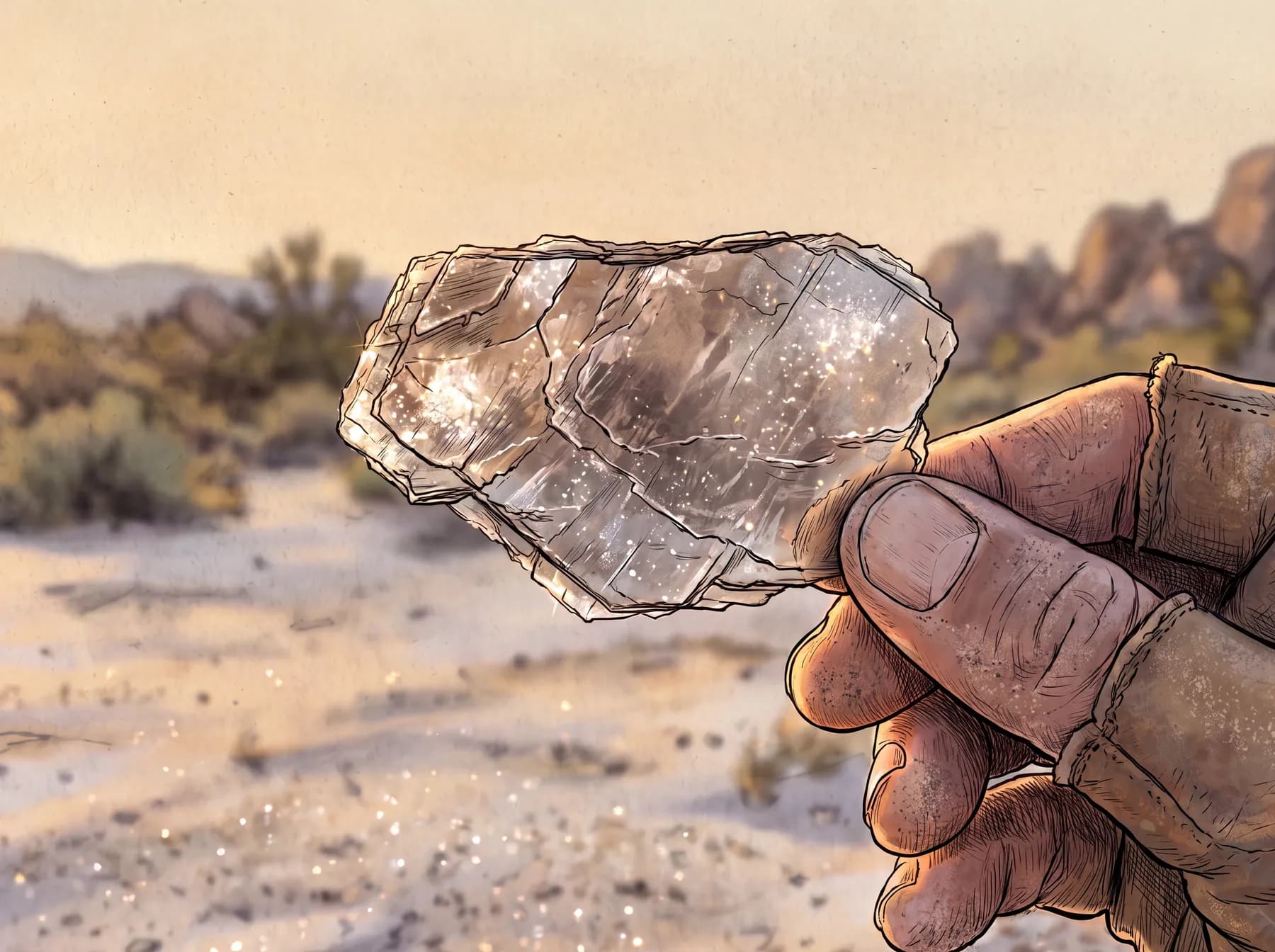
Mica catches your eye at the wrong scale. Walk a sandy wash in low sun and the ground throws back little flashes, bright points that wink out when you move and light up again when you stop. From a few steps off it reads like something valuable is lying loose in the grit. It is the oldest false alarm in the desert, the glint people once mistook for gold.
Pick one of those flashes up and it nearly vanishes, a flake small enough to lose against your own fingerprint. The flash was never gold and never crystal. It was flat faces catching the sun, a scatter of tiny mirrors turning as you walked past. If the piece is big enough, set a fingernail to its edge and peel. Mica splits. It comes apart in paper-thin, flexible, near-transparent sheets, one clean layer after another, springing back when you bend them. Nothing else on this ground does that. Quartz breaks in curved glassy fractures and feldspar in blocky steps, but mica peels like the pages of something. That one perfect cleavage is the whole identification.
It is also the softest thing in the rock it came from. Granite is built mostly of three minerals, and you can rank them by what scratches what: quartz at 7, feldspar at 6, and mica down around 2 to 3, soft enough that a fingernail at about 2.5 marks the pale kind. That weakness is not a flaw in the mineral. It is the mineral. Mica is stacked in flat molecular layers held together loosely in one direction, so it cleaves where the stacking is weak and holds firm every other way.
Those clear, springy, heat-proof sheets had a job before window glass was cheap. Split thin, a good muscovite sheet is transparent and will not melt or crack when it gets hot, so people glazed stove doors and lantern faces with it and called it isinglass. A mineral you can flake apart with a fingernail was, for a while, the pane you watched a fire through.
Out here the flakes are granite taking itself apart. Mica grows as little stacked books in slow-cooled granite and in the coarse pegmatite that runs through this county's decomposed granite, silvery muscovite and dark brown-to-black biotite both. Find loose flakes glittering in the sand and you are not finding treasure. You are finding the mountain in transit, one soft page at a time.
So the test is simple. If the sparkle bends and peels under a fingernail, it never was gold. It was the granite, coming apart.