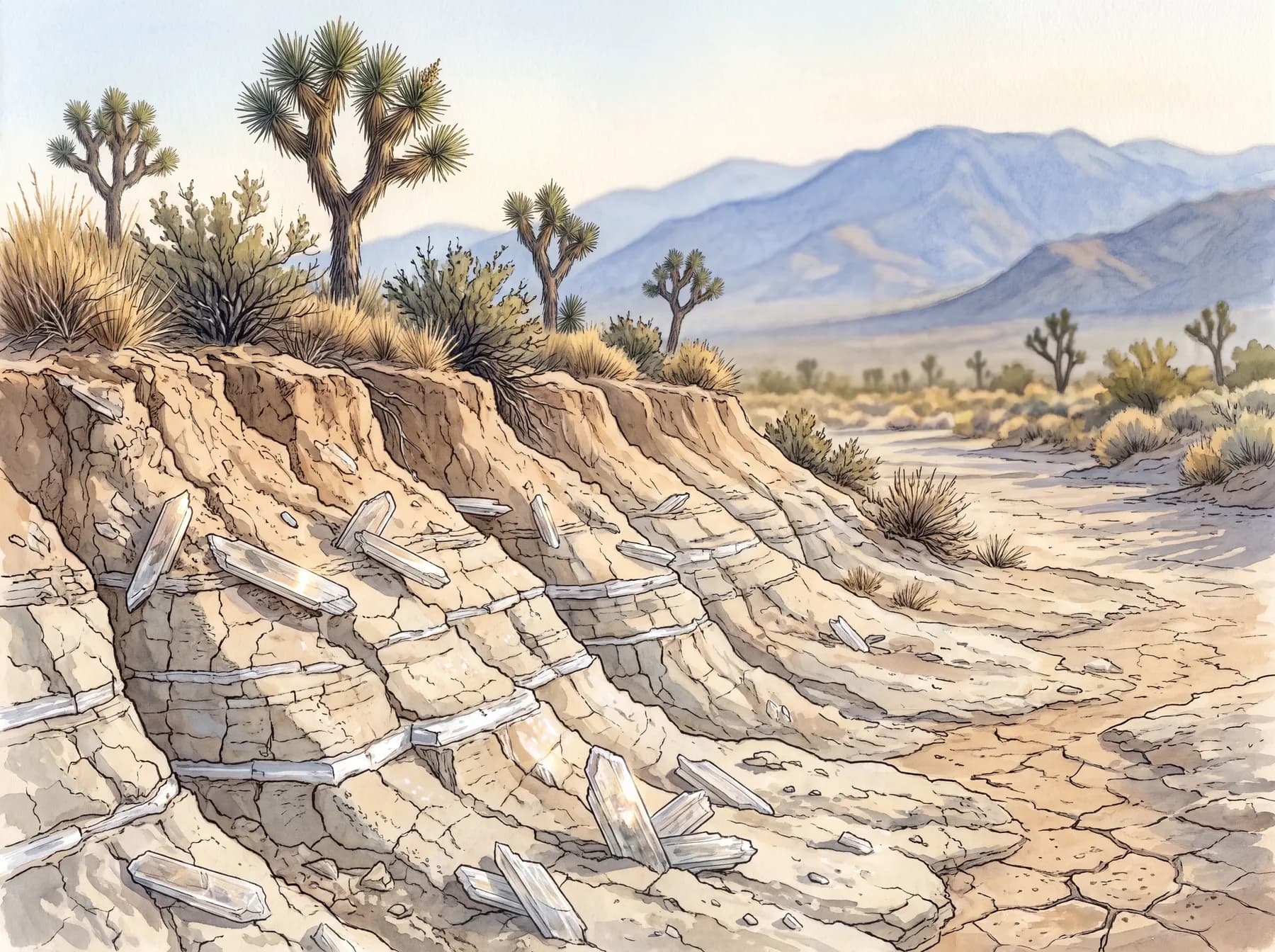
Most stones shrug off a fingernail. Gypsum does not. Drag a nail across a pale, glassy-to-satiny blade of it and you come away with a faint scratch, and that scratch is very nearly the whole identification. No common harder mineral in the desert will let you do that.
The reason sits at 2 on the Mohs hardness scale, the ladder geologists use to rank what scratches what. Quartz, the hard glassy grit that fills half the sand around here, sits at 7. Gypsum is its soft opposite, one of the softest stones you will ever pick up. Its chemistry is hydrous calcium sulfate, written CaSO4·2H2O, and it is the same material pressed into drywall and plaster of Paris. In thin sheets of clear selenite it will even peel or bend a little before it snaps.
It comes in a few looks worth learning. The clear bladed crystals are called selenite. A fibrous form with a soft silky sheen running along its length is satin spar. And where the crystals grow up around loose grains, they fan into a rosette, a desert rose, with the sand still caught inside the blades. All three carry the same giveaway softness.
That softness has a history. Gypsum is evaporation made solid. It forms where sulfate-rich water collects in fine clay and playa mud, stands, and dries, dropping the dissolved mineral out of solution as crystals. This is the same slow concentration that cements caliche underfoot and lays pale salt crusts across a dry flat, except here the water left its leftovers as clear glassy blades rather than hardpan. Pick up a piece and you are holding a record of standing water that is long gone.
Which is why it pays to know where not to look. Gypsum does not sit loose on the gravel the way scattered quartz points do; it grows inside the sediment itself. Look instead along an eroded clay cutbank in a wash, where flat blades and silky satin-spar seams weather slowly out of the dirt, embedded and half-exposed as the bank crumbles away. The crystal did not roll in from somewhere upstream. It grew where you found it, and the clay grew it.
The desert rose adds one honest trap. This county has two of them, and the difference is all in the hand. A barite rose is heavy and a touch harder, 2.5 to 3.5 on the same scale. A gypsum rose is light, and soft enough that a fingernail marks it. Same rosette shape, opposite feel.
So the test stays simple. Find a pale blade in a cutbank, set a nail against it, and watch for the scratch.