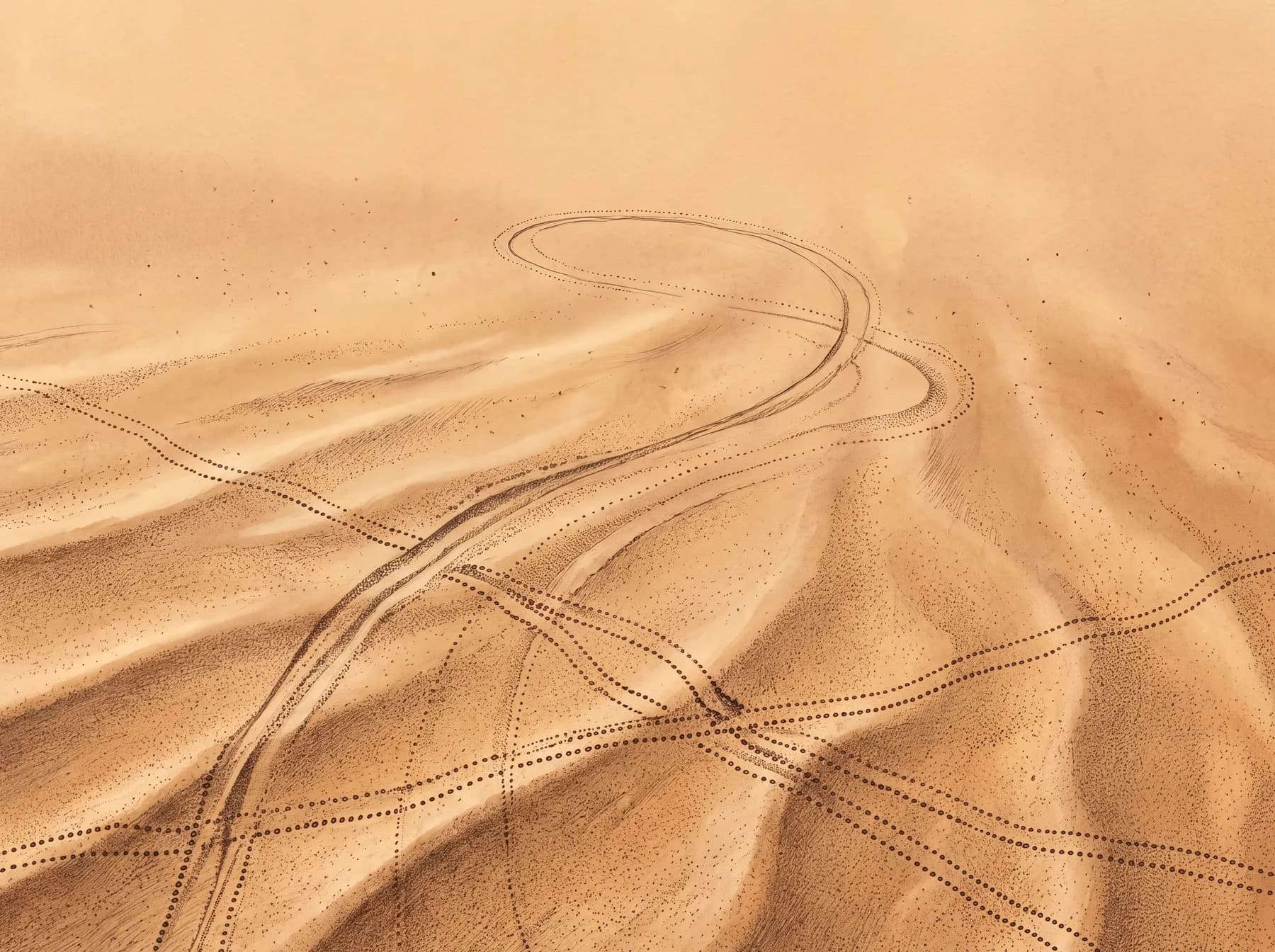
Come to a patch of wind-smoothed sand at first light and you may find it stitched overnight with faint rows of little dots, sometimes a single hairline running down the middle between them. By mid-morning it will be gone. The marks sit only a grain or two deep, so the low raking light of dawn is what makes them legible at all; the overhead sun flattens them, and the day's wind erases the rest. This is a report you have to read early.
The first cut is not the shape but the count. Insects register six legs; the arachnids (spiders, scorpions, and solifuges) register eight. That sounds cleaner than it reads on the ground, where feet land in clusters and a trackway rarely lays out a tidy row to be counted. Still, it is the honest place to start, because the tempting shortcut, that hairline down the middle, is the least trustworthy mark of the lot.
The cleanest and commonest maker is a darkling or pinacate beetle. It leaves two neat rows of paired prints, narrow and evenly spaced, and often a fine belly-drag line down the midline between them. One field description calls it a banana with a small circle above, a tail mark running between. On firmer sand the drag lifts off and you get a clean two-track with no line at all. Learn this one first; most of what you find will be some version of it.
The eight-legged tracks are where a neat rule turns on you. A tarantula or large spider walks a wide trackway, its legs landing as clusters of up to four small dots on each side, with no drag down the center. A scorpion carries eight legs too, so its side-prints look much the same, four or so to a side. The one mark that could tell them apart is a telson drag, the trace of the tail. But a scorpion holds its tail up, so the drag shows only sometimes, on loose dry sand or at a slow walk. Finding it confirms a scorpion. Not finding it rules out nothing.
Not every sign is a set of prints. An ant highway is a continuous cleared lane worn from the nest, a few millimeters to a couple of centimeters wide, with no footfalls in it to read. And before you trust any of this to an invertebrate, rule out the larger walkers on this ground: a lizard leaves alternating five-toed clawed feet with a continuous tail drag, its feet plainly wider than the trail itself; a bird leaves thin three-toed prints, widely spaced, with nothing running down the middle. Big clawed feet and a tail is a lizard; minute paired dots is not.
So go at dawn, kneel with the light low across the sand, and count the legs before you trust the line. The line lies.