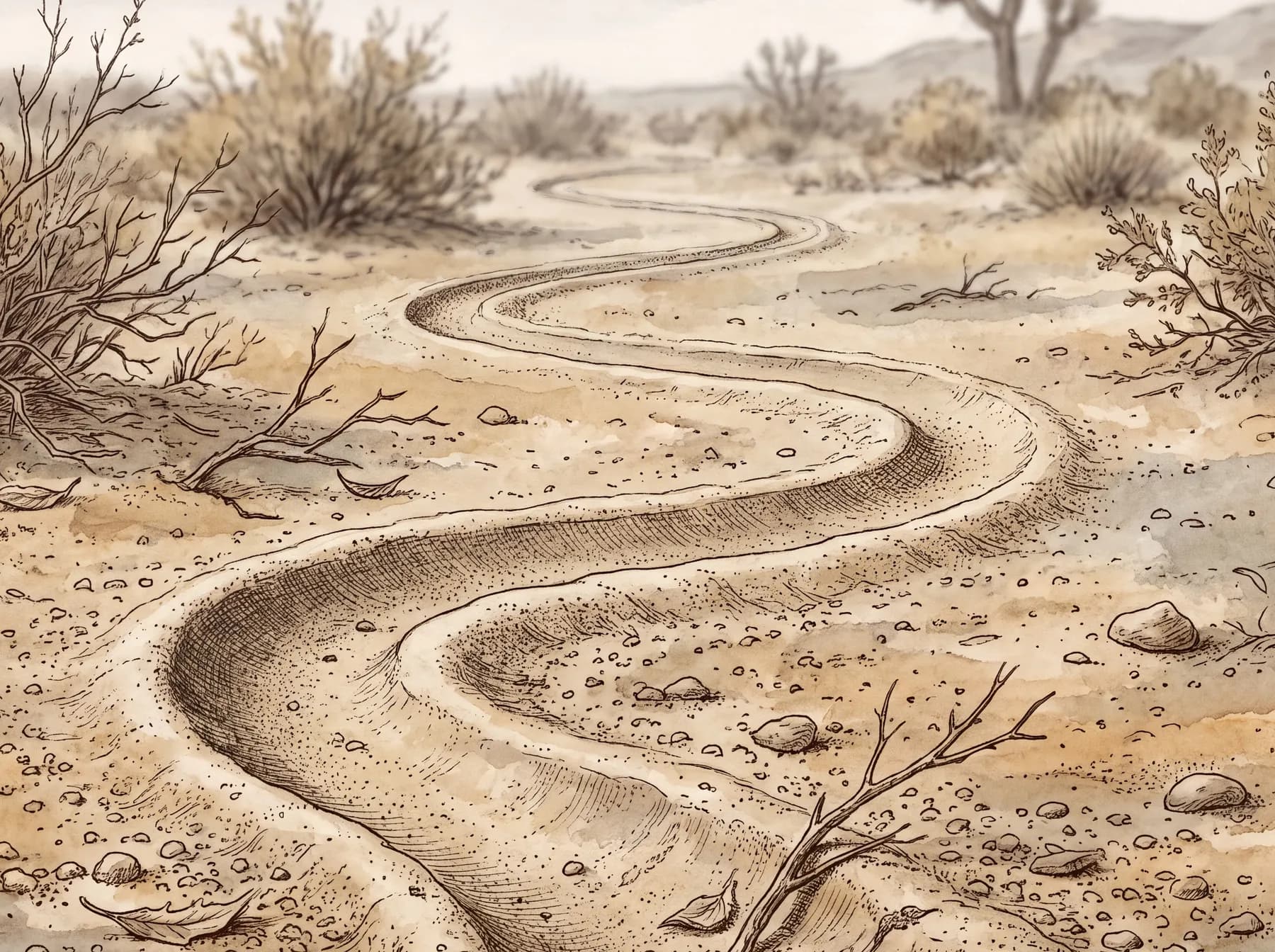
A line comes across the sand with nothing walking beside it. That is the first strange thing to settle in your eye: a track, clearly, a continuous groove pressed into the dust, and no feet anywhere along it. Most animals sign the ground with prints, spaced steps you can count. A snake signs it with the whole body at once, and the absence of any footprint is not a gap in the evidence. It is the evidence. Legless, the animal has nothing to print but its length.
Read the shape next. An ordinary snake moves by lateral undulation, throwing its body into an S and pushing back against the ground, so the trail comes out as one connected, wavering line, a single sinuous furrow that never breaks. This is the clean distinction from the sidewinder, which leaves the sandy flats covered in separate, disconnected J-shaped bars set at an angle, never joined. Continuous wavy line, an ordinary snake. Row of disconnected bars, a sidewinder. The test is only whether the marks join: one connected body, or a series of separate touch-downs.
The furrow will tell you two more things, and refuse to tell you a third. Its width is roughly the thickness of the body that made it, so a faint thread means a small snake and a broad, deep furrow means a big heavy-bodied one; the largest may crawl in a straighter line, dragging rectilinearly rather than waving. Look at the edges under low light. Substrate gets pushed up on the side opposite the direction of travel, so the piled sand marks the push-off, and the animal went away from the mounded side. In fine dust, raking a flashlight or a low sun across the groove can even pop the faint cross-texture of belly scales.
What the line will not give you is a name. There is very little published on identifying snake tracks to species, and for good reason: a gopher snake and a rattlesnake, moving the same way, leave essentially the same groove. Size narrows it a little. Everything else the trail keeps to itself.
Two other signs are worth more than the line. A shed skin — papery, translucent, often turned inside out and snagged on brush or a rock or the mouth of a burrow — is direct proof a snake used that spot. And a groove that runs straight to a rodent burrow, a packrat midden, a brush pile, or a rock crevice and simply disappears into it means the maker may still be inside. Several rattlesnakes live in this high desert. They camouflage and hold still, so keep hands and feet out of anything you cannot see into, and carry a light on warm evenings.
Where the line ends and the ground opens, do not reach in. Read the hole from a step back.