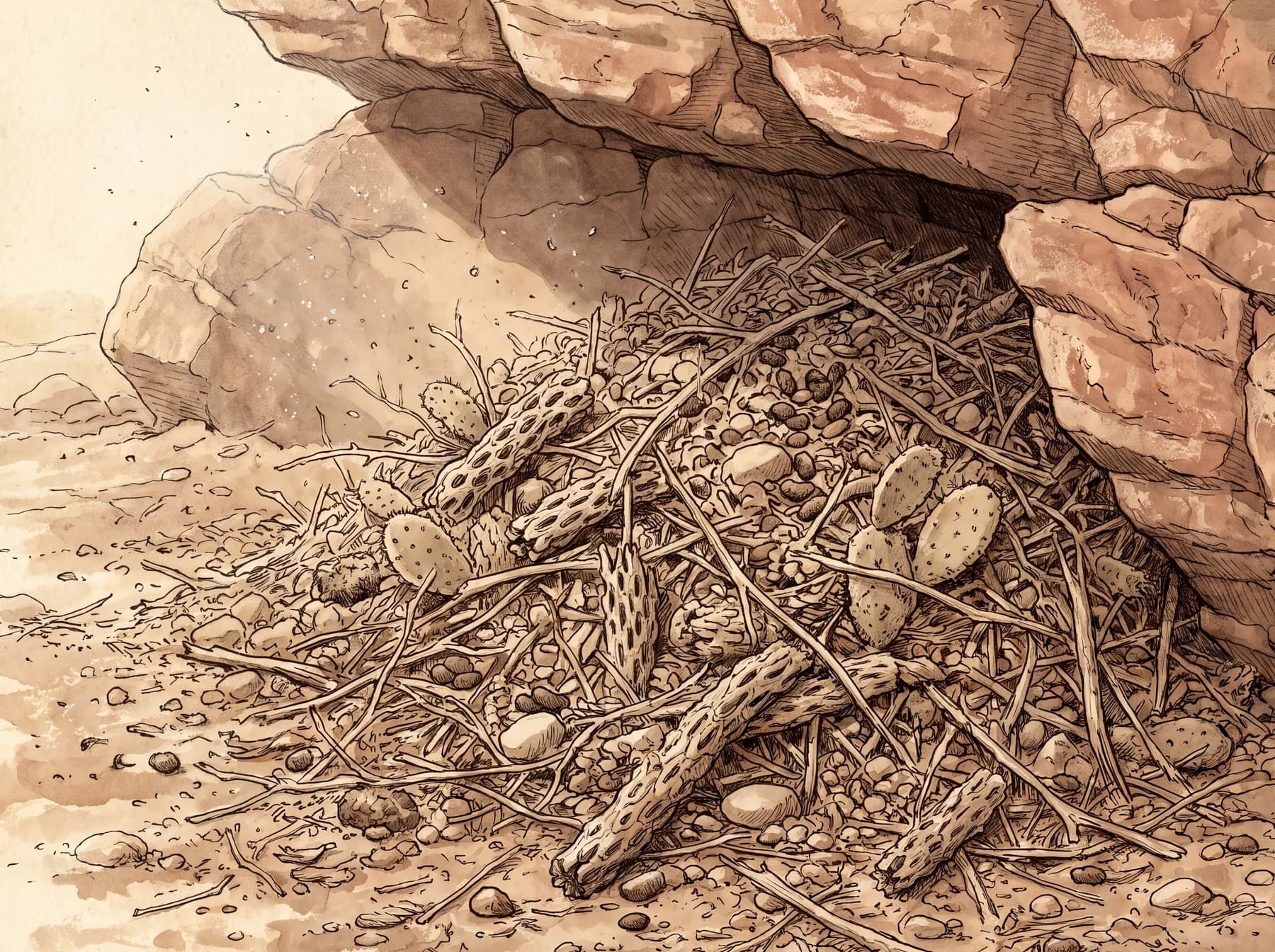
In a shaded crack in the rock, or back under an overhang, you find a bulky, chaotic heap of sticks, cactus joints, splintered bone, seeds, and dry scat, and the first thing to notice is that it does not fall apart when you touch it. It is welded into a hard mass, and the surface carries a dark, varnish-like glaze. That glaze is the whole identification. It is crystallised woodrat urine, called amberat, and it is what separates a midden from a pile of windblown debris.
Look in the dry, sheltered places, not on open ground. A crevice, an overhang, the base of a shrub with a roof of rock over it. Only the dry middens last, so any that sat in the open have long since washed away; the ones you can still read are the ones the weather never reached. The doorway is often armored with cactus spines, which is the easiest tell from a few feet off: a thorny sill guarding a dark pocket.
The strange part is how fragile the cement is. Drop a lump of amberat into a bucket of tap water and it dissolves in about one to two weeks, which is how a lab takes a midden apart on purpose. And yet a dry, sheltered midden sits essentially unchanged for tens of thousands of years, back toward the 50,000-year edge of radiocarbon dating. The same urine a rainstorm would rinse off in days becomes, in a dry crevice, one of the longest-lived records in the desert.
A midden is also not one animal's work. Generation after generation of woodrats uses the same crevice, adding to the heap and sealing each layer under fresh amberat, so the pile reads bottom to top like a stack of dated pages. When researchers opened middens in the Mojave that now stands as bare creosote scrub, they pulled out juniper, the woodland that held this ground before the climate turned. Creosote itself reached the southern Mojave about 9,000 years ago. The trash pile is older than the country around it.
Not every stick heap is ancient, though, and a live nest is easy to mistake for the archive. The glaze settles it: a working nest is loose and pale, a true midden dark and set like poor concrete. One odd warning to carry: in 1849 a starving member of the Manly party, near Death Valley, found a midden's glistening surface and ate it for candy. It was amberat, sweet and sickish, and it made him briefly ill. He lived.
Rub a thumb across the surface. Loose and dry is a nest; hard and dark-glazed is an archive nobody has finished reading.