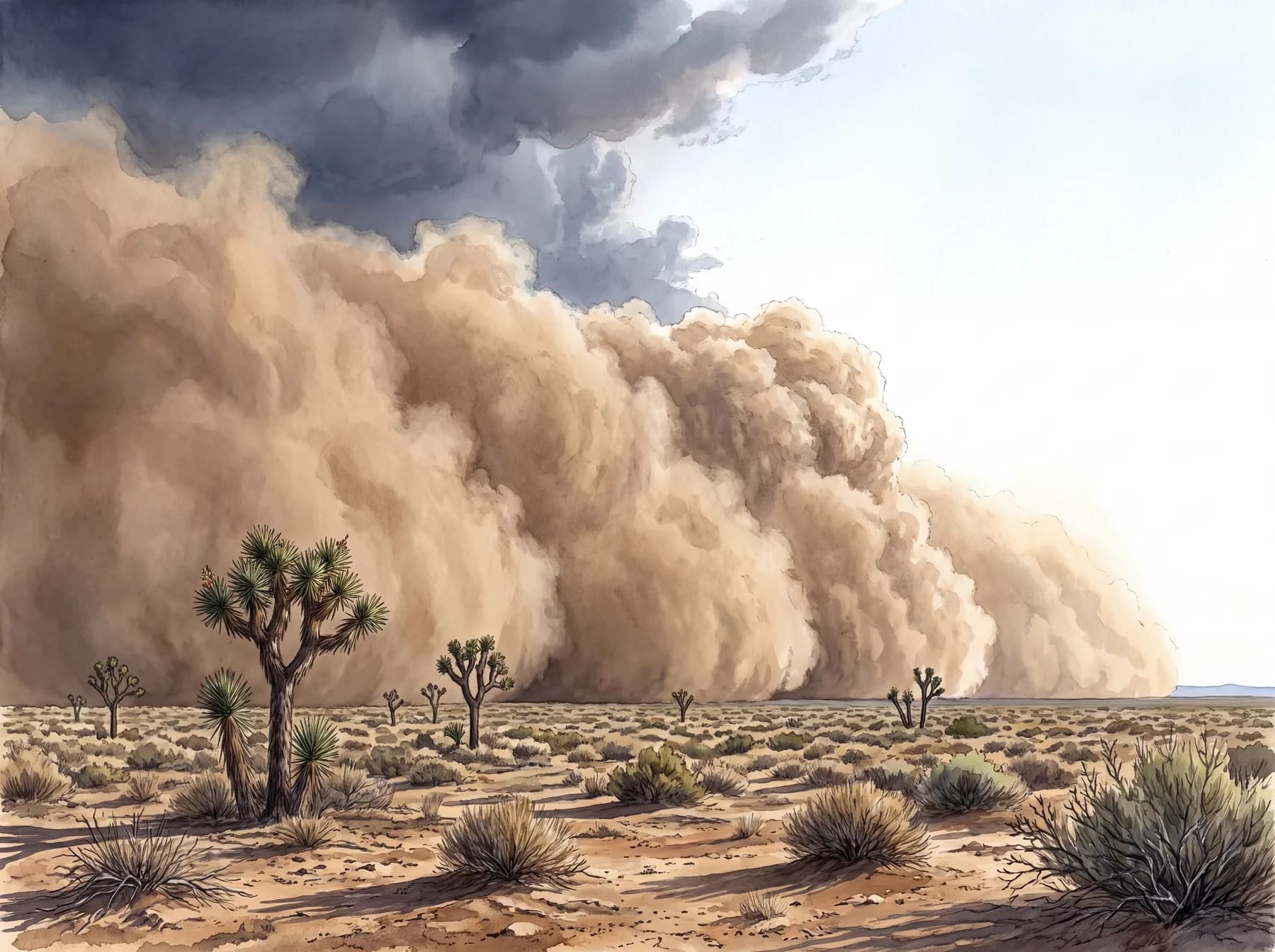
The first thing a monsoon storm sends you is not rain. It is a wall. A haboob is a dense, rolling front of dust and sand, often over a kilometer high, that sweeps across the flat and drops visibility to nothing in the space of a minute. The word is Arabic, from a root meaning to blow, and the thing itself is one of the desert's most theatrical and dangerous sights.
It looks like the storm, but it is really the storm's exhaust. Inside a monsoon thunderstorm, rain and hail fall into dry air and evaporate, which chills the air; cold air is dense, so it sinks as a downdraft and then spreads outward along the ground when it hits, the way water thrown at the floor rushes out flat in all directions. The leading edge of that spreading cold air is a gust front, and where it runs over dry, bare, loose ground, it lifts the sediment into a towering advancing wall. The storm that launched it may be miles away, or already falling apart.
That is why the haboob comes first. The dust front runs out ahead of the rain and the strongest wind, so on the ground the sequence is a strange calm, then a brown wall on the horizon growing fast, then the wind and the grit, and only later, sometimes, the rain. The wall is the advance warning of everything behind it.
It needs fuel, and the desert supplies it. Dry playa beds, disturbed soil, graded pads, and bare washes all give the wind loose dust to lift, which is why the worst haboobs cross the flattest, driest, most worked-over country. A landscape with little to hold its soil down hands the storm its ammunition.
It is worth knowing what it is not. A haboob is a broad, straight, advancing wall, not a spinning column and not a rotating storm. The slender dust column crossing a clear-sky flat is a dust devil, a different and far smaller thing. The haboob is the big one, tied to a thunderstorm, arriving as a front.
If a brown wall climbs the horizon, get off the road before it reaches you. The storm is right behind it.