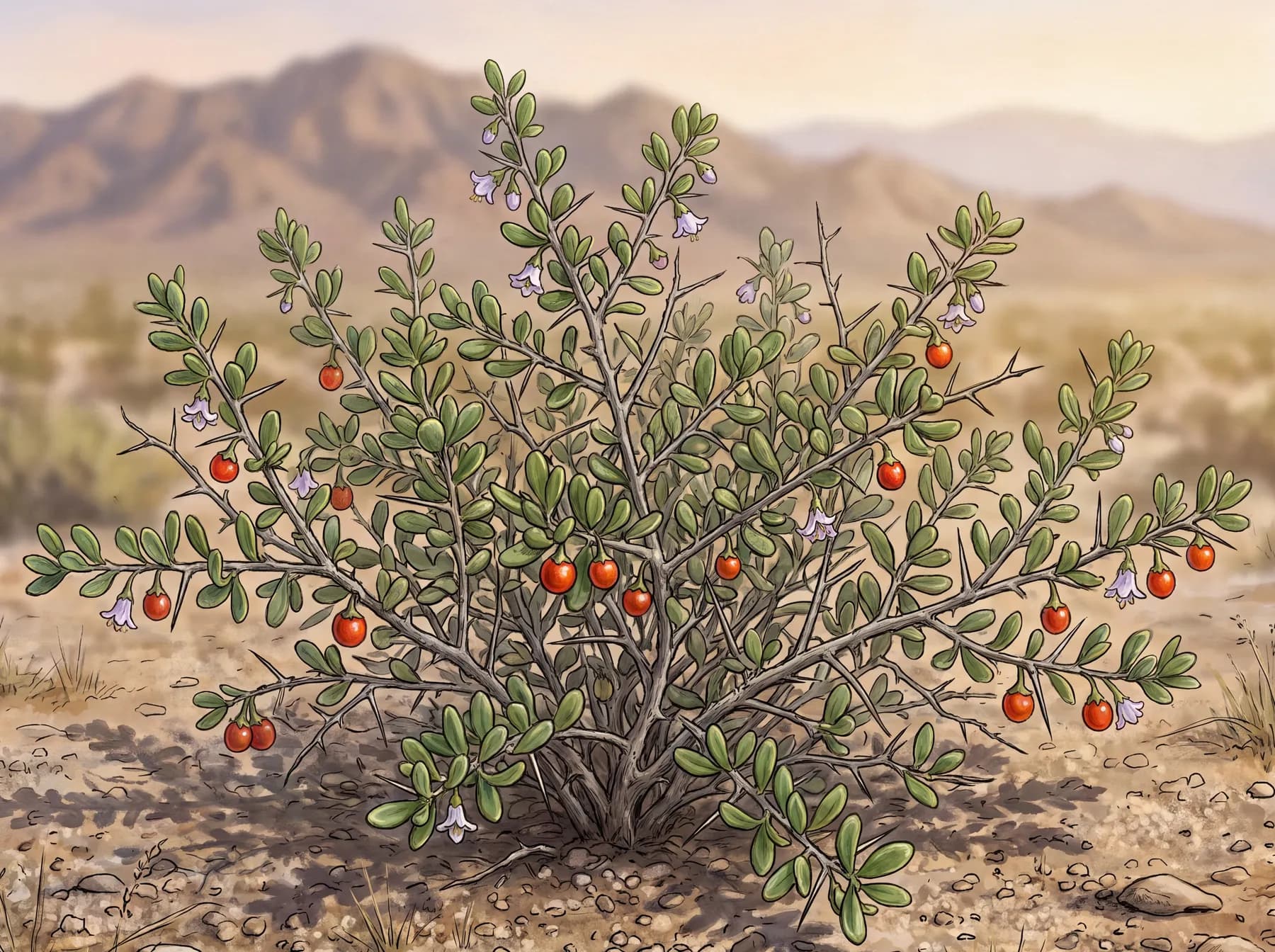
For part of the year this shrub is barely a shrub: a low, pale, much-branched snarl of gray thorns with nothing green on it at all. That is not a dead plant; it is a strategy. Anderson's wolfberry is drought-deciduous. When the ground dries, it drops its leaves and stands as a bare thorny skeleton, waiting. A plant that holds its leaves open through a drought keeps paying for them in water it does not have. This one closes the account.
The waiting has a trigger. New leaves come out roughly late February to March, and the small tubular flowers, whitish to lavender-purple, follow from about February into May. But the schedule answers to water, not the calendar. it can stay dormant anywhere from late May through January depending on how much moisture is available, which is another way of saying it cues its whole productive year to the wet window and skips the rest. Green up fast, flower, set fruit, and finish before the dry closes in.
Once it leafs out, the give-away is easy to read. The leaves are small, thick, and fleshy, spoon- or club-shaped, only 3 to 17 mm long, and they come bundled in tight clusters right at the nodes, usually at the base of a thorn. Most desert shrubs carry flat, papery leaves; a succulent-feeling leaf packed against a spine is the wolfberry signature. The rest is a rounded, spiny, much-branched gray shrub, 1 to 9 feet tall, its spines 5 to 20 mm. In Mohave County high desert it sits mid-band in a range of 1,500 to 6,000 feet, keeping company with Joshua tree and blackbrush, the exact plant community on this ground.
The point of all that timing is the fruit. Wolfberry is a nightshade, family Solanaceae, and its genus Lycium is the one that gives us goji — a wild desert cousin of the tomato, the potato, and the goji berry. It ripens small round red berries, and unlike much of its family they are genuinely edible when the plant is correctly identified. Native peoples in this region ate them fresh, dried, and worked into a drink. Birds and small mammals take them as well; ground birds, quail among them, work the low branches, and every berry that leaves inside one carries a seed somewhere new. That is the shrub's half of the bargain.
One caution belongs in the same breath as the word edible. Wolfberry shares both ground and family with plants that are not, and that family resemblance is exactly what makes an unknown red berry untrustworthy. The plant's own marks are the whole permission slip: fascicled fleshy leaves on gray spiny twigs, small tubular pale-purple flowers, and a bare fleshy berry with no papery husk. Learn those before you trust anything red.
Find the bare thorny version first. After a wet spell, come back and look for fleshy leaves clustered at the thorns. That is the plant.