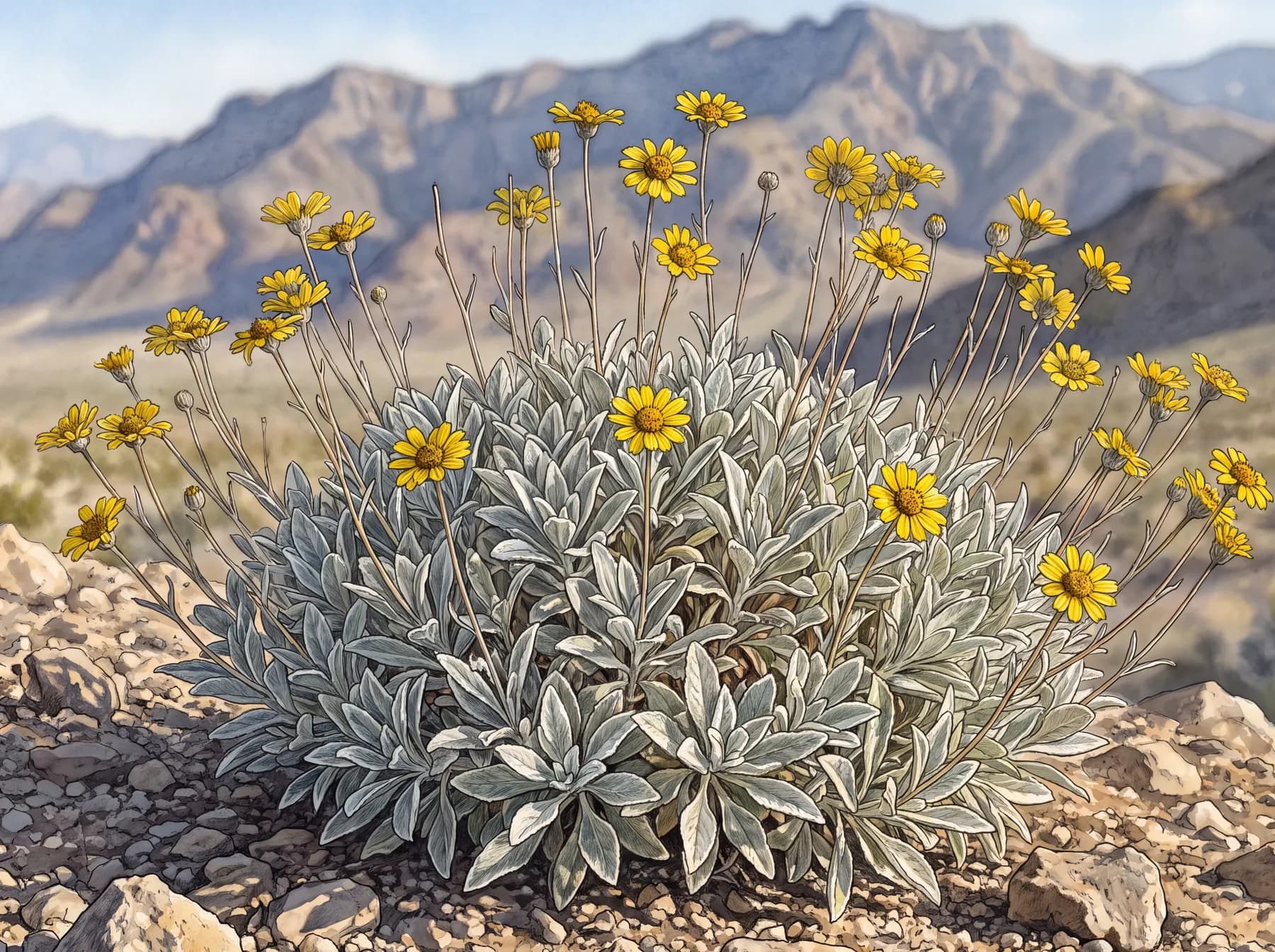
A gray mound of nothing for most of the year, and then, after a wet winter, a solid dome of yellow daisies floating on thin bare stalks above the foliage. That is brittlebush at its two extremes, and the gray version is the honest one: the gold is a good-rain event, not a promise it makes every spring.
The gray is the interesting part anyway, because it is a working sunshade you can measure. Each leaf is covered in a dense felt of fine white hairs, thick enough that the blade reads silver to nearly white and feels like velvet. That felt reflects a large share of the light that hits it, up to about 70 percent of the visible band, and the effect is not decoration. Compared with a related, non-hairy relative, the coat cuts how much light the leaf absorbs by as much as 56 percent, which drops the leaf temperature by 5 to 10 degrees Celsius and cuts its water loss by about a third. The plant wears white to stay cool and to spend less water doing it.
Better still, it re-tools the coat as the year dries. In the cool, moist season it grows larger, greener, thinner-felted leaves; as drought comes on it makes smaller, whiter, hairier ones that last longer and reflect more, and the difference is heritable, varying between families. When the drought turns severe it drops the leaves entirely and stands as bare gray sticks, running on stored resources until the next rain. Snap one of those dry stems and it breaks clean and easy, which is where the name comes from.
The stems also bleed a fragrant clear-to-amber resin, and that gum has a long human record. It was burned as incense, called incienso, in the Spanish mission churches of the Southwest down in Baja California, heated as a glue for hafting stone points, used to seal pottery, and chewed as gum. None of that happened up here, which is worth saying plainly: this cold high desert was never mission country, and the story belongs to the warmer, lower deserts to the south.
Which is the last honest note. Brittlebush is a Sonoran-leaning plant, frost intolerant, and up here this ground sits near the very top of where it can live. Hard winter freezes, not elevation, are what cap it. So do not expect it to carpet the flats; expect it thin or absent on the cold open ground and present on the warm rock, the south-facing slopes, road cuts, and disturbed pads it colonizes first, holding a raw surface while slower plants catch up.
Look on the warm rock, not the frost pocket. A gray shrub with white-felt leaves, gold on naked stalks, is brittlebush.