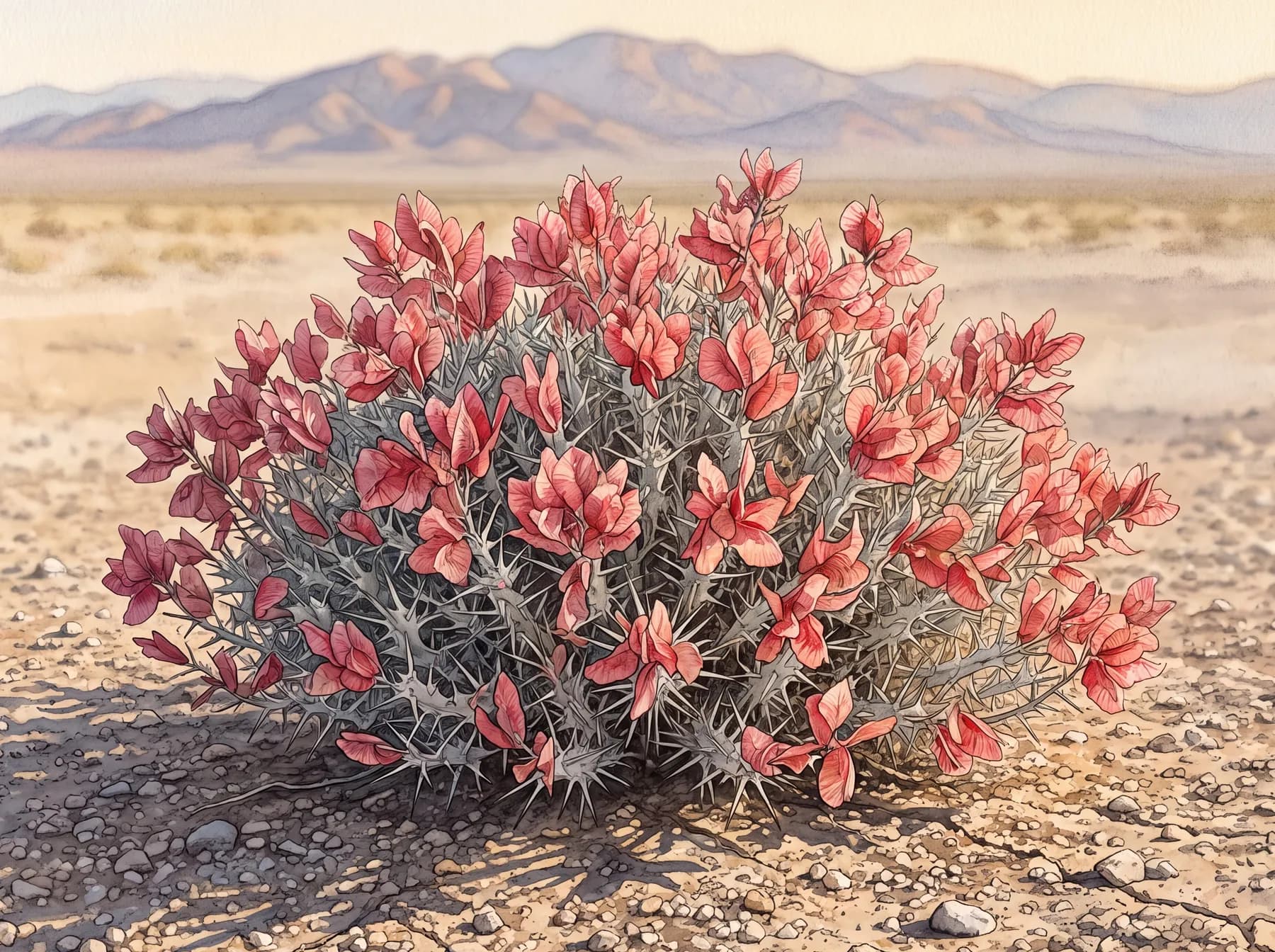
The pink comes before you have decided what you are looking at. In spring a low, brambly shrub on the alkaline flats can go the color of backlit tissue paper, hung all over with flat papery wings that catch the sun and glow. It reads as a shrub in heavy bloom. It is not blooming at all.
Spiny hopsage is a saltbush, part of the goosefoot lineage, the Chenopodioideae that once formed their own family, and saltbushes do not make showy flowers. Its true flowers are tiny, greenish, and wind-pollinated, easy to walk past. The color you see is fruit packaging. Around each ripening seed two bracts fuse and swell into a flattened papery wing, 7.5 to 14 millimeters long, and those wings, turning bright pink to red, are what light the whole plant. Botanists rank it among the more colorful shrubs of its spring habitat, and the reason is a wrapper, not a petal.
There is a second catch. The plant is dioecious: male and female flowers grow on separate plants, and only the female sets fruit. So only half the hopsage on a flat ever puts on the display. Stand two shrubs side by side in April and one may be glowing while its neighbor stays a plain green tangle, and the difference is not health or luck but sex.
Then it leaves. Hopsage is drought-deciduous here. The show is front-loaded into a narrow spring window, a couple of weeks of color by the look of it, and by about mid-July the leaves drop and the plant stands as a bare, spine-tipped skeleton. In the hottest southern deserts it can hold its leaves and stay green; at this elevation, in the upper Mojave, it reads instead as a plant that spends most of the year looking like dead brush. Look straight at it in August and you would never guess it was the brightest thing on the flat in April.
The spines are what get left standing, and it is tempting to give them a job. A dormant, leafless shrub cannot afford to be eaten, so the stiff, thorn-tipped branches look like armor for the lean season. The plants themselves argue against the tidy reading. Hopsage is one of the most palatable of the salt-desert shrubs, prized browse for deer and livestock through late winter and spring, and it gets grazed hard then despite the spines. Whatever the thorns are for, they plainly do not keep hungry mouths off in the season that counts. Better to hold the defense idea as a guess than to state it.
None of this makes it a plant that runs the flat. Spiny hopsage is a scattered associate of the cold-desert scrub, keeping company with big sagebrush, shadscale, greasewood, and creosote rather than dominating anything. It favors dry, alkaline valley soils that many shrubs cannot tolerate, ranking it among the more salt-hardy plants on this ground, and its range across the Great Basin and northern Mojave runs from below 1,640 up to 7,875 feet. This parcel sits low and comfortable inside that band, which is why we expect it here before we have marked any particular shrub as this one.
The give-away is spring: papery wings glowing pink on a spiny, half-leafless shrub, with no real flower anywhere among them.