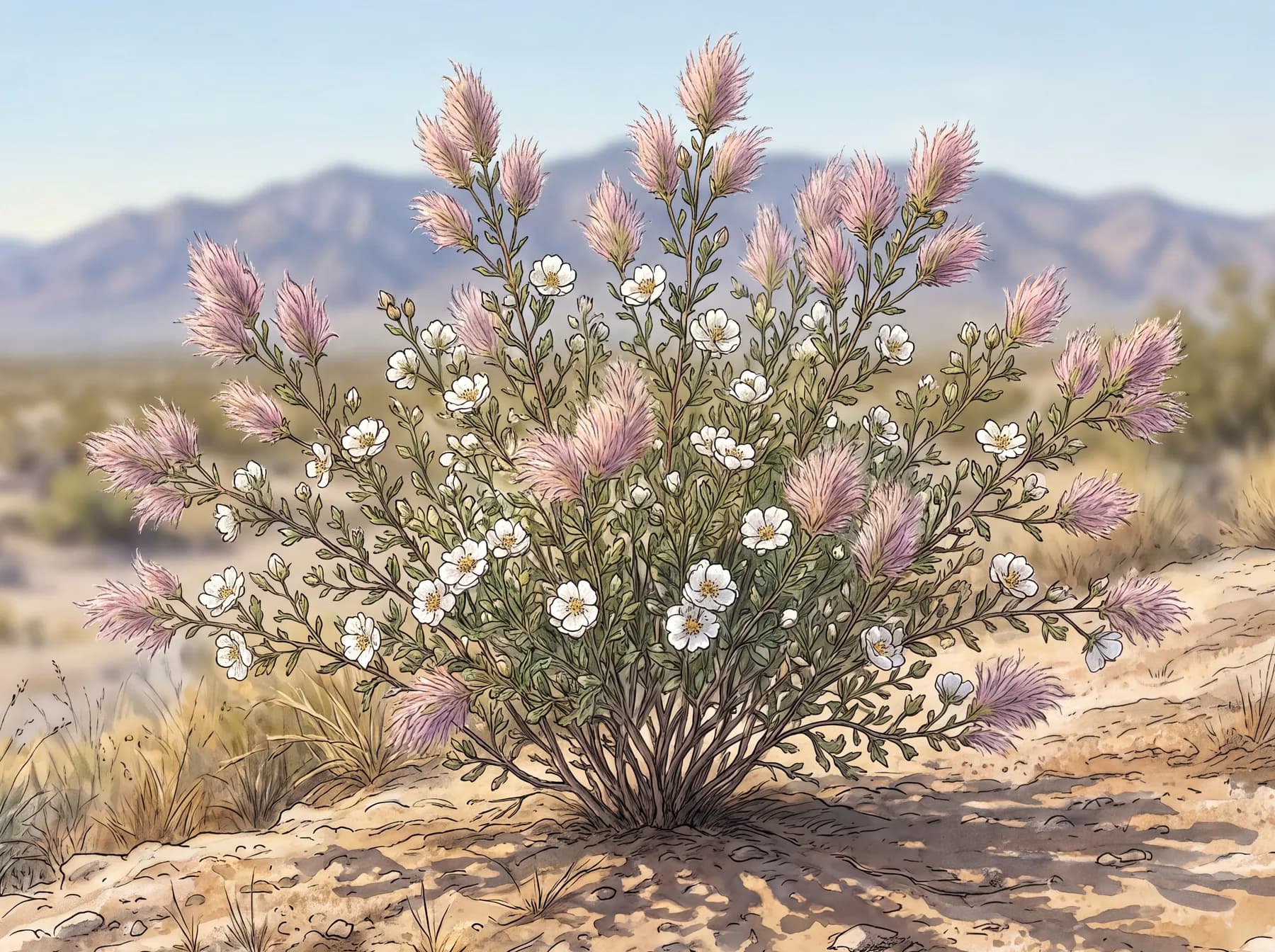
A shrub on the wash bank looks like it caught smoke and held onto it. From a few yards off the haze reads pink, or dusty rose, and it clings to the branches in a way nothing blowing through ever would. Walk up on it and the smoke resolves into thousands of fine feathery tails, each one fixed to a seed. Then the second surprise: the white flowers scattered through the haze are small wild roses, five petals around a yellow center, because the plant is a rose.
That is worth fixing in mind first, because it explains the flower. Apache plume belongs to the rose family, and its bloom reads as a single wild rose once you know to look for it. What it does not do is flower the way most desert plants flower. Where the blooming window here is often measured in weeks, this shrub carries blossom for months, from spring into fall, and because the seed heads persist, one plant will show white flower and pink plume at the same time. The first act and the second run together on the same branch.
The plumes are the namesake and the machinery both. Each seed sits at the base of a long feathery style, roughly 2 inches of curling pink filament, and a whole head is a cluster of these packed tight. When the seed ripens the style becomes a parachute. A dry breeze lifts it, the seed rides off the parent, and it comes down somewhere it was not. That is how the plant covers distance: light, airborne, one seed to a plume.
But distance is only half the strategy, and the more useful half never leaves. Below ground the shrub spreads by root suckers, sending up new stems around itself until one plant becomes a low clump and then a thicket. Those roots are its documented value. On loose, disturbed, sandy ground — the exact material a wash bank is made of — the plant is used to control erosion, holding soil that monsoon flow would otherwise cut loose and carry off. It spreads two ways at once, and the two pull opposite directions: the seed leaves on the wind, the plant stays and grips the bank.
This ground is where the shrub should be. At about 3,050 feet the site sits near the very bottom of its elevation range, which climbs from a floor around 3,000 feet, though elevation is the weaker part of the case. What settles it is habit: Apache plume favors washes and rocky slopes, and keeps company with blackbrush and pinyon-juniper, which is the country this bajada belongs to. A wash bank at this height is core ground for it, not the ragged edge of what it can stand.
Look for the pink smoke first. Up close, small white roses and 2-inch feathery seed tails on one low shrub name it at once.