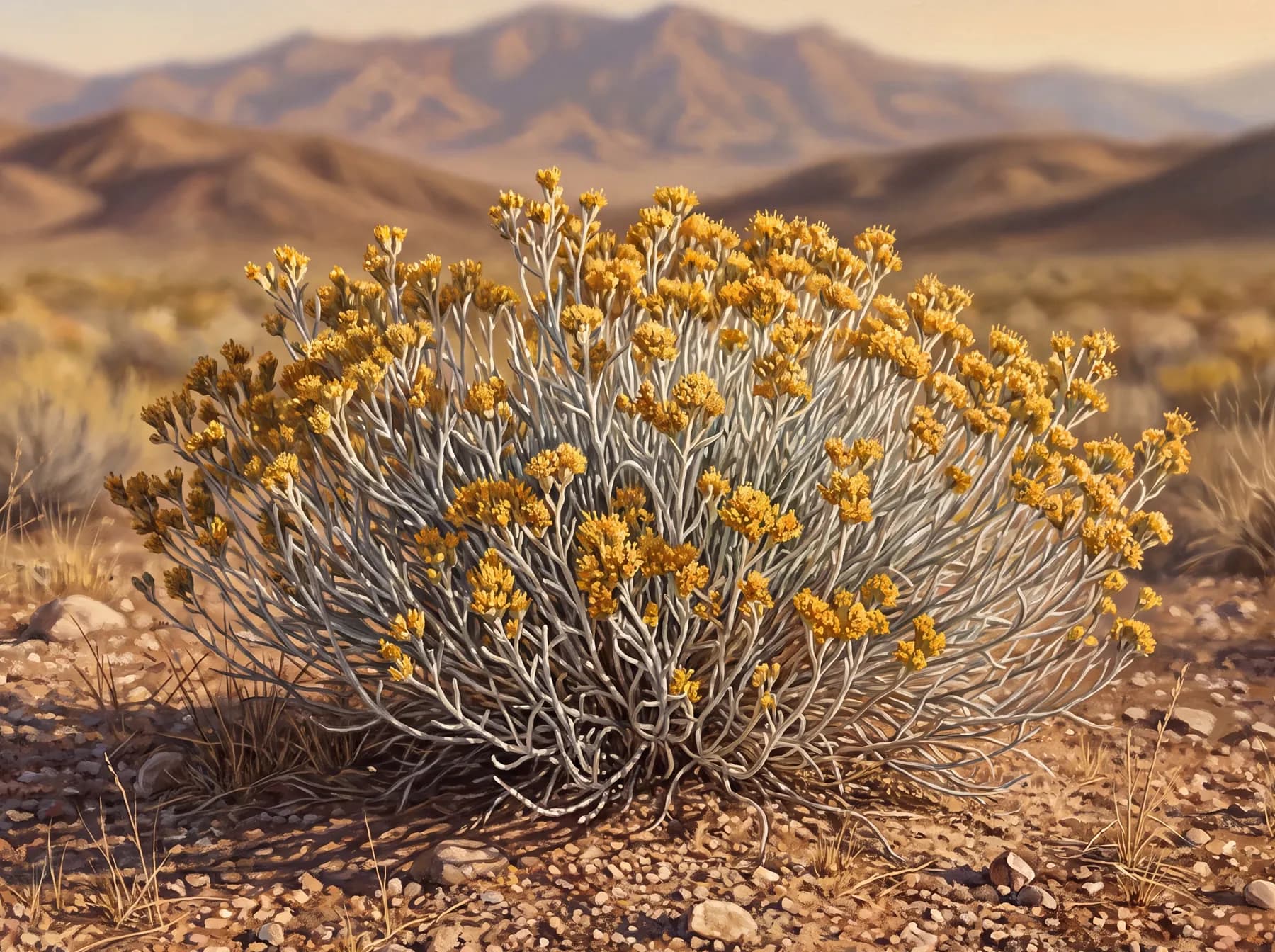
By the time this shrub is worth a second look, most of the desert has quit for the year. Through late summer and into fall, after the spring bloomers have set seed and shut down, rubber rabbitbrush covers its whole crown in dense mustard-yellow heads. The flowers are small and rayless, packed into clusters bright enough to read from across a wash, and they open when almost nothing else is offering. That timing is the point.
Bloom runs roughly August into October, at the tail of the year's nectar. With the earlier flowers gone, native bees, butterflies, and wasps work these heads hard, and the Xerces Society lists the plant for its special value to native bees for exactly this reason. It is among the last significant nectar and pollen sources across a great deal of arid country, one of the few tables still laid as the season closes.
Up close, the give-away is not the flower but the stem. Run a thumb up a young twig: it is pale and soft, sheathed in a dense white-to-gray felt of matted hairs, and it bends without snapping. That felt is a working surface, not a flourish; a pale, hairy coat reflects sun and slows water loss, ordinary desert economy. It is also how botanists sort the plant out. Those flexible, felted branches are what moved it out of the stiff-stemmed genus Chrysothamnus, where it used to sit, and into Ericameria. Crush a leaf for a second confirmation, a pungent, rubbery smell, the one the species name nauseosa was built on.
You will find it where the ground has been worked over. Rubber rabbitbrush is a disturbance colonizer — it establishes fast on roadsides, abandoned fields, and worn-out range, favors loose alluvial soil, and holds poor, scraped ground without being watered. A deep root system carries it through the dry stretches, which is why it turns up on wash margins and cut banks that defeat fussier plants, and why it sits easily in the elevation band, from about 2,000 to 8,000 feet, that takes in this bajada.
The common name is the strange part, and it is literal. There is real rubber in the stems, up to 7 percent of their dry weight, in unusually long polymer chains. During World War II the plant was tested in earnest as a domestic rubber source, after imported supply was cut off. The extraction never became commercially workable and the interest faded, but the latex is genuinely there, the same latex the Navajo once chewed as gum, from a plant they also worked for a yellow dye out of the flower heads. Keep the two names apart. The rubber belongs to the common name, while nauseosa only ever meant the smell.
Look in October, when the rest of the ground has gone quiet: a rounded gray shrub gone gold, loud with bees.