To name this shrub, break off a piece and smell your hand. Crush a stem tip or a leaf and it gives back something sour and rancid, a cheese-gone-wrong odor that no other plant here produces. That is where the name comes from, and it is one of the rare desert plants you can identify by nose before your eyes have caught up. The smell is unpleasant enough that once you have placed it, you will never need to place it any other way.
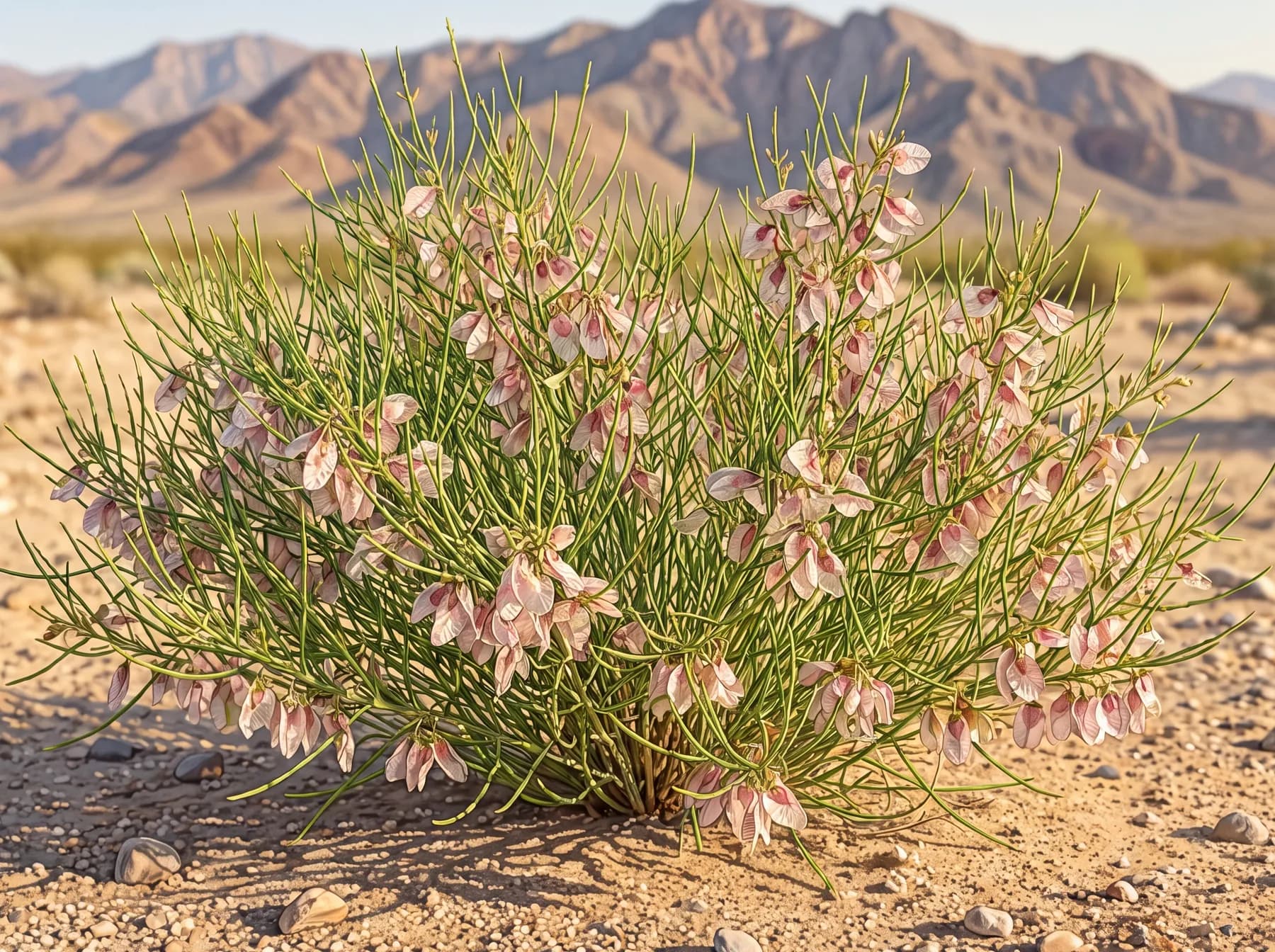
Look at what you have crushed and it barely reads as a bush. Cheesebush is a sprawling tangle of thin green stems, wiry and broom-like, running much of its photosynthesis in the stems themselves. The leaves are threads, up to about 65 millimeters long and only 1.5 wide, so fine and few that the whole plant registers as a green broom more than a leafy shrub. It stands to about 1.5 meters, 5 feet, and can sprawl to 8. This is a plant built cheaply, out of the least material that will still catch light.
The cheapness is deliberate, because cheesebush is in a hurry. It flowers in spring, but do not look for petals. It is a true ragweed, folded into the genus Ambrosia, and like its relatives it is wind-pollinated: the flowers are small and drab, built to throw pollen rather than draw a visitor. The show comes afterward. The female heads harden into little spindle-shaped burs, each ringed by 7 or more thin, papery wings tinted white, straw, or pink. Those wings are a delivery system. The seed rides the wind and washes down the sandy channels, which is how the plant reaches bare ground faster than almost anything near it.
That speed is the whole strategy. Cheesebush is a pioneer, one of the first plants onto freshly opened dirt: a wash scoured out by a flood, a road cut, the raw margin around a building scar. On a single cleared corridor it made up as much as 85 percent of the plant cover 12 years after the ground was stripped. But it does not build anything that lasts. An individual lives only a few decades, and in older, settled ground it dwindles to almost nothing as longer-lived shrubs like creosotebush take over the openings it broke in on. It is the early tenant, and it seems built to be replaced.
None of this makes it rare. In the Mohave County high desert, on sandy washes and disturbed flats, this is close to ideal ground for it, well inside the elevation band where it grows. Give this ground a fresh scar and a few seasons, and cheesebush will likely be there before the slower, sturdier plants.
In fruit, put the low sun behind it: the papery wings light up, and a whole bush seems to glow from within.