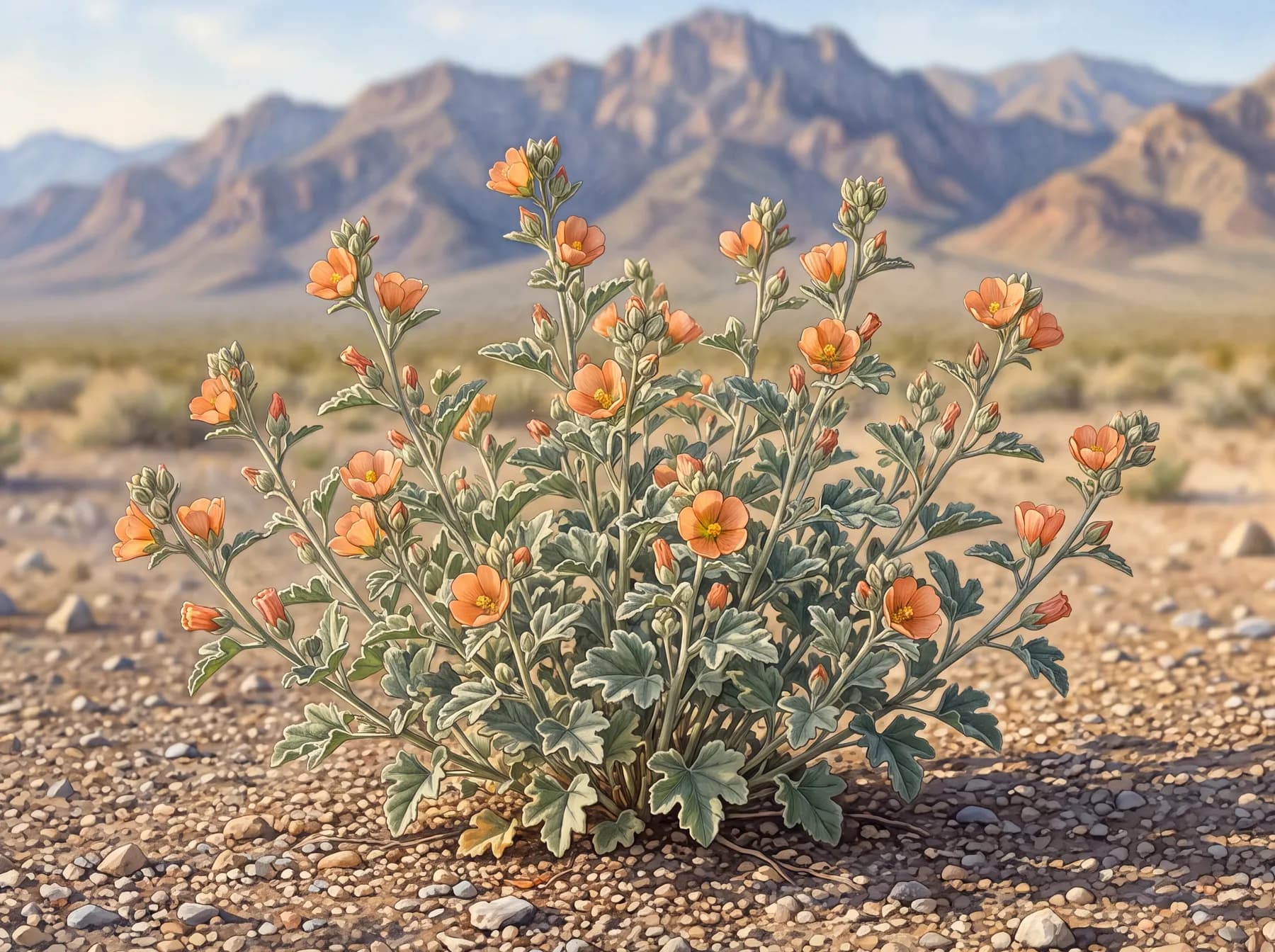
Walk a scraped edge of this bajada in a month when the flats have gone brown and given up, and the one thing still open for business is a thumbnail of apricot-orange. Five petals overlap into a shallow cup, and at dead center stands a single column, the stamens fused into one tube around the style — the same architecture as a hibiscus shrunk to the size of a coat button. That column is the tell. Find that small apricot bowl with the post in the middle and you have found a globemallow, flowering on a schedule the rest of the ground cannot keep.
The foliage tells the other half. The leaves are grey-green and crinkled, scalloped along the edges, and they read dusty rather than green because they are coated in fine star-shaped hairs. Under a hand lens the fuzz resolves into thousands of evenly spaced stars, and that coat does real work. It scatters incoming sun and traps a thin layer of still air against the leaf, which slows the water leaving it; in heat and drought, a leaf carrying its own pocket of calm air loses less than a bare one. The catch is that those same hairs are a mechanical irritant to you. Handle the plant, rub your face, and they set the eyes itching, red and annoyed but not injured, physical rather than chemical, and it passes on its own. The old names sore-eye poppy and mal de ojo come from exactly that. Wash your hands after.
What keeps the apricot going is timing. Peak bloom is late winter, roughly February into March, but with enough rain the plant can open flowers sparsely in almost any month of the year, so between storms it holds a few cups when little else bothers. It also favors the ground most plants avoid: sandy, gravelly, compacted, disturbed — roadsides, scraped pads, the degraded edges where a track was cut. It is often among the first flowering cover back on ground someone has wrecked and left.
A dependable flower on broken ground tends to gather dependents, and this one has a bee named for it. The globemallow bee, Diadasia diminuta, runs 7 to 9 millimeters and gathers pollen almost entirely from Sphaeralcea; it and a few relatives are specialists that cannot easily change flowers if the mallow thins out. They nest alone in the ground, each burrow often ringed by a small turret of soil, a chimney, sunk into the partly compacted dirt along the margins of dirt roads. That is the same packed edge where the mallow itself takes hold. Plant and bee made the same choice, and now one feeds where the other builds.
Look on the packed margin of a cut track: apricot cups on grey wand-stems, and low turrets of soil where the bee comes up.