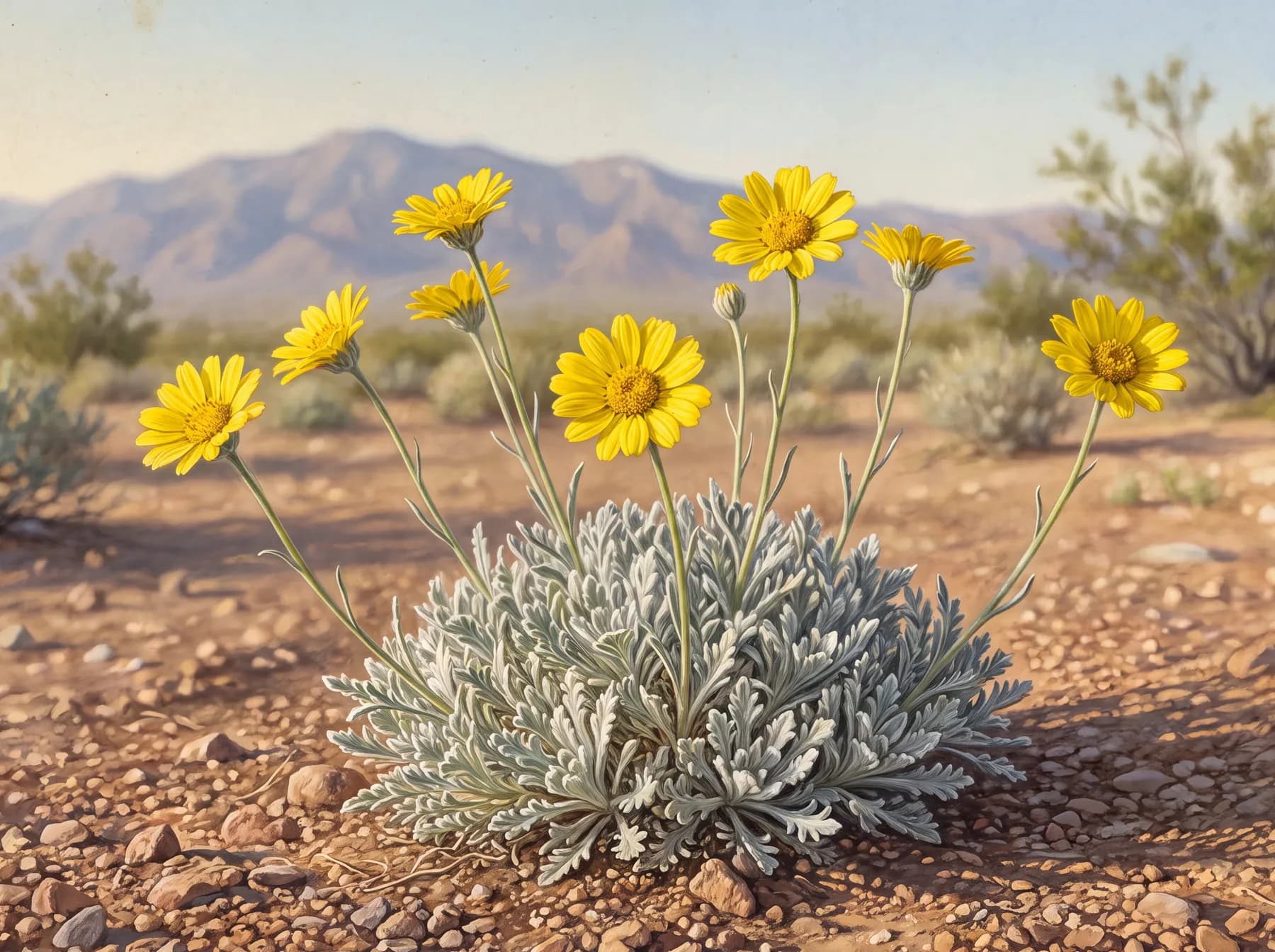
By late July, most of the desert's color is gone. The spring bloom dried to tan weeks ago, and the ground reads as one dust shade. Then a low silver mound throws up a single lemon-yellow daisy on a bare white stalk, and it keeps at it, week after week. Desert marigold flowers from March into November, one plant carrying blooms straight through the months when the heat has closed almost everything else down.
The trick is written on the plant in felt. Its leaves and stems are covered in dense white-grey down, so thick the low rosette looks dusted with wool. That coat is doing two things at once, both about water. Pale hairs bounce sunlight off the surface before it can heat the leaf, and the mat of them holds a layer of still air against the skin, slowing the rate at which a dry wind pulls moisture out. This is standard equipment for a plant living in full desert sun; the marigold simply wears more of it than most, and wears it low, where the reflected heat off the ground is worst.
It is easy to name once you have the combination. A low mound of woolly, grey-white leaves, roughly 8 to 18 inches high, and above it a tall, nearly leafless white stalk lifting one broad daisy well clear of the foliage — 1 to 2 inches across, with something like 34 to 55 yellow rays, each ray notched into 3 small teeth at its tip, packed around a crowded button of 100 or more tiny disk flowers. Nothing nearby copies that silver cushion under a bare felted stem. The flowers hand you a second, later clue as well: rather than dropping cleanly, the old rays dry to papery straw and hang on, so one plant can carry fresh, spent, and long-dead blooms at the same time.
Where it grows says as much as how it looks. Desert marigold is short-lived, a perennial or biennial that sometimes runs as an annual, and it makes its living on raw, disturbed dirt: roadsides, gravelly washes, the graded edges of pads and tracks. It reseeds into bare scars faster than most natives, which is why the rawest ground around a build site is often where it shows up first. On a bajada in the upper Mojave, it sits well inside its range and squarely in its favorite niche, which is any place the ground has lately been torn open.
That same pioneering habit is where the one hard line in its ledger comes in. The plant is toxic to sheep and goats. The poison is a sesquiterpene lactone called hymenoxon, concentrated more in the flowers and seed heads than in the leaves, and the danger is real but dose-dependent: it takes on the order of 16 to 65 pounds of plant, dry or green, to kill an adult sheep. So the animals that die are the ones grazing it steadily where it is the main thing on offer, on overgrazed range, where losses have run as high as a quarter of a flock. Cattle and horses are unaffected. It is less a plant to fear than one to flag before sheep or goats go onto ground where it dominates.
Look for the silver cushion first, then the bare white stalk above it, then the papery ghosts of last month's flowers, still hanging on.