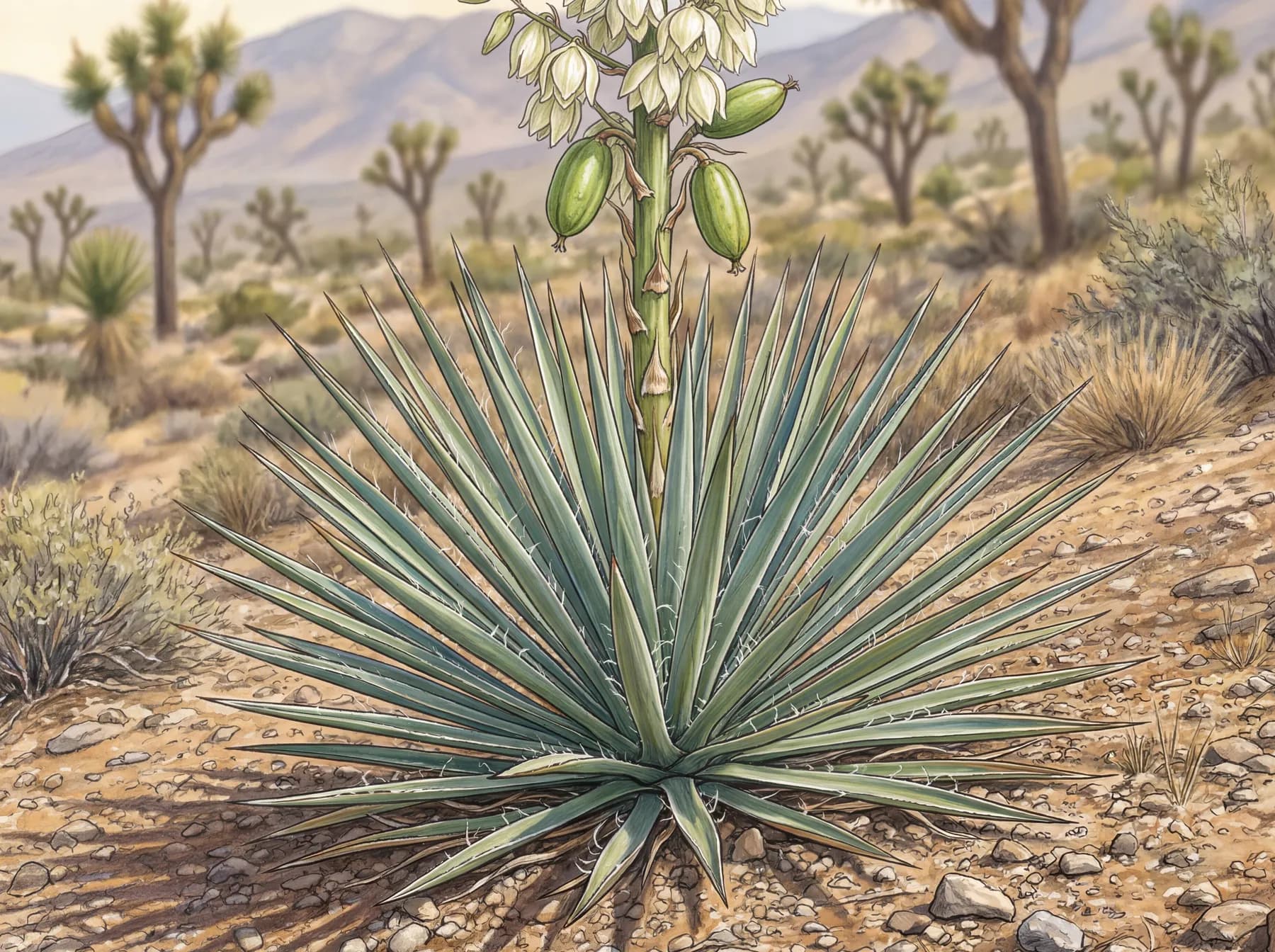
The give-away is a fruit you could mistake for food, because it once was. Many desert yuccas dry their seed into a pod that splits and rattles; banana yucca swells a fat, blunt, banana-shaped fruit, green and cylindrical, roughly 8 to 18 centimeters long and 6 across, with pale flesh the texture of a sweet potato. The plant is named for it, and it is the reason people carried this yucca in their food stores and not just their toolkits.
That makes the fruit sound like a clean way to name the plant. It is not, quite. This ground sits at the low, warm floor of banana yucca's range, which runs from roughly 2,700 up to 8,000 feet across the Mojave, and the larger yucca you are likelier to meet down here is the Mojave yucca, which fruits too. So the honest separator is not the fruit but the posture. Banana yucca stays a low, clumping rosette, essentially trunkless, a starburst of stiff blades sitting on the ground. Mojave yucca stands up on a woody trunk and can reach a small tree near five meters. If it has a trunk, it is not this plant.
Look closer and the leaves settle it. Banana yucca carries thick, blue-green blades, concave and keeled down the middle, 50 to 76 centimeters long, their edges shedding coarse white fibers that curl off in loose threads. Mojave yucca's marginal threads are finer and straighter. Where the two ranges overlap the plants cross, and intermediates turn up in the Mojave, so a specimen at this elevation that refuses to read cleanly is not a contradiction. Expect this one on north-facing slopes, in washes, in cooler microsites rather than the baking flats, alongside Joshua tree, blackbrush, and creosote.
Like its Joshua-tree cousin, it cannot set seed on its own. A night-flying yucca moth, here Tegeticula baccatella, gathers pollen, carries it deliberately to another flower, and packs it into the stigma by hand, then lays her eggs in the ovary where her larvae will eat some of the seeds she just helped make. No moth, no seed. The fat green fruit is the visible end of a bargain struck in the dark.
That fruit fed people. Roasted or pit-baked, de-seeded, pounded to pulp, pressed into cakes and dried in the sun, it was a stored staple for the Apache and Navajo; ripe is the sweet stage, while green fruit and raw tissue stay bitter with saponins that had to be cooked or leached out first. The leaves carried the rest: close to 40 percent of a blade is extractable fiber, worked into cordage, sandals, and baskets, and a spine-tipped leaf with its threads left hanging served as a ready-made needle and thread.
Kneel to it, not over it. A trunkless blue-green starburst with threads curling off the leaf edges, and, in season, fat green fingers of fruit.